The best particle counters make invisible airborne dust easier to measure, helping you assess indoor air quality, troubleshoot filtration, and document environmental conditions.
This roundup compares 10 handheld and professional models by particle-size range, measurement channels, portability, display features, and data-management options.
Best 10 Particle Counters Picks for 2026
Best All-in-One Monitor
Temtop M2000 Air Quality Analyzer

- Measures particles plus PM, CO2, HCHO, temperature, and humidity
- Exports over three months of logged data via USB
- Includes alarms, calibration, rechargeable battery, and carry case
Best For: Comprehensive indoor and portable air-quality monitoring
Best Simple PC-Connected Option

- Uses laser detection for particles from 1 to 2.5 microns and above
- Offers minute, hour, day, and monitor modes
- Includes a computer interface on the standard PC model
Best For: Basic particle monitoring with computer connectivity
Best Handheld Advanced Counter
Temtop Airing 2000 Particle Monitor

- Counts 0.3, 0.5, and 1.0 micron particles plus PM2.5, PM10, and TSP
- Stores readings in 32GB memory and exports directly by USB
- Runs for over four hours with its 3500mAh rechargeable battery
Best For: Portable inspections and industrial or laboratory monitoring
Best Standards-Based Detector
PerfectPrime AQ9600 Particle Counter

- Measures 0.3, 2.5, and 10.0 micron particles
- Supports custom sampling from one second to nearly one hour
- Includes FED209E and ISO14464-1 alarm-level settings
Best For: Configurable particle sampling and standards-oriented checks
Professional Cleanroom Choice
UNI-T UT337B 6-Channel Particle Counter

- Six-channel measurement from 0.3μm to 10.0μm
- Wi-Fi, USB, camera, and environmental sensors
- Stores 10,000 records and meets ISO 21501-4:2018
Best For: Cleanroom monitoring and detailed professional reporting
Visual Documentation Pick
Extech VPC300 Video Particle Counter

- Built-in camera for inspection documentation
- Supports JPEG images and AVI recording
- SD card memory and tripod mounting
Best For: Indoor inspections requiring photos or video evidence
Flexible Everyday Monitor
3-Channel PM2.5 and PM10 Particle Meter
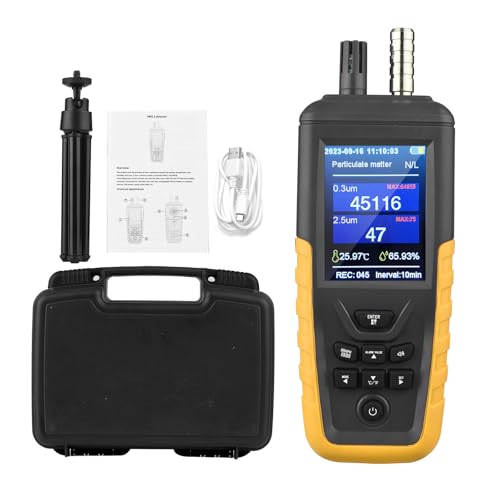
- Measures 0.3μm, 2.5μm, and 10μm particles
- Exports up to 999 records as PDF via USB
- Includes alarms, pollution indicator, and tripod
Best For: Home, office, vehicle, and general air-quality monitoring
Best Feature-Rich Pick
Triplett EPC600 Environmental Particle Counter

- Six particle-size channels down to 0.3µm
- Measures temperature, humidity, dew point, and wet bulb
- Stores up to 5,000 records with camera and video capture
Best For: Detailed inspections and environmental recordkeeping
Best Compact Analyzer
HAL-HPC300(A) Optical Particle Counter

- Measures particles from 0.3µm to 10µm
- Offers counts per liter, cubic foot, or cubic meter
- Stores up to 3,000 records and supports data transfer
Best For: Portable dust analysis and mobile sampling
Best Camera-Equipped Option
PCE-PCO 1 Laser Particle Counter

- Measures six particle sizes
- Includes photo and video recording
- Features temperature and humidity sensing with 80MB memory
Best For: Particle measurements with visual inspection records
Best All-in-One Monitor – Temtop M2000 Air Quality Analyzer
For shoppers comparing particle counters, the Temtop M2000 stands out as a broad air-quality analyzer rather than a particle-only tool. It measures particles alongside PM2.5, PM10, CO2, formaldehyde, temperature, and humidity, while also supporting alarms, calibration, and data export.
Best For: Home, office, laboratory, and travel use where particle readings and wider air-quality measurements are useful.
Pros:
- Combines particle, PM2.5, PM10, CO2, HCHO, temperature, and humidity monitoring.
- Exports more than three months of logged data through USB.
- Includes audio alarms, a color air-quality indicator, and built-in CO2 and HCHO calibration.
- Rechargeable battery, carry case, and 12-month warranty are included.
Cons:
- Its 910 g weight is substantial for a handheld monitor.
- The many functions may be more than needed for users seeking particle counts only.
The M2000 is a strong choice when particle monitoring is just one part of an indoor air-quality assessment. Its data logging and export features are particularly useful for ongoing investigations.
Best Simple PC-Connected Option – DC1100 Laser Particle Counter
If you want a straightforward laser particle counter with computer connectivity, the DC1100 provides two size ranges and several monitoring modes. It detects particles from 1 micron through 2.5 microns and above, covering smaller particles such as bacteria and mold as well as larger particles such as pollen.
Best For: Users who want basic laser particle monitoring with minute, hour, day, and continuous monitor modes.
Pros:
- Uses true laser particle-counting technology.
- Offers two particle-size ranges for smaller and larger airborne particles.
- Supports minute, hour, day, and monitor modes.
- Includes a computer interface for the DC1100-PC model.
Cons:
- Provides fewer environmental measurements than multifunction air-quality analyzers.
- This is the standard DC1100 with PC interface, not the Pro version.
The DC1100 is a focused option for buyers who prioritize particle counting and computer interfacing over a larger set of air-quality sensors. Its compact 3 x 4.5 x 7-inch design also makes it relatively easy to place or carry.
Best Handheld Advanced Counter – Temtop Airing 2000 Particle Monitor
The Temtop Airing 2000 is a portable choice among particle counters for users who need multiple particle-size readings and onboard logging. It measures counts at 0.3, 0.5, and 1.0 microns, along with PM2.5, PM10, and TSP, while also recording temperature and humidity.
Best For: Walkthrough inspections, fieldwork, industrial settings, laboratories, and detailed home or office checks.
Pros:
- Measures three particle sizes plus PM2.5, PM10, and TSP.
- Includes temperature and humidity sensors for broader environmental context.
- 3500mAh battery supports over four hours of continuous monitoring.
- 32GB storage logs readings at user-set intervals and exports through USB without software.
Cons:
- At 1.4 pounds, it is heavier than a basic handheld detector.
- Its advanced functions may be unnecessary for occasional, single-reading checks.
With its pump suction, multiple size channels, large storage capacity, and clear LCD interface, the Airing 2000 is suited to repeated inspections. The seven-button layout also supports direct operation in the field.
Best Standards-Based Detector – PerfectPrime AQ9600 Particle Counter
PerfectPrime AQ9600, PM 0.3/2.5/10 Μm Air Quality Particle/Dust Detector/Counter
Check Price On AmazonThe PerfectPrime AQ9600 is a compact particle counter designed around three size channels: 0.3, 2.5, and 10.0 microns. It offers customizable sampling from one second to 59 minutes 59 seconds, adjustable sampling frequency, and alarm levels associated with FED209E and ISO14464-1 standards.
Best For: Buyers who need configurable sampling and particle-size readings aligned with selectable clean-air alarm standards.
Pros:
- Measures 0.3, 2.5, and 10.0 micron particles.
- Provides customizable sampling duration and sampling frequency, including continuous operation.
- Offers alarm levels tied to FED209E and ISO14464-1 standards.
- Lists measurement accuracy of ±3% of reading plus ±5 digits.
Cons:
- The required 9V battery is not included.
- The 0.3-micron channel is available in Piece/L only, while all three sizes use Piece/L together.
- It does not list temperature or humidity monitoring.
The AQ9600 is a focused option for users who value sampling control and standards-based alarm settings. Its slim form factor is convenient, but buyers should plan for the separately supplied 9V battery.
Professional Cleanroom Choice – UNI-T UT337B 6-Channel Particle Counter
The UNI-T UT337B is a strong option for buyers who need professional particle counters with six-channel synchronous measurement. It tracks particles from 0.3μm to 10.0μm, while also recording temperature, humidity, and dew point for a more complete environmental assessment.
Best For: Cleanroom checks, facility maintenance, and users who need extensive records, connectivity, and environmental context.
Pros:
- Measures six particle sizes simultaneously at a 2.83L/min sampling rate.
- Includes temperature, humidity, dew point, Wi-Fi, USB, and a built-in camera.
- Stores up to 10,000 measurement records and displays ISO/EU-GMP classifications.
- Meets ISO 21501-4:2018 requirements with particle distribution error of no more than ±30%.
Cons:
- Its professional feature set may be more than casual home users need.
- The larger body and multiple functions may make it less convenient for simple spot checks.
Choose the UT337B when detailed particle-size analysis, documentation, and cleanroom-oriented features matter more than basic portability and simplicity.
Visual Documentation Pick – Extech VPC300 Video Particle Counter
The Extech VPC300 stands out among particle counters for its built-in camera and video-oriented documentation features. Its SD card memory, JPEG image support, AVI recording, and tripod mount make it useful when measurements need visual context.
Best For: Indoor inspections where photos or video records should accompany particle measurements.
Pros:
- Built-in camera supports JPEG images and AVI video recording.
- Includes SD card memory and a 4GB card.
- Tripod-mountable for more stable, repeatable positioning.
- Battery powered with a rechargeable lithium-polymer battery included.
Cons:
- The supplied notes do not specify particle-size channels or concentration ranges.
- Its indoor-use designation may limit suitability for outdoor monitoring.
The VPC300 is a practical choice when documenting inspection conditions is a priority, though buyers seeking detailed particle-size specifications should verify those capabilities before purchasing.
Flexible Everyday Monitor – 3-Channel PM2.5 and PM10 Particle Meter
This three-channel model is one of the more approachable particle counters for monitoring homes, offices, vehicles, and other spaces. It measures 0.3μm, 2.5μm, and 10μm particles, while also reporting PM2.5, PM10, temperature, and humidity.
Best For: Home, office, school, vehicle, and light professional monitoring with alarms, trend tracking, and fixed-point measurements.
Pros:
- Measures particle counts plus PM2.5 and PM10 mass concentration.
- Stores 999 records and exports historical data to a PC as PDF via USB.
- Offers customizable alarms, a color pollution indicator, and a supplied tripod.
- Provides a 2000mAh rechargeable battery rated for more than nine hours.
Cons:
- It offers three channels rather than the six channels available on more specialized units.
- Its 999-record capacity is smaller than the storage offered by the UNI-T UT337B.
For buyers who want a balance of particle monitoring, environmental readings, data export, and easy fixed-point operation, this model offers a versatile feature set without focusing exclusively on cleanroom compliance.
Best Feature-Rich Pick – Triplett EPC600 Environmental Particle Counter
The Triplett EPC600 is a versatile choice for users who want particle counters with broader environmental monitoring capabilities. It measures six particle-size channels down to 0.3µm while also tracking temperature, humidity, dew point, and wet-bulb readings.
Best For: Professionals who need detailed particle and environmental records in a portable instrument.
Pros:
- Measures six particle sizes down to 0.3µm.
- Tracks temperature, humidity, dew point, and wet bulb.
- Stores up to 5,000 records and supports an 8GB maximum microSD card.
- Includes a color display, camera, video recording, tripod, and zero filter.
Cons:
- The microSD card is not included.
- At 16 ounces, it may be less convenient than lighter handheld options.
Choose the EPC600 when documentation and environmental context matter as much as particle counts. Its memory, camera, and multiple measurements make it especially useful for repeat inspections and recordkeeping.
Best Compact Analyzer – HAL-HPC300(A) Optical Particle Counter
HAL-HPC300(A) Handheld Optical Particle Counter Dust Analyzer Size Range: 0.3um~10um
Check Price On AmazonThe HAL-HPC300(A) is a compact option for users comparing particle counters for portable dust analysis. Its optical system covers a 0.3µm to 10µm size range, and it can display concentration in counts per liter, cubic foot, or cubic meter.
Best For: Mobile sampling where compact handling and flexible concentration readouts are priorities.
Pros:
- Covers particle sizes from 0.3µm to 10µm.
- Displays concentration in multiple volume-based units.
- Stores up to 3,000 sample records.
- Supports data downloading, real-time printing, software upgrades, and charging.
Cons:
- The digital temperature and relative-humidity probe is described as an available function rather than a clearly listed standard component.
- The supplied component information is incomplete.
The HAL-HPC300(A) stands out for its small 2.09-pound format and practical data-handling features. Confirm the included configuration if temperature and humidity measurements are essential to your work.
Best Camera-Equipped Option – PCE-PCO 1 Laser Particle Counter
PCE Handheld Laser Optical Particle Counter — Measures 6 Particle Sizes, Model# PCE-PCO 1
Check Price On AmazonThe PCE-PCO 1 is a handheld laser optical choice among particle counters, with measurement across six particle sizes. It combines a large color screen with photo and video recording, plus relative-humidity and temperature sensing.
Best For: Users who want visual documentation alongside six-size particle measurements.
Pros:
- Measures six particle sizes.
- Includes photo and video recording.
- Has relative-humidity and temperature sensors.
- Provides a large color screen and 80MB of internal memory.
Cons:
- The listed item weight is 6 pounds, which may be substantial for extended handheld use.
- The supplied notes do not specify the particle-size range.
The PCE-PCO 1 is a good fit when inspection evidence matters alongside measurement data. Its built-in camera functions and environmental sensors add useful context, while USB connectivity supports data access.
How We Picked the Best Particle Counters
We focused on the capabilities that most affect real-world testing: particle-size channels, measurement range, portability, display clarity, sampling flexibility, and data connectivity. The lineup includes compact PM monitors as well as more advanced optical Particle Counters designed for detailed airborne-particle analysis.
We also considered practical extras such as built-in cameras, computer interfaces, synchronized measurements, rechargeable operation, and the ability to measure multiple particle sizes at once. Because intended use varies widely, no single model is ideal for every buyer.
Quick Comparison
Compact PM2.5 and PM10 monitors are generally the simplest choice for routine indoor checks. Three-channel instruments offer a broader view of dust levels, while six-channel models can show particle-size distribution in greater detail. Professional units with computer connectivity or imaging features are better suited to inspections, documentation, and repeatable reporting.
Before buying, confirm the instrument’s stated particle sizes, concentration limits, flow rate, sampling modes, and whether its readings are intended for screening or formal environmental documentation.
Key Buying Factors for Particle Counters
Particle-Size Channels
Particle Counters may report fixed PM categories or several optical size bins, such as 0.3, 0.5, 1.0, 2.5, 5, and 10 microns. More channels provide a clearer picture of particle distribution, but they can increase cost and complexity.
Portability and Battery Life
For inspections across multiple rooms or job sites, choose a handheld design with a readable screen, straightforward controls, and sufficient battery capacity. A compact monitor may be preferable when you need frequent spot checks rather than extended sampling sessions.
Data and Documentation
A computer interface, internal memory, export capability, or built-in camera can make results easier to document. These features matter most for HVAC troubleshooting, workplace assessments, maintenance records, and professional reports.
Measurement Purpose and Accuracy
Decide whether you need a general air-quality indication or detailed particle counting. Follow the manufacturer’s sampling guidance, allow the device to stabilize, and avoid treating consumer-oriented readings as a substitute for certified laboratory or regulatory testing.
Who Should Buy Which Particle Counters?
For home and office checks: Choose a compact PM2.5/PM10 monitor that is quick to operate and easy to carry.
For HVAC and filtration troubleshooting: A three- or six-channel optical counter offers more useful detail across different particle sizes.
For inspectors and technicians: Prioritize durable handheld construction, repeatable sampling controls, data storage, and computer connectivity.
For documented professional work: Consider a model with multiple synchronized channels, a built-in camera, or software support. Verify calibration requirements and reporting limitations before relying on measurements for compliance decisions.