Particle counters with data logging make it easier to measure airborne particles, document changes, and identify air-quality problems over time. The right model can support home investigations, HVAC commissioning, workplace checks, or cleanroom verification.
This roundup compares ten handheld monitors with different channel counts, particle-size ranges, environmental sensors, connectivity options, and reporting features so you can choose the best fit for your testing needs.
Best 10 Particle Counters with Data Logging Picks for 2026
Best Indoor Air Quality Logger
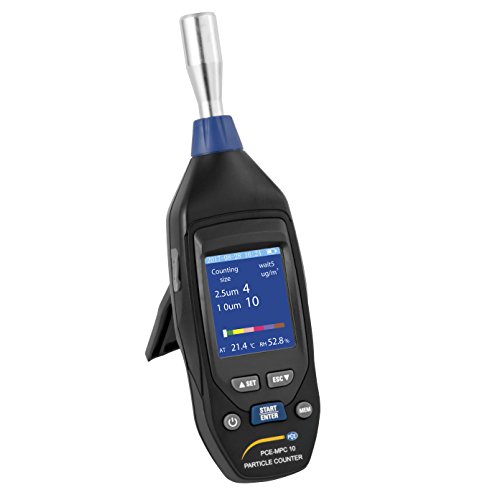
- PM2.5 and PM10 measurement
- 5,000-data logger with USB
- Temperature and humidity readings
Best For: Routine indoor air-quality tracking
Best Multi-Channel Laser Counter
UNI-T UT337B Laser Particle Counter

- Six-channel measurement from 0.3–10.0 μm
- Stores 10,000 data groups
- Wi-Fi app and Type-C PC connection
Best For: Detailed real-time particle-size distribution
Best Home Air Monitor
9600 Particle Counter Air Quality Monitor

- Measures 0.3 μm, PM2.5, and PM10
- Logs 2,000 data sets with USB export
- Adds formaldehyde, gas, temperature, and humidity
Best For: Multi-parameter household air monitoring
Best High-Capacity Cleanroom Counter
6-Channel Cleanroom HVAC Particle Counter

- Six channels from 0.3–10 μm
- Stores over 2 million records
- 2.83 L/min pump with USB-C export
Best For: Cleanroom, HVAC, and filter inspections
Cleanroom Documentation Pick

- Six particle-size channels from 0.3 to 10 µm
- Measures temperature, dew point, and humidity
- Data logger, USB, ISO 14644 reporting, and camera
Best For: Cleanroom and IAQ documentation
Long-Term Tracking Pick
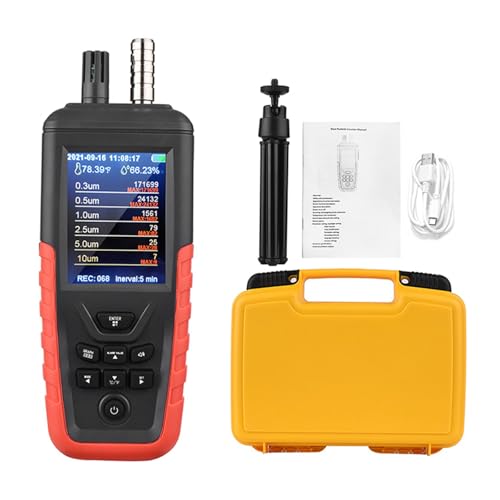
- Stores 999 records with customizable intervals
- Exports historical data to PC as PDF
- Includes tripod, alarms, and 9+ hour battery
Best For: Continuous and fixed-point air monitoring
Portable Six-Channel Pick
JD 3003 Handheld Particle Counter

- Covers six particle sizes from 0.3 to 10 µm
- 2.8-inch high-definition LCD
- Multilingual interface and back stand
Best For: Portable work, home, and lab checks
Professional Cleanroom Monitor

- Six particle channels from 0.3 to 10 µm
- Stores 5,000 records and 20 minutes of video
- Adds PM, HCHO, TVOC, CO2, temperature, and humidity readings
Best For: Cleanroom and laboratory documentation
Connected Data Logger
Tuya PM2.5/PM10 Particle Counter

- Stores up to 10,000 sets of readings
- Exports data in Excel or PDF formats
- Offers Tuya app monitoring and a 10+ hour battery
Best For: Extended monitoring and remote access
Certified Field Instrument

- Detects particle sizes from 0.3 to 10 µm
- Stores 5,000 records and 20 minutes of video
- Includes calibration certificate and field accessories
Best For: Portable cleanroom and facility inspections
Best Indoor Air Quality Logger – PCE-MPC 10 Particle Counter
For shoppers seeking particle counters with data logging for routine indoor checks, the PCE-MPC 10 combines PM2.5 and PM10 measurements with temperature and humidity readings. Its color display and 5,000-data logger make it practical for tracking conditions over time.
Best For: Home, office, and general indoor air-quality monitoring where PM2.5, PM10, temperature, and humidity data are useful.
Pros:
- Measures both PM2.5 and PM10 particulate matter.
- Stores up to 5,000 data records and supports USB connectivity.
- Measures temperature from 0 to 50°C and humidity from 0 to 100% RH.
- Uses a 2-inch full-color LCD with user-friendly graphics.
Cons:
- Only two particulate-size channels are listed.
- Its stated temperature accuracy is ±1°C.
- Tabletop mounting may be less convenient than a fully handheld design.
The PCE-MPC 10 is a straightforward choice when you want logged PM2.5 and PM10 readings without moving into a more specialized multi-channel instrument.
Best Multi-Channel Laser Counter – UNI-T UT337B Laser Particle Counter
The UNI-T UT337B is designed for buyers who want particle counters with data logging and broader size-distribution coverage. It offers six-channel synchronous measurement from 0.3 to 10.0 micrometers, plus wireless app connectivity and computer export.
Best For: Users who need real-time particle-size distribution data, multiple measurement modes, and flexible digital storage or transfer.
Pros:
- Measures six particle-size channels from 0.3 to 10.0 μm.
- Stores up to 10,000 groups of data.
- Supports Wi-Fi app connection and PC connection through Type-C.
- Also measures temperature, humidity, and dew point.
Cons:
- The supplied specifications do not identify the exact six channel sizes.
- Its broader feature set may be more than needed for simple PM2.5 checks.
- The notes do not specify temperature or humidity measurement ranges.
With six-channel measurement, a 3.5-inch color LED screen, and several data-transfer options, the UT337B is the more versatile logging-focused option in this group.
Best Home Air Monitor – 9600 Particle Counter Air Quality Monitor
For household monitoring, the 9600 combines particle counters with data logging and additional indoor-environment measurements. It tracks 0.3 μm, PM2.5, and PM10 particles while also monitoring formaldehyde, gas, temperature, and humidity.
Best For: Homeowners, offices, kitchens, garages, and families wanting a portable monitor with multiple air-quality alerts and logged readings.
Pros:
- Detects 0.3 μm, PM2.5, and PM10 particles.
- Logs up to 2,000 data sets and supports USB export.
- Monitors formaldehyde, gas, temperature, and humidity.
- Offers single, repeat, continuous, timer, and average test modes.
Cons:
- Its 2,000-record capacity is lower than some dedicated logging instruments.
- The supplied notes identify the brand as Generic.
- The notes do not specify the exact measurement ranges for formaldehyde or gas detection.
The 9600 stands out as a broad home-safety monitor rather than a particle-only meter, making it useful when logged particulate readings need to be considered alongside other indoor-air indicators.
Best High-Capacity Cleanroom Counter – 6-Channel Cleanroom HVAC Particle Counter
For cleanroom, HVAC, and filter-checking work, this six-channel meter pairs active laser-scattering sampling with unusually high-capacity data logging. It measures particles from 0.3 to 10 μm at a stated 2.83 L/min flow rate and exports records through USB-C.
Best For: Cleanrooms, laboratories, HVAC inspections, filter verification, and industrial contamination checks requiring extensive records.
Pros:
- Measures six specified channels: 0.3, 0.5, 1.0, 3.0, 5.0, and 10 μm.
- Stores more than 2 million groups of measurement data.
- Uses a built-in pump with a 2.83 L/min active sampling flow rate.
- Includes USB-C export, alarms, temperature and humidity monitoring, and a rear stand.
Cons:
- The supplied dimensions are relatively large for a portable instrument.
- Its specialized cleanroom and HVAC features may be unnecessary for basic home checks.
- The notes do not provide a measurement accuracy specification.
This is the strongest fit for extended professional logging: its six channels and storage capacity support repeat inspections, before-and-after filter comparisons, and report preparation.
Cleanroom Documentation Pick – PCE-PCO 2 Particle Counter
The PCE Instruments PCE-PCO 2 is a strong option for buyers seeking particle counters with data logging for cleanroom and indoor-air-quality checks. It measures six particle sizes from 0.3 to 10 µm, adds temperature and humidity readings, and supports ISO 14644 reporting.
Best For: Cleanroom inspections, IAQ checks, and users who want environmental readings plus recorded images.
Pros:
- Measures six particle sizes, including 0.3, 0.5, 1, 2.5, 5, and 10 µm.
- Records temperature, dew point, and relative humidity.
- Offers cumulative, differential, and concentration counting modes.
- Includes a color LCD, USB connectivity, data logger, and built-in camera.
Cons:
- The supplied notes do not specify the logger’s storage capacity or battery runtime.
- Its feature set may be more extensive than needed for basic spot checks.
Choose this model when reporting flexibility and supporting visual documentation matter as much as particle counts. The built-in camera and multiple counting modes make it particularly useful for professional inspection workflows.
Long-Term Tracking Pick – 6-Channel PM2.5/PM10 Counter
This six-channel meter is designed for buyers who need particle counters with data logging and straightforward record export. It stores up to 999 records, supports customizable logging intervals, and exports historical data to a PC as PDF through USB.
Best For: Fixed-point monitoring, cleanroom checks, filter testing, and longer-term PM2.5/PM10 tracking.
Pros:
- Detects six particle sizes from 0.3 to 10 µm and measures PM2.5 and PM10 mass concentration.
- Stores up to 999 historical records with trend curves and PDF export.
- Includes customizable alarm thresholds, audible alerts, and a color pollution indicator.
- Offers a tripod, rechargeable battery rated for 9+ hours, and a 1/4-inch mounting hole.
Cons:
- The supplied notes do not identify the exact PDF software workflow or export settings.
- At 1.83 pounds, it is heavier than the lightest handheld options.
This is the most compelling choice here for users who prioritize stored measurements and PC archiving. The included tripod and adjustable logging make it practical for repeatable, hands-free monitoring.
Portable Six-Channel Pick – JD 3003 Handheld Particle Counter
The JD 3003 is a compact handheld choice for buyers comparing particle counters with data logging for routine work, home, or lab use. Its six channels cover particle sizes from 0.3 to 10 µm, while the 2.8-inch LCD keeps readings easy to view.
Best For: Portable particle checks in workspaces, homes, and laboratories.
Pros:
- Measures six particle-size channels from 0.3 to 10 µm.
- Uses a 2.8-inch high-definition LCD display.
- Supports Chinese, English, Russian, and Japanese.
- Battery power, a back stand, and a stated 0.8 kg weight support portable use.
Cons:
- The supplied notes do not confirm data-storage capacity, export options, or logging intervals.
- The listed dimensions appear inconsistent with a typical handheld enclosure, so buyers should verify sizing before purchase.
Consider the JD 3003 when portability and broad particle-size coverage are more important than documented export features. Its multilingual interface and stand add convenience for occasional measurements across different settings.
Professional Cleanroom Monitor – CEM DT-9883M Particle Counter
For buyers comparing particle counters with data logging, the CEM DT-9883M combines six particle-size channels with broader air-quality measurements. It records up to 5,000 readings with date, time, counts, humidity, temperature, and sample volume, and supports USB export for on-site documentation.
Best For: Cleanrooms, laboratories, hospitals, and environmental teams that need logged particle and air-quality measurements.
Pros:
- Measures particles from 0.3 to 10 µm across six size channels.
- Also monitors PM2.5/PM10, HCHO, TVOC, CO2, temperature, and humidity.
- Stores 5,000 records and 20 minutes of video, with USB export.
- Includes a calibration certificate and a handheld 2.8-inch display.
Cons:
- Its broader measurement set may be more than needed for basic particle-counting tasks.
- Battery-powered operation uses a NiMH battery, which may require recharging between extended sessions.
The DT-9883M is a feature-rich choice when data logging, visual documentation, and multiple air-quality readings matter more than a minimalist design.
Connected Data Logger – Tuya PM2.5/PM10 Particle Counter
This particle counter with data logging is designed for extended monitoring and convenient data access. It measures six particle sizes, stores up to 10,000 sets of readings, and supports export in Excel or PDF through USB, a flash drive, or an SD card.
Best For: Users who want high-capacity logging, remote monitoring, and flexible export options for ongoing air-quality checks.
Pros:
- Measures particles from 0.3 to 10 µm and reports PM2.5/PM10 mass concentration.
- Stores up to 10,000 data sets for viewing, archiving, and analysis.
- Supports Tuya app monitoring, RS485 display output, alarms, and AQI display.
- Uses a 10,000mAh rechargeable battery rated for more than 10 hours of operation.
Cons:
- The app, RS485, and multiple export features may be unnecessary for simple spot checks.
- The supplied notes do not specify a calibration certificate.
With its large storage capacity, app connectivity, and multiple export methods, this model stands out for users building a repeatable monitoring or reporting workflow.
Certified Field Instrument – CEM DT-9880 Particle Counter
The CEM DT-9880 is a practical option for particle counters with data logging in cleanroom and facility-maintenance settings. It records up to 5,000 readings with environmental details and sample volumes, while its color display and included accessories support on-site work.
Best For: Cleanrooms, dust-free workshops, hospitals, and field technicians who need a portable, documented measurement tool.
Pros:
- Detects particle sizes from 0.3 to 10 µm using the Mie-scattering principle.
- Stores 5,000 records plus 20 minutes of video.
- Includes a calibration certificate and supports USB or flash-drive export.
- Comes with a carrying case, Parker filter tube, power adapter, and manual.
Cons:
- The supplied notes do not list additional HCHO, TVOC, or CO2 measurements.
- Its 5,000-record capacity is lower than some newer high-capacity logging models.
The DT-9880 offers a straightforward balance of portability, certified measurement support, and record storage for teams conducting documented inspections on site.
How We Picked the Best Particle Counters with Data Logging
We focused on the features that determine whether a particle counter produces useful, repeatable, and reviewable results. The selected models cover basic PM2.5 and PM10 monitoring as well as six-channel instruments that measure particles from approximately 0.3 to 10 microns.
Our comparison considers particle-size channels, sampling capability, data-logging and export options, environmental measurements, display usability, portability, and suitability for home, commercial, HVAC, or cleanroom work. Models offering additional readings such as temperature, humidity, formaldehyde, carbon dioxide, TVOC, or gas indicators may be more useful for broader indoor-air investigations, but those readings do not replace dedicated laboratory instruments.
Quick Comparison
- Basic indoor monitoring: Choose a PM2.5/PM10 meter when you mainly need straightforward trend information.
- Detailed particle analysis: Six-channel counters provide more useful size-distribution data, particularly for HVAC and workplace investigations.
- Cleanroom checks: Look for 0.3-micron measurement, multiple channels, documented sampling controls, and suitable reporting features.
- Broader air-quality screening: Models with temperature, humidity, HCHO, CO2, TVOC, or gas readings can help identify several potential issues at once.
- Field documentation: Confirm that stored readings can be reviewed, exported, photographed, or transferred through an app before buying.
Key Buying Factors for Particle Counters with Data Logging
Particle Channels and Size Range
More channels show how particle concentrations are distributed by size instead of reporting only a single mass estimate. A 0.3-to-10-micron range is generally more versatile for professional investigations, while PM2.5 and PM10 measurements may be sufficient for general home monitoring.
Logging, Memory, and Data Transfer
Check whether the instrument records individual samples, time-stamped trends, or only a displayed value. Also verify memory capacity, file formats, USB or app support, and whether data can be exported for reports. A data logger is most valuable when its records are easy to retrieve and interpret.
Sampling and Accuracy Considerations
Review the stated flow rate, sampling time, repeatability, and operating conditions. Keep the inlet unobstructed, allow the instrument to stabilize, and use consistent sampling locations. For regulated or high-consequence work, confirm calibration requirements and use an appropriately certified instrument.
Extra Sensors and Practical Design
Temperature and humidity readings add useful context, while formaldehyde, CO2, and TVOC sensors broaden screening capability. Consider battery life, screen readability, button layout, weight, protective case options, and whether the device is comfortable to hold during repeated measurements.
Who Should Buy Which Particle Counters with Data Logging?
Homeowners and renters will usually get the best value from a compact PM2.5/PM10 monitor with simple logging and clear trend displays. HVAC technicians and building professionals should favor six-channel instruments with broader particle-size coverage, environmental readings, and easy report transfer. Cleanroom and controlled-environment users should prioritize 0.3-micron capability, repeatable sampling, adequate memory, and calibration documentation over extra consumer-oriented sensors. Property inspectors and workplace managers may prefer a multipurpose model that combines particle readings with CO2, HCHO, TVOC, temperature, or humidity data for a broader initial assessment.