Choosing among particle counters for clean work areas can be difficult when specifications range from basic PM monitoring to multi-channel, ISO-certified measurement. The right instrument depends on the particle sizes you need to track, the environment, and how much measurement confidence your procedures require.
This roundup compares 10 handheld and portable options for cleanroom checks, HVAC troubleshooting, facility maintenance, and general indoor-air assessments. Use the guide below to narrow the field by accuracy, channel coverage, usability, and documentation needs.
Best 10 Particle Counters for Clean Work Areas Picks for 2026
Best Professional Choice
Temtop PMD331 7-Channel Particle Counter

- ISO 21501-4 certified for professional monitoring
- Seven channels from 0.3 to 10 µm
- Stores over 2,000,000 records
Best For: Cleanroom, laboratory, pharmaceutical, and HVAC monitoring
Best Compact Budget Monitor
TC-8100 Air Quality Particle Counter

- Measures 0.3 µm and 2.5 µm particles
- Stores up to 999 readings
- Portable battery-powered design
Best For: Routine spot checks and basic indoor monitoring
Best Advanced Analyzer
Temtop PMD371 Environmental Monitor
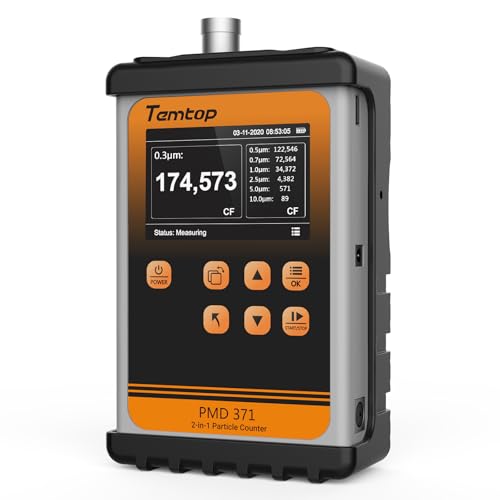
- Measures count and mass concentration
- Stores over 2,000,000 data sets
- Includes five-year warranty and calibration service
Best For: Comprehensive monitoring in cleanrooms and sensitive facilities
Best Fixed-Point Monitoring Kit
6-Channel PM2.5/PM10 Particle Counter
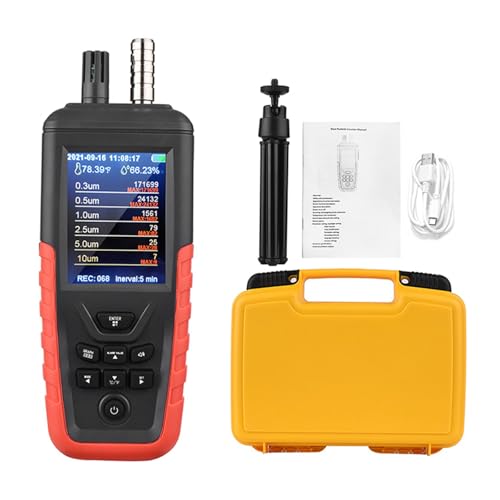
- Six particle channels from 0.3 to 10 µm
- Includes tripod and custom alarms
- Exports up to 999 records as PDF
Best For: Cleanroom spot checks and fixed-location monitoring
Best Multi-Channel Pick
UNI-T UT337B Laser Particle Counter

- Six-channel measurement from 0.3µm to 10.0µm
- Wi-Fi, USB-C, camera, and 10,000-record storage
- Temperature, humidity, dew point, and classification displays
Best For: Detailed cleanroom and facility monitoring
Best Simple PM Monitor
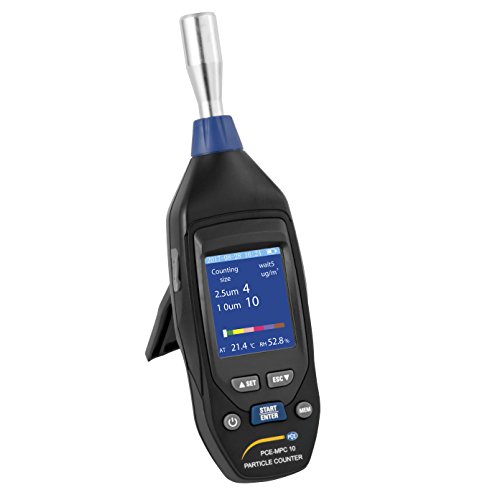
- Measures PM2.5 and PM10
- Tracks temperature and relative humidity
- Includes color display, USB, and 5,000-data logging
Best For: Basic indoor air-quality checks
Best Field-Ready Handheld
Temtop Airing-2000 Particle Counter

- Detects particles from 0.3µm to 1.0µm
- Adds PM2.5, PM10, TSP, temperature, and humidity
- 3500mAh battery and 32GB internal storage
Best For: Portable facility and environmental inspections
Best Overall Documentation
CEM DT-9880 Handheld Particle Counter

- Seven particle-size channels from 0.3 to 10 microns
- Stores 5,000 records and 20 minutes of video
- Includes calibration certificate and carrying case
Best For: Portable cleanroom inspections with documented readings
Best for Long-Term Data Storage
JD-3003 6-Channel Air Particle Meter

- Six channels cover 0.3 to 10 micron particles
- Stores over 2 million measurement groups
- Includes USB-C export, alarms, and a rear stand
Best For: Recurring cleanroom and HVAC inspections
Best for Combined Dust Metrics
JD-3000 8-Channel Particle Counter

- Combines six size channels with PM2.5 and PM10
- Stores over 2 million records with USB-C export
- Rechargeable battery, alarms, and temperature/humidity sensing
Best For: Teams needing particle counts and PM mass data together
Best Professional Choice – Temtop PMD331 7-Channel Particle Counter
For facilities that need dependable particle counters for clean work areas, the Temtop PMD331 combines ISO 21501-4 certification, seven simultaneous size channels, and extensive data logging. Its rugged components and RS-485 Modbus connectivity make it suited to recurring professional monitoring and documentation.
Best For: Cleanroom certification support, laboratories, pharmaceutical manufacturing, surgical suites, and HVAC monitoring.
Pros:
- Measures seven particle sizes from 0.3 to 10 µm simultaneously.
- Stores more than 2,000,000 records and supports USB export.
- Includes an RS-485 Modbus interface, protective case, and calibration certificate.
Cons:
- Individual ISO calibration certificates for specific audits are optional and may cost extra.
- At 9 pounds, it is heavier than many basic handheld monitors.
The PMD331 is a strong fit when measurement repeatability, reporting capacity, and industrial durability matter more than minimizing size or cost.
Best Compact Budget Monitor – TC-8100 Air Quality Particle Counter
The TC-8100 is a straightforward option for checking particle levels in clean work areas and general indoor environments. Its laser-scattering sensor measures selected particle sizes, while the color display, rechargeable operation, and onboard records support routine spot checks.
Best For: Basic cleanroom checks, indoor air-quality surveys, and production areas needing a lightweight portable detector.
Pros:
- Detects 0.3 µm and 2.5 µm particles using laser scattering.
- Stores up to 999 records and displays data curves on a 3.2-inch color screen.
- Battery powered with USB power support and a one-year manufacturer warranty.
Cons:
- It monitors fewer particle channels than the professional Temtop models in this roundup.
- The supplied listing has inconsistent product naming and packing-list details, so verify the package before ordering.
This model makes sense for accessible, portable screening, but buyers needing broader particle-size coverage or extensive audit data should consider a more advanced counter.
Best Advanced Analyzer – Temtop PMD371 Environmental Monitor
The Temtop PMD371 stands out among particle counters for clean work areas because it measures both particle count and mass concentration. Its professional pump, metal construction, large storage capacity, and Modbus connectivity support detailed analysis in controlled or sensitive environments.
Best For: Cleanrooms, laboratories, hospitals, and industrial settings requiring comprehensive particulate analysis.
Pros:
- Combines particle counts from 0.3 to 10 µm with PM1, PM2.5, PM4, PM10, and TSP measurements.
- Stores more than 2,000,000 data sets and supports USB and RS-232 Modbus transfer.
- Includes an 8-hour battery, metal housing, five-year warranty, and two-year free calibration service.
Cons:
- Individual ISO certificates for specific units are optional and subject to additional charges.
- Its professional feature set may be more than needed for simple occasional checks.
Choose the PMD371 when a single instrument must provide both particle-count and mass-concentration views, along with long-term data handling and substantial manufacturer support.
Best Fixed-Point Monitoring Kit – 6-Channel PM2.5/PM10 Particle Counter
This six-channel monitor offers a practical balance for particle counters for clean work areas, combining particle counts, PM2.5 and PM10 readings, temperature, and humidity. Its included tripod and customizable alarms make it useful for repeatable fixed-point checks as well as handheld inspections.
Best For: Class 5–9 cleanroom checks, filter-seal testing, contamination detection, and fixed-location monitoring.
Pros:
- Measures six particle sizes from 0.3 to 10 µm plus PM2.5, PM10, temperature, and humidity.
- Includes a tripod for hands-free monitoring and adjustable alarm thresholds.
- Stores 999 records and supports USB export as PDF.
Cons:
- Its 999-record capacity is much smaller than the professional Temtop models.
- The stated particle-count accuracy and ISO 14644-1 suitability do not replace site-specific certification requirements.
For buyers who value a complete, easy-to-deploy kit, the included tripod, alarms, and environmental readings make this a versatile choice for routine monitoring.
Best Multi-Channel Pick – UNI-T UT337B Laser Particle Counter
For clean work areas that need detailed particle-size data, the UNI-T UT337B is a feature-rich option. It measures six particle channels from 0.3µm through 10.0µm at a 2.83 L/min sampling rate, while also recording temperature, humidity, and dew point.
Best For: Cleanroom, laboratory, and facility teams that need broad particle sizing, environmental readings, and substantial onboard data storage.
Pros:
- Measures six particle sizes simultaneously, with cumulative and differential counting modes.
- Includes temperature, humidity, and dew-point sensors.
- Offers Wi-Fi, USB-C, camera-linked records, and storage for 10,000 measurements.
- Displays ISO/EU-GMP classifications and cites ISO 21501-4:2018 compliance.
Cons:
- Its extensive feature set may be more than needed for basic spot checks.
- The unit is larger than some simpler handheld air monitors.
The UT337B stands out when documentation and particle-size coverage matter as much as portability. Its six-channel measurement, connectivity, and environmental sensing make it a strong choice for structured clean-area monitoring.
Best Simple PM Monitor – PCE Instruments PCE-MPC 10
The PCE-MPC 10 is a straightforward choice among particle counters for clean work areas where PM2.5 and PM10 readings are the main priority. Its 2-inch color display presents readings alongside temperature and relative humidity measurements.
Best For: Indoor air-quality checks in workspaces, offices, and facilities that need basic particulate and environmental readings.
Pros:
- Measures PM2.5 and PM10 particle channels.
- Includes temperature and 0–100% relative-humidity measurement.
- Uses a full-color LCD with user-friendly graphics.
- Provides a 5,000-data logger and USB connectivity.
Cons:
- It covers fewer particle channels than specialized six-channel counters.
- Its temperature range is limited to 0–50°C.
Choose the PCE-MPC 10 when you want accessible PM2.5 and PM10 monitoring without the broader sizing and workflow features of a professional cleanroom counter. The built-in logger adds useful support for tracking readings over time.
Best Field-Ready Handheld – Temtop Airing-2000 Particle Counter
The Temtop Airing-2000 is a practical handheld option for particle counters for clean work areas, workshops, and facility inspections. It detects 0.3µm, 0.5µm, and 1.0µm particles while also reporting PM2.5, PM10, TSP, temperature, and humidity.
Best For: Portable environmental monitoring and extended field use where simple controls, battery operation, and local data storage are valuable.
Pros:
- Detects 0.3µm, 0.5µm, and 1.0µm particles.
- Reports PM2.5, PM10, TSP, temperature, and humidity.
- Includes a 3500mAh battery rated for more than four hours of continuous operation.
- Provides 32GB of internal storage and USB data transfer.
Cons:
- Its listed particle-size range stops at 1.0µm.
- It offers fewer particle channels than the UNI-T UT337B.
The Airing-2000 is well suited to users who move between rooms, work areas, or inspection sites. Its handheld design, clear interface, extended battery, and large storage capacity support routine measurements without a complicated setup.
Best Overall Documentation – CEM DT-9880 Handheld Particle Counter
For particle counters for clean work areas, the CEM DT-9880 is a practical handheld option when you want particle-size readings plus documented environmental conditions. It measures seven particle sizes, includes temperature and humidity readings, and supports on-site records, photos, and video.
Best For: Cleanrooms, laboratories, hospitals, and teams that need portable readings with calibration documentation and exportable records.
Pros:
- Measures particles from 0.3 to 10 microns across seven size categories.
- Stores up to 5,000 records and 20 minutes of video.
- Includes a calibration certificate, Parker filter tube, USB accessories, and carrying case.
- Records temperature, humidity, sample volume, date, and time.
Cons:
- Its 5,000-record capacity is smaller than the multi-million-record storage offered by the other listed meters.
- The product details identify the model as DT-9880s, while the title names it DT-9880.
The DT-9880 stands out for users who value a complete field kit and richer inspection documentation. Its handheld design and clear color display make it well suited to spot checks, while the included calibration certificate adds useful support for professional workflows.
Best for Long-Term Data Storage – JD-3003 6-Channel Air Particle Meter
Among particle counters for clean work areas, this six-channel meter is geared toward repeated inspections and extended data collection. Its 2.83 L/min active sampling, Type-C USB export, and storage capacity of more than 2 million measurement groups make it useful for tracking conditions over time.
Best For: Cleanroom, HVAC, laboratory, and industrial teams performing recurring inspections, filter checks, and before-and-after cleaning comparisons.
Pros:
- Measures six particle sizes from 0.3 to 10 microns.
- Uses laser scattering with a stable 2.83 L/min built-in pump.
- Stores more than 2 million groups of measurement data.
- Offers USB-C export, adjustable alarms, temperature and humidity monitoring, and a rear stand.
Cons:
- The supplied details do not specify a calibration certificate or report.
- Power is listed as AC, which may be less convenient for fully mobile work.
This JD-3003 is a strong fit when storage and repeatable active sampling matter more than a compact inspection record. Its multilingual interface and hands-free display add convenience for shared workplace use, while USB export simplifies reporting.
Best for Combined Dust Metrics – JD-3000 8-Channel Particle Counter
For particle counters for clean work areas that need both particle counts and mass-concentration data, the JD-3000 adds PM2.5 and PM10 readings to six particle-size channels. Its handheld format, rechargeable battery, alarms, and continuous-sampling mode support routine checks in clean areas and industrial settings.
Best For: Cleanroom technicians, HVAC professionals, laboratory teams, and inspectors who want particle-size counts alongside PM2.5 and PM10 measurements.
Pros:
- Combines six particle-size channels with PM2.5 and PM10 readings.
- Provides stable 2.83 L/min sampling through an internal pump.
- Stores more than 2 million records and supports USB-C export.
- Includes temperature, humidity, adjustable alarms, and a rechargeable 2,000 mAh battery.
Cons:
- The supplied information identifies the brand as Generic.
- The calibration report covers PM2.5 and PM10 mass-concentration measurements, not explicitly every particle-size channel.
The JD-3000 is the most versatile choice here for users who want count data and PM mass concentrations in one handheld instrument. It offers substantial storage and flexible sampling modes, making it practical for comparing areas or checking conditions before and after cleaning or filter maintenance.
How We Picked These Particle Counters for Clean Work Areas
We focused on portable instruments that measure airborne particles across useful size ranges, especially around 0.3, 0.5, 1, 2.5, 5, and 10 microns. We also considered channel count, real-time display, environmental sensors, sampling convenience, data handling, and features that support inspections or cleanroom documentation.
Certification and stated standards matter, but buyers should verify the current calibration certificate, counting-efficiency data, and manufacturer documentation before using any meter for regulated release decisions. A consumer-oriented PM monitor may be useful for trends, yet it is not automatically equivalent to a validated cleanroom particle counter.
Quick Comparison
For the broadest particle-size profiling, look for a six- or eight-channel counter covering approximately 0.3 to 10 microns. Instruments with PM2.5 and PM10 reporting are convenient for general indoor-air work, while ISO 21501-4 certification and a built-in sampling pump are more relevant to formal cleanroom measurements. Models with temperature and relative-humidity readings add useful context during HVAC or facility investigations.
Key Buying Factors
Particle-Size Channels and Range
Match the channel thresholds to your protocol. A meter that starts at 0.3 microns offers more detail for clean environments than one designed mainly around PM2.5 and PM10. More channels can reveal whether contamination is concentrated in fine or coarse particles, but they may also increase cost and complexity.
Sampling Method and Flow Control
A built-in pump, consistent flow rate, adjustable sampling time, and clear inlet design help produce repeatable readings. Check whether the instrument supports the sample volume and locations required by your procedures, and consider whether an isokinetic probe or remote tubing is needed.
Calibration, Standards, and Records
For quality-controlled work, prioritize calibration traceability, ISO 21501-4 information, alarm settings, sample logging, date and time stamps, and export options. A color display or photo function can help document field conditions, but it does not replace calibration evidence.
Environmental Readings and Usability
Temperature and humidity sensors help explain changing results and identify conditions that may affect equipment or processes. Also evaluate battery life, screen readability, portability, cleaning requirements, charging, and whether controls can be used while wearing gloves.
Who Should Buy Which Particle Counters for Clean Work Areas?
Cleanroom and controlled-environment teams: Choose a multi-channel instrument with a stated calibration program, a sampling pump, and documented counting performance. Certification and service support should outweigh a lower purchase price.
HVAC technicians and facility managers: A portable six-channel meter with PM2.5, PM10, temperature, and humidity readings can provide a practical balance of detail and field convenience for troubleshooting airflow and filtration.
General indoor-air users: A simpler PM-focused counter may be sufficient for trend monitoring, provided you do not treat its readings as a formal cleanroom certification.
Inspection and maintenance teams: Prioritize fast startup, readable live data, adequate battery life, and saved measurements. Before ordering, confirm included accessories, calibration status, warranty terms, and the manufacturer’s support for replacement filters or service.