Choosing among today’s LCR meters can be difficult when specifications, test frequencies, accuracy ratings, and form factors vary so widely. The right instrument depends on whether you need quick field checks, SMD testing, repair work, or repeatable laboratory measurements.
We selected 10 options across handheld, tweezers-style, and benchtop designs to help you match measurement capability, usability, and budget to your electronics workflow.
Best 10 Lcr Meters Picks for 2026
Precision Handheld Pick
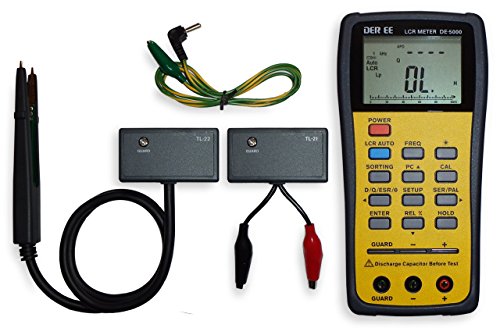
- Auto-LCR operation with serial or parallel testing
- Measures D, Q, phase angle, ESR, and Rp
- Five selectable test frequencies plus sorting mode
Best For: Technicians and detailed component testing
Feature-Rich Modern Pick
FNIRSI LC1020E 100kHz LCR Meter

- 19,999 counts with dual-parameter color display
- Sorting mode supports nominal and tolerance comparisons
- Rechargeable 3000mAh battery and Kelvin-style fixtures
Best For: Advanced screening and portable precision testing
High-Frequency Specialist
Peak Atlas LCR45 LCR and Impedance Meter
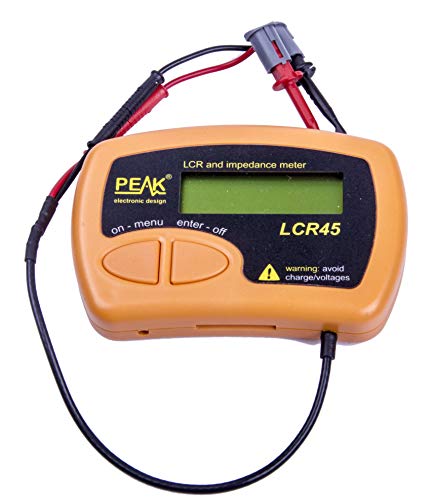
- Tests at DC, 1kHz, 15kHz, and 200kHz
- Automatic or manual component selection
- Resolution down to 0.2μH, 0.2pF, and 0.2 ohms
Best For: High-frequency impedance measurements
Wide-Range Budget Tester
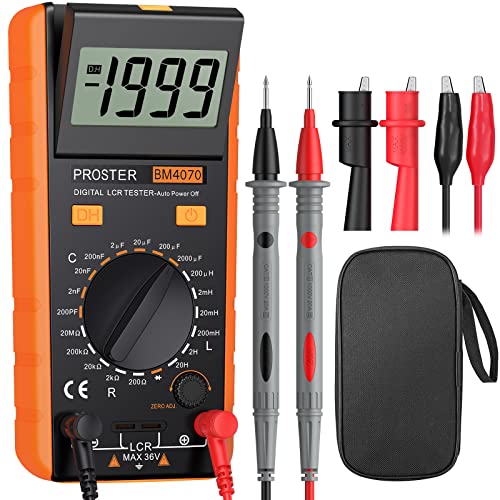
- Measures 200pF–2000μF capacitance and 200μH–20H inductance
- Includes resistance and diode testing
- Rotatable LCD, data hold, and complete accessory kit
Best For: Hobbyist repairs and general component testing
High-Frequency Handheld Pick
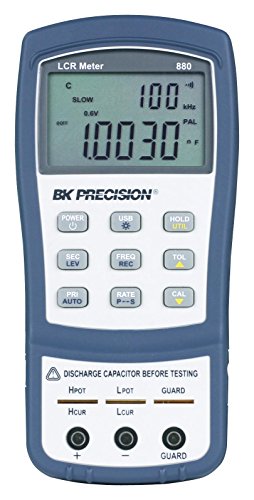
- 40,000-count primary display
- Up to 100 kHz test frequency
- Measures L, C, R, and Z
Best For: Portable, detailed component testing
Versatile Value Choice

- Five frequencies up to 100 kHz
- Dual backlit parameter display
- Includes fixture and test leads
Best For: Routine bench and repair measurements
Production Bench Powerhouse
MATRIX MCR5200 Benchtop LCR Meter

- 40 Hz–200 kHz range
- 0.1% basic accuracy
- USB and RS232C connectivity
Best For: R&D, production, and quality-control testing
Best Portable Pick

- Tests R, C, L, diodes, and ESR-related parameters
- Three frequencies up to 10 kHz
- Pointed and hook tweezer heads included
Best For: SMD repairs and quick board-level testing
Best Frequency Range

- Six test frequencies from 100 Hz to 100 kHz
- Includes ESR calibration and correction functions
- 2.8-inch backlit display with Mini-USB connectivity
Best For: Portable testing across varied component applications
Best Bench Instrument

- Bench-style precision LCR meter
- 2 kHz maximum test frequency
- High listed resistance, capacitance, and inductance limits
Best For: Permanent workbench component testing
Precision Handheld Pick – DE-5000 Handheld LCR Meter
The DE-5000 is a capable choice among lcr meters for users who need automatic L/C/R testing plus detailed secondary readings. Its dual display, multiple test frequencies, and included probes support both general troubleshooting and more methodical component evaluation.
Best For: Electronics technicians, repair work, and component sorting where impedance details matter.
Pros:
- Measures inductance, capacitance, and resistance with D, Q, phase angle, ESR, or Rp readings.
- Auto-LCR mode automatically identifies the basic component type and measurement setup.
- Offers 100Hz, 120Hz, 1kHz, 10kHz, and 100kHz test frequencies, plus serial or parallel measurement.
- Includes alligator leads, SMD tweezers, a guard line, battery, and manual.
Cons:
- The optional IR-to-USB cable is not included.
- Uses a 9V battery rather than a rechargeable power system.
With its 19,999/9,999-count dual display and component sorting mode, the DE-5000 is a strong fit for users who want more than basic LCR readings in a portable instrument.
Feature-Rich Modern Pick – FNIRSI LC1020E 100kHz LCR Meter
The FNIRSI LC1020E stands out among lcr meters with a color display, dual-parameter measurements, calibration controls, and rechargeable operation. It is designed for precise component screening, including comparison against preset nominal values and tolerances.
Best For: Users who want advanced sorting, Kelvin-style connections, and a rechargeable bench or field tester.
Pros:
- Displays main and secondary parameters such as X, D, Q, θ, and ESR simultaneously.
- Supports five frequencies from 100Hz to 100kHz and a 19,999-count display.
- Sorting mode calculates relative error and tracks pass/fail counts with sound and LED alerts.
- Includes open/short calibration, adjustable test voltage, 3-pin sockets, and 5-slot jacks for four-terminal measurements.
Cons:
- Components must be fully discharged, and live circuits should not be tested.
- Calibration is recommended before measurement for dependable results.
The LC1020E is one of the most versatile options here, combining broad measurement ranges with useful screening tools, a 2.8-inch TFT display, and a 3000mAh rechargeable battery.
High-Frequency Specialist – Peak Atlas LCR45 LCR and Impedance Meter
The Peak Atlas LCR45 is a focused option among lcr meters for users who value straightforward impedance measurements and high-frequency testing. Its automatic or manual controls let you tailor component identification and test frequency to the job.
Best For: Technicians and hobbyists who need compact LCR and impedance testing up to 200kHz.
Pros:
- Supports automatic or manual component-type selection.
- Offers automatic or manual testing at DC, 1kHz, 15kHz, and 200kHz.
- Provides enhanced resolution down to 0.2μH, 0.2pF, and 0.2 ohms.
- Includes a hold function and an easy menu system for user settings.
Cons:
- The supplied notes do not specify included accessories or power details.
- Its listed measurement functions are more focused than the feature set of advanced dual-parameter meters.
Choose the LCR45 if high-frequency capability and simple operation are more important than extensive sorting or calibration features. Its 200kHz maximum test frequency is notable for this group.
Wide-Range Budget Tester – Proster BM4070 LCR Meter
The Proster BM4070 is a practical choice among lcr meters for basic component testing across broad capacitance, inductance, and resistance ranges. Its manual range structure, rotatable display, and included accessories make it suitable for bench work, repairs, and hobby projects.
Best For: Hobbyists, repair users, and beginners who want broad ranges without advanced automatic LCR features.
Pros:
- Measures capacitance from 200pF to 2000μF and inductance from 200μH to 20H.
- Provides five resistance ranges from 200Ω to 20MΩ and includes diode testing.
- Rotatable LCD, data hold, zero adjustment, and auto power-off support bench use.
- Complete kit includes leads, crocodile clips, screwdriver, 9V battery, manual, and storage bag.
Cons:
- Its 1,999-count display is lower resolution than the higher-end options listed here.
- Measurement ranges are manually selected rather than presented as an automatic LCR workflow.
- It does not list advanced parameters such as ESR, Q, or dissipation factor.
The BM4070 favors range coverage and approachable operation over advanced analysis. It is a sensible entry-level pick for identifying and troubleshooting common passive components.
High-Frequency Handheld Pick – B&K Precision 880
For technicians who need capable lcr meters in a portable format, the B&K Precision 880 combines fast autoranging with measurements for inductance, capacitance, resistance, and impedance. It offers selectable test frequencies up to 100 kHz and accuracy up to 0.1%.
Best For: Portable component testing where high test frequency and detailed secondary readings matter.
Pros:
- 40,000-count primary display and 10,000-count secondary display resolution.
- Measures L, C, R, and Z, with automatic calculations for D, Q, theta, ESR, and DCR.
- Fast autoranging and selectable frequencies up to 100 kHz.
- Battery-powered handheld design.
Cons:
- At 2.2 pounds, it is heavier than many compact handheld meters.
- Its broader measurement capability may be more than needed for basic passive-component checks.
The 880 is a strong choice when portability does not have to mean giving up display resolution or advanced component parameters. Its 100 kHz ceiling and 0.1% accuracy make it particularly appealing for more demanding bench or field work.
Versatile Value Choice – Extech LCR200
The Extech LCR200 is a practical option for everyday lcr meters use, measuring inductance, capacitance, and resistance while showing secondary values such as Q, dissipation, phase, and ESR. Its five test frequencies and built-in fixture add flexibility for bench troubleshooting.
Best For: General-purpose passive-component measurements with straightforward controls and useful calibration features.
Pros:
- Supports five test frequencies from 100 Hz to 100 kHz.
- Dual backlit display shows primary and secondary parameters simultaneously.
- Open and short calibration helps reduce stray impedance effects.
- Includes a built-in test fixture, test leads, and 9 V battery.
Cons:
- Its 20,000/2,000-count display is lower resolution than the B&K Precision 880’s listed resolution.
- It relies on a 9 V battery, with automatic power-off enabled by default.
With series and parallel modes, limit settings, and a useful frequency range, the LCR200 balances capability and convenience. It is well suited to repair benches, education, and routine component verification.
Production Bench Powerhouse – MATRIX MCR5200 Benchtop LCR Meter
For R&D, production, and quality-control work, the MATRIX MCR5200 is a benchtop addition to the lcr meters category with 0.1% basic accuracy, 41 selectable frequency points from 40 Hz to 200 kHz, and extensive impedance measurement ranges. USB Host and RS232C connectivity support data handling and automation-oriented workflows.
Best For: Benchtop testing, component characterization, production checks, and data-supported troubleshooting.
Pros:
- Measures from 40 Hz to 200 kHz across 41 frequency points.
- Offers 0.1% basic accuracy and a broad L, C, R, impedance, ESR, D, and Q range.
- Includes open/short calibration, averaging, adjustable measurement speed, and comparator modes.
- Supports USB Host, RS232C, Handler, SCPI, and GPIB-related workflows.
Cons:
- Corded operation requires a 110–220 V AC power source.
- At 7.7 pounds, it is intended for bench use rather than portability.
- Its extensive controls and interfaces may be unnecessary for occasional basic measurements.
The MCR5200 stands out when repeatability, connectivity, and test-process control matter more than compact size. Its comparator, calibration, saving, and multi-speed functions make it the most workflow-oriented option in this group.
Best Portable Pick – FNIRSI LCR-ST1 Tweezer Tester
For compact, hands-on lcr meters testing, the FNIRSI LCR-ST1 combines tweezer-style probing with automatic component recognition. It measures resistance, capacitance, inductance, and diodes, making it a practical choice for SMD work and circuit-board troubleshooting.
Best For: SMD repairs, quick component checks, and locating faults on circuit boards.
Pros:
- Measures resistance from 10 mΩ to 10 MΩ, capacitance from 1 pF to 22 mF, and inductance from 1 µH to 10 H.
- Offers 100 Hz, 1 kHz, and 10 kHz test frequencies with 0.3 Vrms or 0.6 Vrms test voltage.
- Includes auto recognition, D/Z/Q/R and ESR readings, data export via USB, and pointed and hook tweezer heads.
Cons:
- Its fixed screen does not flip or rotate.
- The listed frequency range is narrower than the 100 kHz option on some handheld meters.
The LCR-ST1 is especially convenient when you need to hold and test small components directly. Its portable design, storage case, and rechargeable USB connection support field or bench-side repairs, while the built-in recording and export functions help preserve test results.
Best Frequency Range – Handheld 4080 LCR Meter
This handheld lcr meter suits engineers and technicians who want broad frequency selection in a portable format. The 4080 measures inductors, capacitors, and resistors, while its recording, calibration, and PC communication features support repeatable testing.
Best For: Portable engineering work requiring multiple test frequencies and PC-based data acquisition.
Pros:
- Provides six test frequencies: 100 Hz, 120 Hz, 1 kHz, 10 kHz, 40 kHz, and 100 kHz.
- Includes open- and short-circuit correction, ESR calibration, and an integrated recording mode.
- Uses a 2.8-inch backlit TFT display and supports remote control and data acquisition through Mini-USB.
Cons:
- The supplied notes do not specify its measurement ranges for resistance, capacitance, or inductance.
- It requires a 5 V DC minimum operating voltage.
Choose this model when frequency flexibility matters more than tweezer-style probing. Its dedicated controls, visible TFT screen, adjustable settings, and two-year warranty make it a capable general-purpose handheld option.
Best Bench Instrument – GW INSTEK LCR-6002
The GW INSTEK LCR-6002 is a bench-style choice for users who need substantial stated measurement capacity in a larger precision instrument. This lcr meter operates at 2 kHz and supports high maximum values for inductance, capacitance, and resistance.
Best For: Fixed workbench testing of electronic components with high listed measurement limits.
Pros:
- Bench-format design with a 2 kHz maximum test frequency.
- Listed maximum measurement values reach 9.99999 kH for inductance, 9.99999 F for capacitance, and 99.9999 MΩ for resistance.
- RoHS compliant and built for a dedicated measurement setup.
Cons:
- It is substantially heavier and larger than the portable options, weighing 4 kg.
- Only a 2 kHz maximum test frequency is listed.
- The supplied details state that it has no warranty.
The LCR-6002 makes the most sense for a permanent bench station rather than mobile troubleshooting. Its large stated component capacities are the main attraction, but buyers should account for the fixed bench footprint and the lack of a listed warranty.
How We Picked These Lcr Meters
We compared the selected instruments by measurement range, test-frequency options, stated accuracy, supported parameters, display and control layout, portability, connectivity, and intended use. We also considered practical features such as automatic component identification, ESR measurement, sorting functions, rechargeable or battery operation, and compatibility with test leads or SMD tweezers.
Specifications can vary by test conditions, accessories, and component type, so treat published accuracy as a reference rather than a guarantee for every measurement. For precision work, calibration quality and the test fixture may matter as much as the headline resolution.
Quick Comparison
| Type | Best suited to | What to prioritize |
|---|---|---|
| Basic handheld | General repair and hobby use | Simple controls, broad ranges, portability |
| Advanced handheld | Field service and design work | Frequency selection, ESR, accuracy, data visibility |
| Tweezers-style | Small SMD components | One-handed operation, auto detection, tip access |
| Benchtop | Production, engineering, and lab testing | Stability, precision, interfaces, fixtures, calibration |
Key Buying Factors for Lcr Meters
Measurement Frequency
Frequency affects the measured behavior of capacitors, inductors, and impedance-sensitive components. A meter offering multiple frequencies is more versatile for circuit design and troubleshooting, while a 100 kHz model can be useful for many switching, filter, and general electronics applications.
Accuracy and Resolution
Resolution shows how finely a display reports a value; accuracy indicates how close that value is to the true result. Look for both specifications, and check whether the stated accuracy applies across the full range. Benchtop models are generally preferable when repeatability is more important than portability.
Useful Parameters
Capacitance, inductance, and resistance are essential, but ESR, impedance, quality factor, dissipation factor, phase angle, and theta can provide more insight. Automatic component recognition saves time, though manual mode is valuable when testing unusual or connected components.
Fixtures and Connectivity
Short test leads, Kelvin connections, zeroing, and suitable component fixtures can significantly improve readings. USB, RS-232, or computer-control support is useful for documentation and production testing, while compact tweezers are convenient for densely packed SMD boards.
Who Should Buy Which Lcr Meters?
Choose a basic handheld meter if you mainly identify and check passive components during repairs, education, or hobby projects. Choose an advanced handheld model if you need selectable frequencies, ESR or additional parameters, and a better balance of accuracy and mobility. Choose a tweezers-style tester for frequent SMD work where speed and one-handed probing matter most.
Choose a benchtop LCR meter for engineering validation, production screening, or measurements that demand stable readings, higher precision, and computer connectivity. Before buying, confirm the required component ranges, operating frequency, included accessories, power arrangement, and calibration options.