A responsive audio interface can make recording, monitoring, and live software effects feel immediate instead of distracting. The best models combine dependable low-latency performance with clean preamps, useful connectivity, and controls that suit your setup.
We compare 10 audio interfaces with low latency for musicians, podcasters, streamers, and home-studio users, covering compact two-channel models, mobile options, and interfaces with extra outputs or DSP features.
Best 10 Audio Interface with Low Latency Picks for 2026
Best Entry-Level Pick
Focusrite Scarlett Solo 3rd Gen

- 24-bit/192kHz recording
- Air mode and Hi-Z instrument input
- Mac, Windows, and iPadOS support
Best For: Solo musicians, vocalists, and podcasters
Best for Guitar Effects

- Guitar-focused ultra-low-latency design
- 192kHz sampling and 108dB dynamic range
- Footswitch and expression-pedal inputs
Best For: Guitarists using amp and effects software
Best Hardware-Monitoring Option

- Two preamps with 2-in/2-out operation
- Hardware monitoring for responsive tracking
- 24-bit/192kHz support
Best For: Home studios needing two inputs
Best Plug-and-Play Value

- Two combo XLR/TRS inputs with 48V phantom power
- Zero-latency direct monitoring
- USB-C, bus-powered, and driver-free
Best For: Mobile creators and simple home studios
Best Overall

- 4x4 USB-C interface with two mic preamps
- Hardware monitoring, LCD screen, and loopback
- Up to 192 kHz with MIDI I/O
Best For: Flexible home studios, podcasting, and mobile-compatible recording
Best Budget Pick

- 2-in/2-out USB stereo interface
- USB-powered with no external supply
- Dedicated headphone control and digital output
Best For: Simple stereo recording, playback, and mixer connections
Best for Beginners
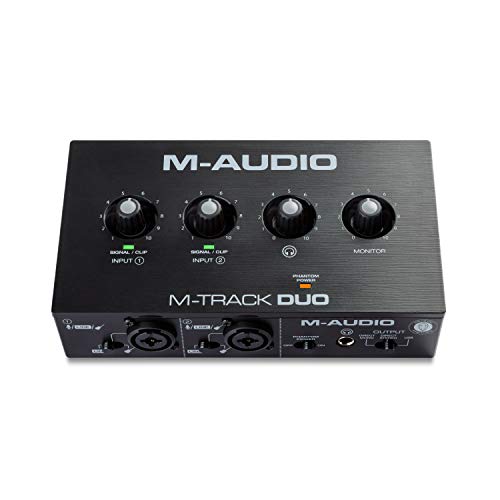
- Two combo mic, line, and instrument inputs
- Zero-latency USB/Direct monitoring switch
- Includes MPC Beats and Ableton Live Lite
Best For: Beginner recording, podcasting, and live streaming
Flexible Recording Pick
BlueAVS AR013 2-In/4-Out Interface

- Zero-latency monitoring with four modes
- 24-bit/192kHz recording support
- Two combo inputs and four outputs
Best For: Home studios, podcasts, streaming, and flexible two-input recording
Creator Control Pick

- 80dB gain for XLR microphones
- Ultra-low-latency 24-bit/48kHz monitoring
- Built-in effects and Wave Link routing
Best For: Streaming and voice-focused creator setups
Simple Home Studio Pick

- Two XLR/TRS combo inputs
- 48V phantom power for condenser microphones
- 24-bit/192kHz recording support
Best For: Beginners and compact home recording setups
Best Entry-Level Pick – Focusrite Scarlett Solo 3rd Gen
The Focusrite Scarlett Solo 3rd Gen is a practical audio interface with low latency for solo musicians, vocalists, and podcasters. Its 1 XLR mic input and Hi-Z instrument input support straightforward guitar-and-vocal recording, while Air mode can add clarity to acoustic sources.
Best For: Solo recording, guitar and vocal tracks, podcasts, and home studios.
Pros:
- 24-bit/192kHz recording with high-performance converters.
- Air mode and 56dB of gain support detailed vocal and acoustic recordings.
- Includes low-noise balanced outputs, headphones connectivity, and useful bundled software.
- Compatible with Mac, Windows, and iPadOS.
Cons:
- Only one microphone preamp is available.
- The two-input layout is aimed at smaller recording setups.
The Solo is a strong choice when you want familiar controls, solid specifications, and an uncomplicated path to recording. Choose it over a larger interface if you mainly track one microphone or instrument at a time.
Best for Guitar Effects – XSONIC Xtone Mobile Interface
The XSONIC Xtone is an audio interface with low latency designed around guitar effects and amp-simulation software. Its 192kHz capability, 108dB dynamic range, pure guitar input, and pedal-oriented connections make it suited to mobile and computer-based guitar rigs.
Best For: Guitarists using BIAS FX, JamUp, Guitar Rig, AmpliTube, and similar effects applications.
Pros:
- Designed specifically for guitar effects and VST applications.
- Supports 192kHz sampling and a stated ultra-low-latency design.
- Includes footswitch and expression-pedal inputs.
- Works with iOS, Windows, and Mac and can be powered directly by compatible devices.
Cons:
- The single-channel design is less suitable for multi-microphone recording.
- Its feature set is more specialized for guitar than general studio use.
The Xtone makes the most sense for players who prioritize software effects, portable operation, and hands-free control. It is less versatile than a two-channel studio interface but more purpose-built for guitar processing.
Best Hardware-Monitoring Option – MOTU M2 USB-C
The MOTU M2 is a compact two-channel USB-C audio interface with low latency for recording and monitoring in a home studio. It combines two preamps, hardware monitoring, and 24-bit/192kHz support in a simple 2-in/2-out format.
Best For: Musicians and creators who need two inputs with direct hardware monitoring.
Pros:
- Two preamps provide a flexible 2-in/2-out recording setup.
- Hardware monitoring helps support low-latency tracking.
- Records at up to 24-bit/192kHz.
- Supports macOS, Windows, and iOS, with free content included.
Cons:
- The supplied details do not specify the included input connector types.
- At 612g, it is less lightweight than the smallest mobile interfaces.
The M2 is a sensible middle ground for users who have outgrown a one-input interface but do not need a large channel count. Its hardware-monitoring feature is especially useful when responsive tracking is a priority.
Best Plug-and-Play Value – PIYONE Q2 2×2 Interface
The PIYONE Q2 is a plug-and-play audio interface with low latency for PC, Mac, and mobile recording. Its two combo inputs, USB-C bus power, 48V phantom power, and direct monitoring make it a flexible option for simple vocal, instrument, and podcast setups.
Best For: Mobile creators and home users wanting two inputs with straightforward direct monitoring.
Pros:
- Two XLR/TRS combo inputs support microphones and instruments.
- 24-bit/192kHz recording is designed for high-fidelity capture.
- Direct monitoring provides zero-latency tracking, with a 3.5mm headphone output.
- Class-compliant USB-C operation requires no drivers and uses bus power.
Cons:
- The supplied notes identify Windows compatibility but do not provide detailed OS support for every platform.
- The product details do not specify a separate power option beyond USB-C bus power.
The Q2 is appealing when convenience matters as much as recording quality. Its combination of combo inputs, phantom power, and direct monitoring covers common home-recording needs without requiring an external power supply.
Best Overall – MOTU M4
The MOTU M4 is a strong pick when you need an audio interface with low latency for recording, mixing, podcasting, or mobile-compatible setups. Its 4×4 USB-C connectivity, hardware monitoring, LCD screen, and MIDI I/O give it a versatile feature set for Mac, PC, and iOS users.
Best For: Musicians, podcasters, and home studios that need flexible I/O and low-latency monitoring.
Pros:
- 4-in/4-out USB-C connectivity with two microphone preamps
- Hardware monitoring and LCD screen for practical recording control
- Supports up to 192 kHz and includes MIDI I/O and loopback
- Compatible with Mac, PC, and iOS devices
Cons:
- More features than needed for simple two-channel recording
- USB-C connectivity may require an adapter for some older computers
The M4 stands out for users who want room to expand beyond basic recording. Its broader channel count and monitoring features make it a particularly capable low-latency option for more involved setups.
Best Budget Pick – Behringer UCA202
Behringer U-CONTROL UCA202 Ultra-Low Latency 2 In/2 Out USB/Audio Interface with Digital Output
Check Price On AmazonThe Behringer UCA202 is a straightforward choice if you want an audio interface with low latency for basic computer recording and playback. It offers stereo 2-in/2-out connectivity, USB bus power, a dedicated headphone level control, and digital output in a compact design.
Best For: Users connecting instruments, mixers, or other stereo audio sources to a Mac or PC.
Pros:
- Ultra-low-latency USB audio connectivity
- Works with PC or Mac without setup or drivers according to the supplied notes
- USB bus-powered, so no external power supply is required
- Dedicated headphone output level control and digital output
Cons:
- Limited to two input and two output channels
- Maximum sample rate is 48 kHz
- Designed for basic stereo connectivity rather than microphone-focused recording
The UCA202 keeps the essentials simple and portable. It is best suited to uncomplicated stereo recording or playback rather than a feature-rich production setup.
Best for Beginners – M-Audio M-Track Duo
The M-Audio M-Track Duo is a practical audio interface with low latency for podcasting, recording, and live streaming. Its two combo XLR/line/instrument inputs, phantom power, and USB/Direct monitoring switch make it flexible for microphones, guitars, and line-level sources.
Best For: Beginners who need an affordable two-input interface for vocals, guitar, podcasting, or streaming.
Pros:
- Two combo XLR/line/instrument inputs with phantom power
- USB/Direct switch enables zero-latency monitoring
- Includes headphone and stereo main outputs for flexible monitoring
- Includes MPC Beats and supports Ableton Live Lite
Cons:
- Limited to two channels and a 48 kHz maximum sample rate
- USB Type-B connectivity is less current than USB-C
- Not as expandable as a 4×4 interface
The M-Track Duo offers the core connections most new creators need without unnecessary complexity. Its direct-monitoring switch is especially useful for keeping input monitoring immediate during recording and streaming.
Flexible Recording Pick – BlueAVS AR013 2-In/4-Out Interface
If you need an audio interface with low latency for recording, streaming, or podcasting, the BlueAVS AR013 offers zero-latency monitoring with four monitoring modes. Its two XLR/TRS combo inputs, 24-bit/192kHz support, and 2-in/4-out design give home setups useful flexibility.
Best For: Home studios, podcasters, streamers, and musicians who need two inputs plus extra output routing.
Pros:
- Zero-latency monitoring with Off, Mono, Crossfeed, and Stereo modes.
- Two combo inputs, 48V phantom power, and dedicated PAD switches.
- Supports recording up to 24-bit/192kHz and works with major DAWs on Mac and Windows.
- Balanced TRS outputs and a compact, portable design.
Cons:
- Only two input channels are provided.
- Its 2-in/4-out layout may be more than needed for a very simple setup.
The AR013 is a versatile choice when direct monitoring, high-resolution recording, and flexible outputs matter more than having a larger channel count.
Creator Control Pick – Elgato Wave XLR MK.2
The Elgato Wave XLR MK.2 is an audio interface with low latency designed around a single XLR microphone. It combines ultra-low-latency monitoring with 80dB of gain, onboard voice processing, and Wave Link software for routing and effects.
Best For: Streamers, creators, and voice-focused users who want software-controlled mixing and built-in processing.
Pros:
- 80dB of gain supports a wide range of XLR microphones.
- Ultra-low-latency monitoring at 24-bit/48kHz resolution.
- Built-in voice enhancer, compressor, EQ, and Wave FX processing.
- Touch controls, LED feedback, and mute functionality simplify live operation.
Cons:
- It has one XLR audio input, limiting multi-microphone recording.
- Wave Link requires Windows 11 or Apple silicon Mac systems.
- It is focused on creator workflows rather than multiple instrument inputs.
Choose the Wave XLR MK.2 if convenient live controls, strong microphone gain, and integrated DSP are more important than having several physical inputs.
Simple Home Studio Pick – KA2 2×2 USB Interface
For beginners seeking an audio interface with low latency, this compact 2×2 model provides straightforward monitoring for vocals, guitar, podcasts, and home recording. It includes two XLR/TRS combo inputs, 48V phantom power, and 24-bit/192kHz recording support.
Best For: Beginners, home musicians, podcasters, and creators who need a simple two-input interface.
Pros:
- Two combo inputs accept microphones, instruments, and external audio devices.
- 48V phantom power supports condenser microphones.
- 24-bit/192kHz recording is available for compatible projects.
- Plug-and-play operation works with Windows and Mac OS and supports popular DAWs.
Cons:
- The 2×2 design offers fewer routing options than larger interfaces.
- The listed warranty period is 90 days.
- Its supplied details do not specify multiple monitoring modes.
The KA2 keeps the essentials in a compact 2×2 format, making it a practical entry point for recording two sources without a complicated setup.
How We Picked the Best Audio Interface with Low Latency
We focused on interfaces that support responsive monitoring while recording vocals, instruments, podcasts, or software-based effects. Our comparison considers driver and connection reliability, direct-monitoring options, preamp quality, conversion specifications, input and output flexibility, phantom power, device compatibility, and ease of use. USB-C models are represented alongside budget USB interfaces and specialized options for guitarists or streamers.
Published specifications such as sample rate and bit depth are useful, but they do not guarantee the lowest real-world latency. Driver stability, buffer settings, computer performance, and your recording software also affect response time. Direct monitoring is especially valuable because it can let you hear an input without sending it through the computer first.
Quick Comparison
- Best for simple home recording: Focusrite Scarlett Solo and M-Audio M-Track Duo.
- Best for detailed metering and expansion: MOTU M2 or MOTU M4.
- Best for streaming and vocal processing: Elgato Wave XLR MK.2.
- Best for guitar-focused mobile use: XSONIC Xtone.
- Best for basic, low-cost stereo connectivity: Behringer U-CONTROL UCA202.
- Best for flexible budget setups: the 2-in/4-out and 2×2 24-bit/192kHz models in this roundup.
Key Buying Factors for an Audio Interface with Low Latency
Inputs and Outputs
Count the microphones, guitars, keyboards, and other sources you expect to connect at once. Combo XLR/TRS inputs handle microphones and line or instrument sources, while extra outputs help with multiple monitor pairs, external effects, or separate streaming feeds.
Monitoring and Driver Performance
Look for direct monitoring, a stable driver package, and a connection supported by your computer or mobile device. A low buffer can reduce software-monitoring delay, but extremely low settings may cause clicks or dropouts. Choose an interface that remains stable at practical buffer sizes.
Sound Quality and Gain
Higher sample-rate and bit-depth ratings can be useful, but clean preamps and sufficient gain matter more for most home users. Guitarists should confirm that an instrument input is included; condenser microphone users need switchable 48V phantom power.
Controls and Compatibility
Physical input, output, and headphone controls make quick adjustments easier. Check operating-system support, USB requirements, iOS or mobile compatibility, included cables, and whether the interface needs an adapter or external power.
Who Should Buy Which Audio Interface with Low Latency?
Choose a compact two-input interface if you record one microphone and one instrument, make voiceovers, or want a straightforward home-studio setup. Choose the MOTU M2 or M4 if clear metering, strong connectivity, and room to grow are priorities. The M4 is better suited to users who need additional inputs or outputs.
Choose the Elgato Wave XLR MK.2 if streaming, microphone control, and software-based mixing are central to your workflow. Choose the XSONIC Xtone if portable guitar processing is more important than a conventional desktop layout. Choose the UCA202 for simple stereo playback or basic recording where advanced microphone features are unnecessary.
Before buying, match the interface’s inputs, outputs, power requirements, and device support to your exact setup. That practical fit usually matters more than chasing the highest advertised specification.