Finding a capable LCR meter on a budget is easier when you know which specifications matter. The best affordable models can measure resistance, capacitance, and inductance while adding useful features such as ESR testing, automatic component identification, frequency selection, and multimeter functions.
We selected 10 LCR meters under $100 for different needs, from compact SMD tweezers to versatile handheld testers. Use the comparison and buying advice below to narrow the list by accuracy, test frequency, measurement range, display, and portability.
Best 10 Lcr Meters Under 100 Picks for 2026
Best High-Frequency Choice
FNIRSI LC1020E Precision LCR Meter

- Tests from 100 Hz to 100 kHz
- Displays dual parameters including ESR and Q
- Includes sorting mode and open/short calibration
Best For: Detailed bench testing and component screening
Best for SMD Work

- Tweezer design suits SMD components
- Automatically recognizes components and shows ESR
- Stores records and exports data to a PC
Best For: SMD repair and circuit-board troubleshooting
Best PC-Connected Option

- Provides six test frequencies up to 100 kHz
- Advertises 0.2% measurement accuracy
- Supports PC control and data acquisition
Best For: Organized bench testing and engineering workflows
Best Compact LC Tester

- Measures 1 pF–100 mF and 1 uH–100 H
- Includes correction functions and multiple test leads
- Compact design for repair, lab, or classroom use
Best For: Broad capacitance and inductance testing
Best Budget Basic Meter

- Tests L, C, R, continuity, and diodes
- Includes data hold, zero adjustment, and auto power-off
- Powered by an included 9V battery
Best For: General household and automotive troubleshooting
Best Feature-Rich Option
ZT-XC1 True RMS LCR Multimeter

- Combines LCR testing with a 25,000-count True RMS multimeter
- Supports SMD and leaded component terminals
- Adds ESR, selectable frequencies, and waveform trends
Best For: Advanced electronics testing and troubleshooting
Best Value Bench Meter

- Measures 200pF–2000µF capacitance and 200µH–20H inductance
- Includes leads, clips, battery, screwdriver, manual, and case
- Rotatable LCD with data hold, auto-off, and capacitance zero adjust
Best For: Bench testing and general electronics troubleshooting
Best Pocket Smart Meter

- Automatic component identification for R, C, L, diodes, and continuity
- Three test frequencies with broad component measurement ranges
- Color display, built-in battery, replaceable tweezer heads, and data hold
Best For: Portable SMD testing and PCB repair
Best Professional Tweezers
AUTOOL DM103 Digital LCR Tweezer
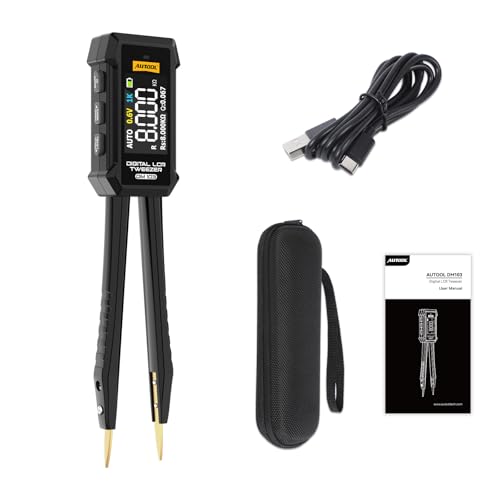
- Auto-identifies resistors, capacitors, and inductors
- Shows primary and secondary parameters including Q, D, Z, and X
- IPS display, precision probes, USB-C firmware upgrades, and three-year warranty
Best For: Detailed SMD repair and PCB diagnostics
Best High-Frequency Choice – FNIRSI LC1020E Precision LCR Meter
For shoppers comparing LCR meters under 100, the FNIRSI LC1020E stands out with 100 kHz testing, dual-parameter display, and component-sorting features. It is designed for more detailed bench testing than a basic handheld multimeter.
Best For: Electronics technicians and serious DIY users who need broad component ranges, ESR/Q/D readings, and screening tools.
Pros:
- Supports 100 Hz through 100 kHz test frequencies.
- Displays primary and secondary parameters such as ESR, Q, D, θ, and X.
- Offers open/short calibration, adjustable test voltage, and sorting mode.
- Includes four-terminal measurement fixtures and a rechargeable 3000mAh battery.
Cons:
- Requires calibration and proper component discharge before testing.
- Its advanced settings may be more than casual users need.
Choose the LC1020E if measurement flexibility and component screening matter more than keeping operation extremely simple. Its 19,999-count display and Kelvin-style connections make it a particularly capable option in this price category.
Best Multimeter Value – LCR600 LCR Meter Multimeter
If you want one of the more versatile LCR meters under 100, the LCR600 combines component testing with everyday multimeter functions. Its auto-ranging design is suited to quick troubleshooting around the workbench or home.
Best For: DIY electronics, home repair, and users who want LCR functions alongside voltage, current, and continuity testing.
Pros:
- Measures capacitance, inductance, resistance, voltage, current, frequency, and duty cycle.
- Provides 6000-count auto-ranging readings.
- Includes NCV detection, backlight, flashlight, data hold, and auto power-off.
- Comes with test leads and a temperature probe.
Cons:
- Its notes do not specify the individual capacitance or inductance ranges.
- It is positioned as an entry-level LCR tester rather than a dedicated precision bridge.
The LCR600 is a practical pick when you need broad electrical troubleshooting in addition to basic component measurements. It offers more general-purpose functionality than a dedicated LCR-only instrument.
Best for SMD Work – FNIRSI LCR-ST1 Tweezer Tester
Among LCR meters under 100, the FNIRSI LCR-ST1 is especially convenient for board-level work because its tweezer format lets you contact small SMD components directly. Automatic recognition and data export add useful convenience for repair tasks.
Best For: SMD repair, circuit-board fault finding, and testing loose or salvaged components.
Pros:
- Measures resistance, capacitance, inductance, and diodes.
- Supports 100 Hz, 1 kHz, and 10 kHz frequencies with two test voltages.
- Displays D, Z, Q, R, and ESR values with automatic component recognition.
- Stores test records and exports data to a PC via cable.
Cons:
- Its maximum test frequency is 10 kHz.
- The fixed screen does not flip or rotate.
- Tweezer operation is optimized for small components rather than general bench use.
The LCR-ST1 makes the most sense when compact SMD access is your priority. Its pointed and hook tweezer heads, carrying case, and lightweight design support quick component checks without separate test leads.
Best PC-Connected Option – Handheld 4080 LCR Meter
The 4080 is a strong contender among LCR meters under 100 for users who want multiple test frequencies and computer connectivity. Its 2.8-inch TFT display, recording mode, and correction functions support organized bench measurements.
Best For: Engineers, technicians, and advanced hobbyists who want PC control or data acquisition alongside component testing.
Pros:
- Offers six test frequencies from 100 Hz to 100 kHz.
- Lists 0.2% accuracy for component measurements.
- Supports PC remote control and data acquisition through Mini-USB.
- Includes recording mode, open/short correction, and a backlit TFT display.
Cons:
- Uses a Mini-USB connection rather than the newer USB-C standard.
- The supplied notes do not list detailed measurement ranges.
Pick the 4080 if frequency flexibility and computer-based workflows are important. Its dedicated controls and correction functions make it more suitable for structured testing than a basic component checker.
Best Compact LC Tester – LC200A Handheld LCR Meter
If you need an LCR meter under 100 for basic component testing, the LC200A focuses on inductance and capacitance measurements in a compact handheld format. Its correction functions and included test leads make it practical for bench work, repairs, and educational use.
Best For: Testing capacitors and inductors in labs, workshops, and electronics repair settings.
Pros:
- Measures capacitance from 1 pF to 100 mF and inductance from 1 uH to 100 H.
- Provides open-circuit capacitance correction and short-circuit inductance correction.
- Includes banana-to-alligator leads, a Kelvin alligator clip lead, USB cable, and power cable.
- Sturdy design with four measuring positions.
Cons:
- Focused on LCR testing rather than broader multimeter functions.
- The supplied notes do not specify automatic ranging or a built-in display type.
The LC200A is a straightforward choice when you want broad capacitance and inductance ranges, correction capability, and a useful set of accessories without moving beyond a dedicated component tester.
Best Budget Basic Meter – CAMWAY Digital LCR Tester
For shoppers comparing LCR meters under 100, the CAMWAY combines inductance, capacitance, and resistance testing with continuity and diode checks. Its LCD, data hold, zero adjustment, and wide stated measurement ranges suit general household and automotive troubleshooting.
Best For: Everyday electrical troubleshooting where basic LCR, continuity, and diode testing are useful.
Pros:
- Measures capacitance from 200 pF to 2000 uF, inductance from 200 uH to 20 H, and resistance from 200 ohms to 200 Mohms.
- Offers a 1999-count LCD with overrange display and a screen that can be flipped.
- Includes auto power-off, data hold, low-power indication, and capacitance zero adjustment.
- Comes with a manual, certificate, crocodile clips, and a 9V battery.
Cons:
- Its capacitance and inductance ranges do not extend as broadly as some dedicated LC testers.
- Accuracy varies by measurement type and is specified in the product notes.
- Designed for 9V battery operation rather than a rechargeable power system.
The CAMWAY is a practical general-purpose option for users who want LCR measurements alongside common diagnostic functions and convenient handheld features.
Best Feature-Rich Option – ZT-XC1 True RMS LCR Multimeter
If you want an LCR meter under 100 that also works as a full electrical tester, the ZT-XC1 adds True RMS multimeter functions, component testing terminals, and selectable test frequencies. It is suited to users who need more insight than basic L, C, and R readings.
Best For: Electronics work involving SMD parts, leaded components, ESR measurements, and everyday electrical troubleshooting.
Pros:
- Combines an LCR bridge with a 25,000-count True RMS digital multimeter.
- Supports 100 Hz, 1 kHz, and 10 kHz test frequencies plus 0.3 V or 0.6 V test levels.
- Displays secondary parameters such as ESR, dissipation factor, quality factor, and phase angle when supported.
- Offers gold-plated clip terminals, spring-loaded SMD terminals, waveform trend display, and a rechargeable 2000 mAh battery.
Cons:
- Its broader feature set may be more than needed for simple capacitance or inductance checks.
- The supplied notes do not provide specific LCR measurement ranges or accuracy figures.
- Charging is via USB-C, so a suitable charging source is needed.
The ZT-XC1 stands out for versatility: it supports leaded and SMD components, advanced secondary readings, and regular multimeter tasks in one rechargeable handheld instrument.
Best Value Bench Meter – Proster LCR Meter
For shoppers comparing lcr meters under 100, the Proster is a practical dedicated bench meter for routine inductance, capacitance, and resistance checks. Its rotatable LCD, manual ranges, and included accessories make it suited to component testing and troubleshooting.
Best For: Bench testing of through-hole components, coils, capacitors, and general electronics repairs.
Pros:
- Measures capacitance from 200pF to 2000µF and inductance from 200µH to 20H.
- Includes test leads, crocodile clips, a mini screwdriver, 9V battery, manual, and storage bag.
- Offers data hold, auto power-off, low-power indication, and zero adjustment for capacitance.
- Rotatable LCD can be adjusted for easier viewing.
Cons:
- Uses a 3 1/2-digit display rather than a color screen.
- Requires a 9V battery and weighs about 0.66 kg.
- Its listed resistance range is 200Ω to 100kΩ.
The Proster prioritizes broad basic LCR coverage and a complete out-of-box kit over pocket-sized portability. It is a sensible choice when you want a conventional meter for general component work.
Best Pocket Smart Meter – FNRSI LCR-ST1 Mini
Among lcr meters under 100, the FNRSI LCR-ST1 stands out for compact, automated testing. It identifies components automatically, supports three test frequencies, and uses replaceable tweezer heads for convenient SMD work.
Best For: Portable PCB repair, SMD component checks, and users who want automatic identification with displayed secondary parameters.
Pros:
- Measures resistance, capacitance, inductance, diodes, and continuity.
- Supports 100Hz, 1kHz, and 10kHz testing with 0.3V and 0.6V RMS levels.
- Wide stated ranges include 1pF–22mF capacitance, 1µH–10H inductance, and 10mΩ–10MΩ resistance.
- Compact 1.45-ounce design has a color screen, built-in battery, data hold, and automatic shutdown.
Cons:
- The small 1.4-inch display may be less suitable for users wanting a large readout.
- Its feature set is oriented toward component and SMD testing rather than general multimeter use.
- Only one included component is listed in the supplied specifications.
The LCR-ST1 is a strong fit when portability and automated component recognition matter more than a traditional handheld meter format. Its frequency selection and data-transfer function add flexibility for repeat testing.
Best Professional Tweezers – AUTOOL DM103 Digital LCR Tweezer
For buyers searching lcr meters under 100 for SMD-focused work, the AUTOOL DM103 combines tweezer-style probing with automatic component recognition. Its IPS display, selectable frequencies, and secondary readouts are useful for detailed PCB diagnostics.
Best For: SMD component measurement, electronics repair, PCB troubleshooting, and lab-style testing.
Pros:
- Automatically identifies resistors, capacitors, and inductors without manual mode selection.
- Offers 100Hz, 1kHz, and 10kHz frequencies with 0.3V and 0.6V RMS excitation levels.
- Displays R, C, and L alongside RS, D, Q, Z, and X values.
- Uses gold-plated precision probes, an HD IPS display, USB-C firmware upgrades, and includes a three-year warranty service.
Cons:
- Its tweezer design is specialized for small components rather than general-purpose lead testing.
- The supplied notes do not specify the full capacitance, inductance, or resistance ranges.
- At 165 g, it is less lightweight than the smallest pocket-style option listed here.
The DM103 is the most analysis-oriented option in this group, with multiple frequencies and secondary parameters for evaluating component behavior. Choose it when SMD access and richer on-screen information are priorities.
How We Picked the Best Lcr Meters Under 100
We focused on practical capability rather than headline specifications alone. Each model was evaluated for its core LCR functions, stated measurement ranges, available test frequencies, display readability, component-detection features, portability, and usefulness for common electronics work. We also included both dedicated LCR testers and combination meters so shoppers can choose between specialized component testing and broader electrical measurements.
Because accuracy and range can vary by setting, component type, test leads, and frequency, treat published specifications as a guide rather than a guarantee. For precision work, calibration, stable fixtures, and suitable test frequencies remain important.
Quick Comparison
| Best For | Features to Prioritize |
|---|---|
| General bench testing | Wide ranges, auto identification, multiple frequencies |
| SMD components | Tweezer probes, compact design, quick automatic readings |
| Capacitor diagnosis | ESR measurement, low-capacitance resolution, discharge protection |
| Broader electrical work | Voltage, resistance, continuity, and LCR functions |
| Portable troubleshooting | Rechargeable battery, clear display, durable handheld housing |
Key Buying Factors for LCR Meters Under $100
Measurement Range and Resolution
Check whether the meter covers the values you work with most often. Hobbyists may need everything from small-picofarad capacitors to large electrolytics, while coil testing may require useful microhenry-to-henry coverage. Count resolution can improve readability, but it does not automatically equal higher real-world accuracy.
Test Frequency and Accuracy
Multiple frequencies help reveal how components behave in different circuits. A 100 Hz or 120 Hz setting is useful for many power-supply capacitors, while 1 kHz and 10 kHz settings are common for general component testing. Models reaching 100 kHz can provide more flexibility for higher-frequency applications. Compare accuracy specifications alongside frequency options.
ESR, Q, D, and Automatic Identification
ESR is especially valuable when checking aging electrolytic capacitors. Q, dissipation factor, phase angle, and reactance can provide additional insight, but they are not essential for every user. Automatic component detection saves time; manual range or test-mode controls can be preferable when troubleshooting unusual parts.
Probe Style and Usability
Tweezer-style meters are convenient for tiny SMD parts, whereas standard leads work better with through-hole components and parts mounted on a board. Look for a readable display, straightforward controls, component-discharge warnings, and a stable connection method.
Who Should Buy Which Lcr Meters Under 100?
Choose a dedicated handheld LCR meter if you primarily test loose capacitors, inductors, and resistors at a workbench. Select an LCR tweezers model if your work centers on SMD components and fast measurements. A combination LCR multimeter is the better fit for users who also need voltage, continuity, and general electrical troubleshooting.
For repair technicians, prioritize ESR, multiple test frequencies, dependable leads, and a broad capacitance range. For hobbyists and students, automatic identification, a clear screen, and simple operation may matter more than advanced parameters. If you need repeatable precision for production or laboratory work, consider moving beyond this price category and verify calibration support before buying.