Moisture content affects food quality, shelf life, texture, weight, and regulatory consistency. The right moisture balance can make routine testing faster and more repeatable than conventional oven-drying methods.
This roundup compares 10 halogen moisture analyzers and balances across capacity, readability, temperature control, automation, and ease of use, so you can choose equipment that fits your sample volume and testing workflow.
Best 10 Moisture Balances for Food Samples Picks for 2026
Best All-Rounder
100 g Touchscreen Halogen Moisture Analyzer
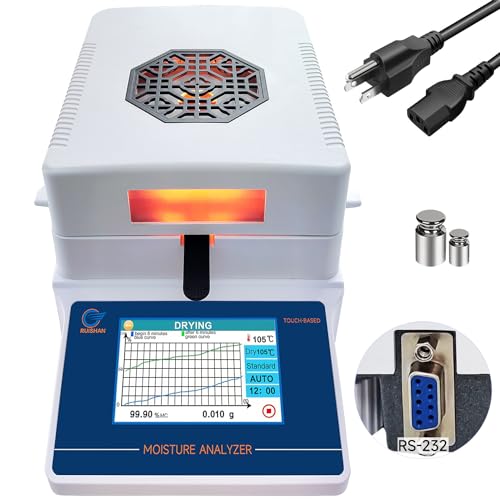
- 100 g capacity with 0.01% readability
- Three drying modes and 32 stored methods
- RS232 output plus included calibration accessories
Best For: Food testing and small laboratories needing flexible repeat measurements
Best Premium Option

- 120 g capacity with 1 mg graduation
- Displays curves, statistics, and multiple result types
- Metal-base construction with halogen heating
Best For: Industrial labs needing detailed on-screen moisture reporting
Best for Calibration Control

- 0.002 g readability for fine weighing
- Digital calibration and self-check function
- Four programs with 400 W halogen heating
Best For: Small-sample testing where resolution and calibration matter
Best Portable Choice

- Portable 110 g analyzer with 10 mg precision
- 40–160°C control and 1–99 minute heating
- Stores 20 results and includes 20 sample pans
Best For: Quick food and plant moisture checks in flexible workspaces
Fast Food Testing
Touchscreen Halogen Moisture Analyzer

- 0.002 g readability with included calibration weight
- Rapid halogen testing in minutes
- Stores up to 100 records; RS232 printer support
Best For: Coffee, nuts, grains, dried foods, and routine food quality control
Versatile Lab Control

- 110 g capacity with 1 mg readability
- 40–199°C range and three drying modes
- 15 method presets, 50 pans, and RS232 output
Best For: Labs and production teams running recurring food and material tests
Compact Multi-Material Testing
GS110 Halogen Moisture Balance
- 40–160°C control in 1°C increments
- 1–99 minute testing with rapid halogen heating
- Stores 20 results and includes 20 pans plus calibration weight
Best For: Food and mixed-material testing where compact, flexible operation matters
Flexible Touchscreen Testing
160°C Halogen Moisture Analyzer

- 110 g capacity with 0.005 g weight readability
- Stores 20 test profiles with flexible stopping modes
- Includes RS232 output and 50 sample pans
Best For: Routine food, grain, and laboratory testing
High-Capacity Data Tracking
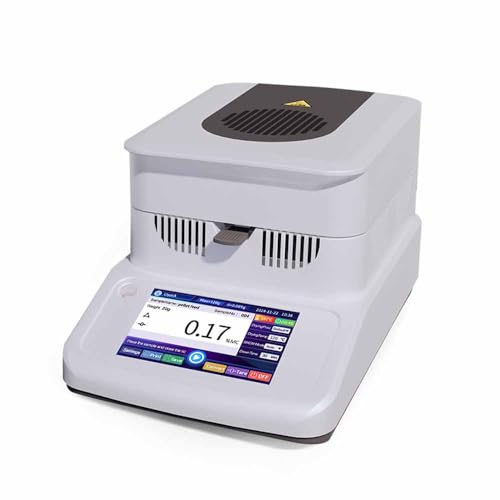
- 120 g capacity with 0.01% moisture readability
- Four drying modes and three ending modes
- Stores 100 data sets with RS232 printer support
Best For: Production and quality monitoring across food and agriculture
High-Temperature Drying
199°C Halogen Moisture Balance
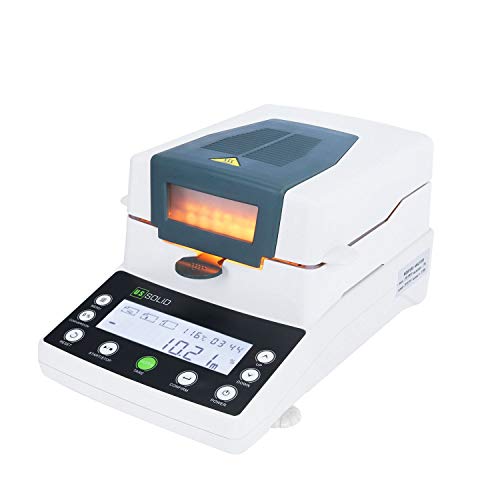
- 40–199°C range with 450 W halogen heating
- 110 g capacity and 5 mg weight readability
- Stores 15 methods and includes 50 sample pans
Best For: High-temperature food, grain, chemical, and lab testing
Best All-Rounder – 100 g Touchscreen Halogen Moisture Analyzer
For buyers comparing moisture balances for food samples, this analyzer combines a 100 g capacity with 0.01% readability, rapid halogen heating, and straightforward touchscreen controls. Its adjustable 50–180°C range, multiple drying modes, and stored methods make it practical for repeat testing across food and other materials.
Best For: Food testing and small laboratories that want flexible drying programs, quick results, and basic data connectivity.
Pros:
- 5-inch touchscreen with automatic or timed operation and standard, fast, or soft drying modes
- Stores up to 32 research methods and supports RS232 output to a printer or computer
- Halogen heating, a high-accuracy sensor, and 0.01% readability support rapid measurements
- Includes calibration weights, a pan holder, remover, and 10 disposable aluminum pans
Cons:
- The 100 g maximum capacity may not suit larger sample batches
- Its 3.3 kg body is less convenient for frequent portable use
With broad temperature control and useful preset storage, this is a versatile option for routine food moisture testing. The included accessories also reduce the need for immediate add-on purchases.
Best Premium Option – Ohaus MB120 Moisture Analyzer
The Ohaus MB120 is a higher-capacity choice among moisture balances for food samples, offering 120 g capacity and 1 mg graduation with 0.01% readability. Its touchscreen reports moisture, solids, regain, time, temperature, weight, drying curves, and statistics for more detailed testing records.
Best For: Industrial users who need comprehensive on-screen results and a sturdy, established laboratory-style instrument.
Pros:
- 120 g maximum capacity with 1 mg graduation and 0.01% readability
- 4.3-inch QVGA TFT color touchscreen displays results and drying-curve information
- Reports moisture, solids, regain, temperature, time, weight, method name, and statistics
- Metal base, ABS top housing, halogen heat source, and stainless steel pan components
Cons:
- The listed specifications focus on industrial use rather than portable food testing
- At 12 pounds, it is relatively heavy to move between work areas
This model stands out when reporting depth and construction matter more than compactness. It is a strong fit for established workflows that benefit from multiple displayed measurements and statistics.
Best for Calibration Control – A&D 51 g Moisture Balance
A&D Engineering Moisture Balance, 51g Capacity, 0.002g Readability, 10 sets of Program
Check Price On AmazonFor targeted moisture balances for food samples, this A&D model offers a 51 g maximum sample weight and fine 0.002 g readability. Its digital calibration, self-check function, halogen heating system, and programmable measurement options support repeatable routine testing.
Best For: Users who prioritize fine readability, calibration features, and a compact set of programmed measurement options.
Pros:
- 0.002 g readability for detailed sample weighing
- Full digital calibration with a self-check function
- 400 W straight halogen lamp heating system with SRA filter and SHS weighing technology
- Supports four measurement programs and up to 51 g sample weight
Cons:
- The 51 g capacity is lower than the other listed analyzers
- The supplied notes do not specify touchscreen controls or data-output connectivity
This is a focused choice for smaller samples where weighing resolution and calibration convenience are priorities. Its lower capacity makes it better suited to controlled, modest-size testing than larger batch work.
Best Portable Choice – GS110 Halogen Moisture Meter
This portable analyzer is a practical pick among moisture balances for food samples when quick setup and transport matter. It uses halogen heating and real-time weight monitoring, with adjustable 40–160°C temperature and 1–99 minute heating settings for automated testing.
Best For: Food, plant, grain, and general laboratory users needing compact, fast moisture checks with basic result storage and printing.
Pros:
- Portable design with 110 g capacity and 10 mg precision
- Temperature adjusts from 40–160°C in 1°C increments, with 1–99 minute heating times
- Stores up to 20 historical data sets and includes a printer interface
- Package includes 20 aluminum pans, a calibration weight, wind cover, and pan accessories
Cons:
- Its 10 mg precision is less fine than the A&D model’s 0.002 g readability
- The supplied details do not identify the exact touchscreen display size
Its compact format, broad sample compatibility, and included consumables make it convenient for quick testing away from a fixed bench. Choose it when portability and simple data handling outweigh ultra-fine readability.
Fast Food Testing – Touchscreen Halogen Moisture Analyzer
For moisture balances for food samples when quick results and simple operation matter, this halogen analyzer combines rapid heating with 0.002 g readability. Its touchscreen controls, included calibration weight, and broad sample compatibility make it practical for food-processing and quality-control workflows.
Best For: Coffee, nuts, grains, dried foods, and other food-production samples requiring fast, repeatable moisture checks.
Pros:
- Delivers moisture readings in minutes using halogen heating.
- Provides 0.002 g readability with a calibration weight included.
- Offers a responsive 5-inch touchscreen and storage for up to 100 test records.
- Supports RS232 printer connection and includes sample pans.
Cons:
- The supplied notes do not specify a moisture-percentage accuracy rating.
- Its 120 g capacity may not suit larger batch samples.
This is a strong choice for users who prioritize fast testing, accessible controls, and extensive record storage. Confirm that its capacity and documentation features match your required testing protocol.
Versatile Lab Control – U.S. Solid Moisture Analyzer
Among moisture balances for food samples, this U.S. Solid model stands out for its 110 g capacity, 1 mg readability, and flexible drying controls. Its 40–199°C range, saved methods, and multiple result displays support repeatable testing across food and industrial materials.
Best For: Laboratories and production teams testing food, grains, plastics, textiles, and chemical samples with recurring procedures.
Pros:
- Measures up to 110 g with 1 mg readability and 0.01% moisture readout.
- Uses 450 W halogen heating with standard, fast, and soft drying modes.
- Stores up to 15 methods and offers automatic, manual, or timed endpoints.
- Includes 50 sample pans and RS232 data export.
Cons:
- Method storage is limited to 15 presets.
- The 199°C maximum may require careful parameter selection for delicate food samples.
With its broad temperature range and method-management features, this model is well suited to repeatable lab workflows. The included pans also reduce the need for immediate accessory purchases.
Compact Multi-Material Testing – GS110 Halogen Moisture Balance
For moisture balances for food samples that also need to handle plants, chemicals, and building materials, the GS110 uses real-time weight monitoring and rapid halogen heating. Adjustable temperatures from 40–160°C and test durations from 1–99 minutes provide practical control over different sample types.
Best For: Food, grains, plants, chemicals, soil, wood, paper, textiles, and building-material testing in compact lab or production settings.
Pros:
- Completes moisture measurements in minutes through rapid halogen heating.
- Offers 40–160°C adjustment in 1°C increments and 1–99 minute timing.
- Stores up to 20 historical results and supports printer output.
- Includes 20 aluminum pans, a 100 g calibration weight, wind cover, and accessories.
Cons:
- The listed temperature range is narrower than models reaching 199°C.
- The notes do not state a moisture-percentage readability or accuracy specification.
This balance is appealing when sample variety, straightforward controls, and compact storage are more important than an exceptionally wide temperature range. Its included calibration weight and pans help support an out-of-box testing setup.
Flexible Touchscreen Testing – 160°C Halogen Moisture Analyzer
For routine moisture balances for food samples, this analyzer combines a 110 g capacity with 0.005 g weight readability and 0.05% moisture readability. Its 160°C halogen heater, preheat function, saved test profiles, and multiple stopping modes make it practical for repeatable food, grain, and laboratory testing.
Best For: Labs and quality-control teams testing food, grain, and other materials that benefit from touchscreen controls and repeatable saved methods.
Pros:
- 160°C, 250 W halogen heating with standard, fast, and soft drying modes.
- 110 g capacity with 0.005 g weight readability and 0.05% moisture readability.
- Stores up to 20 test profiles and supports automatic, timed, or manual stopping.
- Includes RS232 output, external-weight calibration, and 50 sample pans.
Cons:
- Operates on 110 V AC, 60 Hz, which may limit use in other electrical environments.
- Calibration requires a separate 100 g external weight.
This is a well-rounded option when touchscreen operation, method storage, and fine displayed resolution matter more than maximum heating temperature. The included pans and RS232 connection also support regular lab workflows.
High-Capacity Data Tracking – Automatic Halogen Lab Balance
This automatic analyzer is a practical choice for moisture balances for food samples when you want a 120 g capacity, touchscreen operation, and multiple drying options. It displays moisture, solid content, dry weight, sample temperature, and time while storing up to 100 data sets.
Best For: Food, agriculture, chemical, and production-quality monitoring where higher data storage and direct parameter display are useful.
Pros:
- 120 g capacity with stated 0.01% moisture readability and 1 mg accuracy configuration.
- Offers standard, fast, slow, and soft drying modes.
- Supports automatic, timed, and manual ending modes.
- Stores up to 100 data sets and connects to a printer through RS232.
Cons:
- The supplied notes do not specify the analyzer’s maximum heating temperature.
- Its stated repeatability error is 0.6%, which may not suit every precision application.
Choose this model if capacity and record storage are priorities. Its broad drying and stopping controls provide useful flexibility, while the touchscreen and RS232 port help integrate testing into a routine workflow.
High-Temperature Drying – 199°C Halogen Moisture Balance
For moisture balances for food samples that need higher-temperature drying, this model reaches up to 199°C and uses a 450 W halogen lamp. It combines 110 g capacity with 5 mg weight readability, three drying modes, stored methods, and result displays for moisture percentage or dry weight.
Best For: Food, grain, chemical, pharmaceutical, and laboratory users who need adjustable high-temperature drying and straightforward method reuse.
Pros:
- Adjustable 40–199°C drying range with powerful 450 W halogen heating.
- 110 g capacity and 5 mg weight readability with 0.1% moisture readability.
- Stores up to 15 preset method groups and offers standard, fast, and soft drying.
- Includes RS232 connectivity, manual calibration, and 50 sample pans.
Cons:
- Moisture readability is 0.1%, less fine than the first model’s stated 0.05%.
- Stores up to 15 methods, fewer than some comparable touchscreen analyzers.
This analyzer is the stronger fit when temperature range and faster 450 W heating are central to the testing process. Its simpler LCD interface and 15 method groups still cover repeat testing without adding unnecessary complexity.
How We Picked the Best Moisture Balances for Food Samples
We compared the listed analyzers by the specifications that matter most in food laboratories, production areas, quality-control stations, and field testing. Key considerations included weighing capacity, readability, drying-temperature range, heating method, programmable test settings, display and controls, sample-pan design, and included accessories.
We also considered practical differences between compact portable meters and larger touchscreen instruments. A high capacity is useful for irregular or low-density samples, while finer readability can help when small changes in moisture content matter. Because performance depends on sample preparation and method validation, specifications should be treated as a starting point rather than a guarantee of results for every food type.
Quick Comparison
- For general laboratory work: Choose a 110g- or 120g-capacity halogen analyzer with 1mg readability and adjustable temperature control.
- For finer measurements: Look for models offering 0.002g or 0.005g readability, particularly when testing small or relatively uniform samples.
- For repeatable workflows: Programmable methods, automatic shutoff, and touchscreen controls can reduce setup time and operator variation.
- For field or occasional testing: A portable unit with straightforward controls may be more practical than a feature-heavy laboratory balance.
- For high-throughput testing: Multiple sample dishes, saved methods, and rapid halogen heating can simplify repeated measurements.
Key Buying Factors for Moisture Balances for Food Samples
Capacity and Readability
Match capacity to the amount and density of your typical samples. A 110g or 120g capacity covers many food applications, while a smaller 51g unit may be suitable for controlled, small-batch testing. Readability expressed in grams or percentage indicates how finely the instrument displays changes; it does not by itself establish accuracy.
Temperature Range and Drying Control
Food samples can respond very differently to heat. Adjustable ranges such as 40–160°C or 40–199°C provide flexibility for grains, powders, baked goods, and other materials. Use a validated method that avoids scorching, splattering, or losing volatile compounds too quickly.
Methods, Automation, and Usability
Saved programs are valuable when several products require different temperatures, drying times, or endpoint criteria. Touchscreens can make setup easier, while automatic testing and shutoff help standardize routine work. Check whether the interface records final moisture values and whether results can be transferred to your existing documentation system.
Sample Handling and Operating Environment
Consider pan diameter, replacement dishes, ventilation, cleaning access, and available bench space. Disposable or reusable pans can affect operating cost. For production areas, also assess portability, power requirements, and resistance to dust or frequent handling.
Who Should Buy Which Moisture Balances for Food Samples?
Small laboratories and quality-control teams should prioritize repeatability, programmable methods, and clear result displays. A touchscreen model with multiple stored procedures may justify its cost when several operators share the instrument.
Food producers testing a broad range of samples should look for adjustable temperature control, at least 110g of capacity, and a readable display that supports quick pass/fail decisions. Models with included dishes can reduce initial setup costs.
Researchers and users measuring small samples may benefit from finer gram readability and a lower-capacity balance, provided the sample size fits the pan and the method has been validated.
Mobile inspectors or occasional users should favor a compact, uncomplicated halogen moisture meter. Before buying, confirm that its heating range, power arrangement, and precision meet the requirements of the samples being tested.