Choosing the right moisture balance can make grain testing faster, more consistent, and easier to document. The products in this roundup range from portable grain meters to laboratory-grade halogen analyzers.
Use the guide below to compare accuracy, capacity, drying controls, usability, and data features before selecting a tester for your operation.
Best 10 Moisture Balances for Grains Picks for 2026
Fast Testing Pick
Portable Halogen Moisture Meter

- 40°C–160°C adjustable heating
- Stores 20 test records
- Includes pans and calibration weight
Best For: Flexible grain and material testing
Dedicated Grain Pick
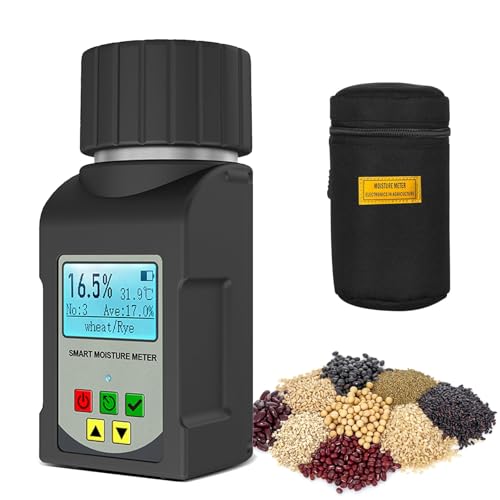
- Tests 25 grain types
- Automatic temperature compensation
- Backlit display with voice broadcast
Best For: Portable farm and field measurements
Precision Lab Pick
- 1 mg accuracy with 110 g capacity
- 40°C–160°C programmable heating
- Stores and prints test results
Best For: Precision laboratory grain analysis
Established Laboratory Pick

- 51 g capacity with 0.001 g readability
- Four selectable heating modes
- Five measurement programs and self-checks
Best For: Controlled laboratory moisture testing
Best Value Moisture Balance
Touchscreen Halogen Grain Analyzer
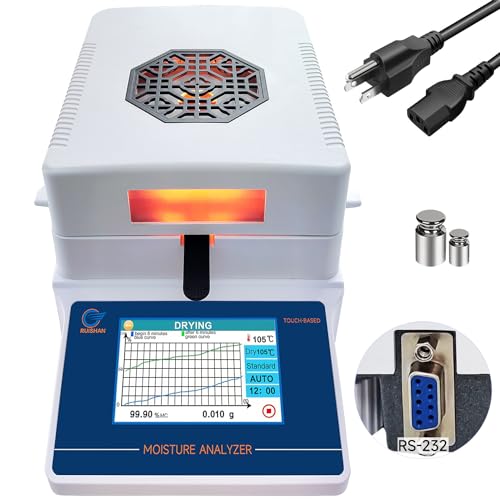
- 100 g capacity with 0.01% readability
- Three drying modes and two endpoint modes
- Stores 32 methods and supports RS232 output
Best For: Flexible grain, food, wood, and laboratory moisture testing
Best for Precision Readings
120 g Halogen Moisture Analyzer

- 0.002 g stated weighing precision
- 120 g sample capacity
- Stores 100 records with RS232 support
Best For: Precision-focused grain, food, and agricultural testing
Best High-Capacity Option
120 g 180°C Grain Moisture Analyzer
- 120 g capacity with 0–100% moisture range
- 50–180°C heating and three drying modes
- 32 method presets plus RS232 connectivity
Best For: Versatile, repeatable testing of grains and other materials
Best with Extra Features
1201MA Halogen Moisture Analyzer

- Rapid halogen drying for moisture testing
- Manual or timed drying modes
- RS232 output with selectable accuracy
Best For: Food, feed, plastics, and research laboratories
Versatile Grain Tester
U.S. Solid USS-HMA01 Moisture Analyzer
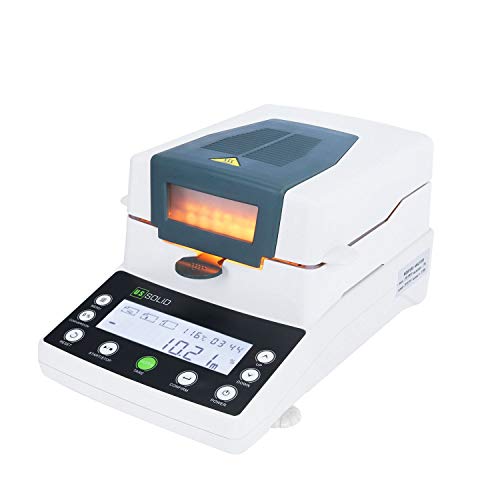
- 110 g capacity with 0.1% moisture readability
- Three drying modes up to 199°C
- 15 stored methods and 50 sample pans
Best For: Routine grain and multi-material laboratory testing
Touchscreen Method Manager
U.S. Solid 160°C Moisture Analyzer

- 5-inch color touchscreen with 20 methods
- 110 g capacity and 0.05% moisture readability
- Preheat, three drying modes, and RS232 output
Best For: Organized recurring grain and laboratory testing
Fast Testing Pick – Portable Halogen Moisture Meter
For buyers comparing moisture balances for grains and other materials, this portable halogen analyzer emphasizes quick, automated testing. It uses adjustable heating from 40°C to 160°C, monitors weight changes during drying, and reports moisture results in minutes.
Best For: Users who need flexible moisture testing for grains, food, plants, soil, wood, chemicals, and other laboratory or production samples.
Pros:
- Adjustable temperature in 1°C increments and test duration from 1 to 99 minutes.
- Stores up to 20 historical data sets and includes a printer interface.
- Includes 20 aluminum weighing pans, a calibration weight, wind cover, and tray accessories.
Cons:
- Its broad material compatibility may be more functionality than grain-only users need.
- The supplied readout accuracy is 0.01 g or 10 mg, rather than the 1 mg specification of the comparable GS110C model.
This is a practical choice when speed, sample flexibility, and basic result documentation matter more than a dedicated grain-only design.
Dedicated Grain Pick – 25-Grain Moisture Tester
If your search for moisture balances for grains centers on field-friendly grain measurements, this battery-powered tester is purpose-built for the job. It supports 25 grain types, provides moisture and temperature information, and uses automatic temperature compensation for more consistent readings.
Best For: Farmers, ranchers, and researchers checking common grains and seeds indoors or outdoors.
Pros:
- Supports 25 grains, including wheat, corn, coffee, soybeans, lentils, and rye grass.
- Claims measurement accuracy of ±0.5% and includes automatic temperature compensation.
- Backlit display and voice broadcast make readings easier to access in varied lighting.
Cons:
- It is designed for listed grains rather than general laboratory materials.
- The supplied notes do not specify a data-storage or printer function.
Choose this model for straightforward, portable grain checks where a dedicated crop menu and battery operation are more useful than heated drying analysis.
Precision Lab Pick – Halogen Moisture Balance
For more demanding moisture balances for grains, this countertop halogen moisture balance combines rapid heating with 1 mg weighing precision. It automatically tracks weight loss as samples dry, with programmable temperatures and test times for repeatable laboratory workflows.
Best For: Laboratories and production settings testing grains alongside food, plants, chemicals, and building materials.
Pros:
- Offers 110 g capacity with 1 mg accuracy according to the product title.
- Provides 40°C–160°C heating and 1–99 minute programmable drying.
- Stores up to 20 results and supports printed output through its printer interface.
Cons:
- As a countertop heated analyzer, it is less field-portable than a battery-powered grain tester.
- The drying workflow may be unnecessary for users who only need quick grain screening.
This is the stronger fit when measurement precision, automated drying, and record handling are central to your grain-testing process.
Established Laboratory Pick – A&D MX-50 Moisture Balance
The A&D MX-50 is a laboratory-focused option for buyers comparing moisture balances for grains and requiring fine weighing resolution. Its 51 g capacity and 0.001 g readability are paired with selectable heating modes, measurement programs, and self-check functions.
Best For: Laboratory users who value controlled heating, clear instrument feedback, and a compact 51 g sample capacity.
Pros:
- Provides 0.001 g readability with a 51 g maximum capacity.
- Four selectable heating modes allow greater temperature-control flexibility.
- Includes five measurement programs, a progress window, and self-check functions.
Cons:
- Its 51 g capacity is lower than the 110 g capacity of the GS110 models.
- The supplied notes do not identify grain-specific presets or data storage.
- It is listed as a 115 V model, which may require power compatibility checking.
The MX-50 suits controlled laboratory work where fine readability and established measurement features outweigh grain-specific portability or higher capacity.
Best Value Moisture Balance – Touchscreen Halogen Grain Analyzer
For routine moisture balances for grains, this analyzer combines a 100 g capacity with 0.01% readability, halogen heating, and a touchscreen interface. Its automatic or timed operation and three drying modes make it practical for grain, food, wood, soil, and other sample testing.
Best For: Farms, food processors, and small laboratories needing flexible grain and general-purpose moisture testing.
Pros:
- Offers standard, fast, and soft drying modes plus automatic and timed endpoints.
- Stores up to 32 research methods for repeat testing.
- Supports RS232 connection to a printer or computer.
- Includes sample pans, calibration weights, a pan holder, and a sample remover.
Cons:
- Its 100 g maximum capacity may limit larger sample batches.
- Readability is 0.01%, rather than the finer resolution offered by some alternatives.
This is a well-rounded option when straightforward controls, method storage, and included accessories matter more than maximum capacity or ultra-fine resolution.
Best for Precision Readings – 120 g Halogen Moisture Analyzer
When comparing moisture balances for grains, this 120 g halogen analyzer stands out for its stated 0.002 g weighing precision and quick testing workflow. The touchscreen lets users set temperature and time, while record storage and RS232 support help with documentation.
Best For: Grain, coffee, nut, food, agricultural, and laboratory users who prioritize fine weighing precision and repeatable records.
Pros:
- Provides 0.002 g precision after calibration with the included weight.
- Handles samples up to 120 g.
- Stores up to 100 test records and supports RS232 printer connection.
- Includes calibration weight and sample pans for startup.
Cons:
- The supplied details do not specify the available drying modes or temperature range.
- Its listed package dimensions suggest it may require more bench space than a compact balance.
This model is appealing for users who need more record storage and finer stated weighing precision, provided its unspecified heating settings fit the intended grain-testing workflow.
Best High-Capacity Option – 120 g 180°C Grain Moisture Analyzer
For moisture balances for grains that need a larger sample capacity and configurable heating, this 120 g analyzer uses halogen heating up to 180°C. Its touchscreen, three drying modes, method presets, and RS232 connectivity support both quick checks and repeatable laboratory workflows.
Best For: Grain, food, plant, soil, wood, and multi-material testing where 120 g capacity and flexible drying control are useful.
Pros:
- Accepts samples up to 120 g and measures moisture across a stated 0–100% range.
- Offers standard, fast, and soft drying modes with automatic or timed endpoints.
- Supports temperatures from 50–180°C and heating times from 2–100 minutes.
- Stores up to 32 research methods and connects to a printer or computer through RS232.
Cons:
- The stated readability is 0.01%, which may not suit applications needing finer displayed moisture increments.
- At 3.3 kg, it is not the lightest option for frequent relocation.
This is a strong fit for buyers wanting high capacity without giving up drying presets or method storage. Its broad material compatibility also makes it useful beyond grain testing.
Best with Extra Features – 1201MA Halogen Moisture Analyzer
For labs comparing moisture balances for grains and other materials, the 1201MA combines halogen thermogravimetric drying with selectable manual or timed operation. Its RS232 connection also supports straightforward result transfer to a computer or printer.
Best For: Research labs, universities, and quality-control testing across food, feed, plastics, and related materials.
Pros:
- Halogen heating enables rapid sample drying and moisture detection.
- Offers manual and timed drying modes for different procedures.
- Backlit LCD interface and RS232 data connectivity simplify operation and reporting.
- Supports selectable 0.001, 0.002, and 0.005 g accuracy options.
Cons:
- The supplied notes do not specify sample capacity or drying-temperature range.
- Its lab-focused design may be more equipment than occasional users need.
The 1201MA is a practical choice when repeatable moisture testing and data transfer matter more than portability. Confirm the desired accuracy configuration before purchasing.
Versatile Grain Tester – U.S. Solid USS-HMA01 Moisture Analyzer
The U.S. Solid USS-HMA01 is a well-equipped option among moisture balances for grains, offering 110 g capacity, 0.1% moisture readability, and drying temperatures up to 199°C. Its stored methods and included sample pans suit recurring testing workflows.
Best For: Food, grain, chemical, plastic, textile, and laboratory testing where repeatable methods are useful.
Pros:
- Measures samples up to 110 g with 5 mg weight readability.
- 450 W halogen heating and three drying modes support varied materials.
- Stores up to 15 preset method groups for repeated tests.
- Includes 50 sample pans and RS232 output for PC or printer transfer.
Cons:
- Calibration is manual and requires a 100 g weight.
- The unit operates on 110 V, 60 Hz AC, which may limit use in other regions.
With its broad temperature range, method storage, and generous pan supply, this model is suited to routine bench testing. It is especially useful when operators need moisture, dry-weight, or dry-weight-percentage results.
Touchscreen Method Manager – U.S. Solid 160°C Moisture Analyzer
For users seeking moisture balances for grains with a more guided interface, this U.S. Solid analyzer pairs a 5-inch color touchscreen with 20 saved test methods. It provides 0.05% moisture readability, 110 g capacity, and drying control up to 160°C.
Best For: Laboratories and quality-control teams running recurring food, grain, plastic, textile, or chemical tests.
Pros:
- Color touchscreen makes test setup and result review more direct.
- Stores up to 20 test profiles for routine sample workflows.
- Supports standard, fast, soft, automatic, timed, and manual drying options.
- Includes preheat, RS232 output, external calibration, and 50 sample pans.
Cons:
- Its maximum drying temperature is 160°C, lower than some comparable analyzers.
- Calibration requires a separate 100 g external weight.
This model stands out for method organization and touchscreen operation rather than maximum temperature. It is a strong fit for teams that repeat documented procedures and want multiple result formats.
How We Picked the Best Moisture Balances for Grains
We focused on the features that most affect practical grain testing: measurement accuracy, sample capacity, heating range, drying speed, readability, operating controls, and repeatability. The selection includes dedicated grain moisture meters for quick field checks as well as halogen moisture balances designed for more controlled laboratory or quality-assurance work.
We also considered useful workflow features such as preset drying programs, touchscreens, multiple test methods, temperature displays, removable sample pans, and RS232 connectivity. Because grain types and testing environments vary, no single model is ideal for every buyer.
Quick Comparison
- Best for field screening: Portable grain moisture testers with built-in readings for common grains such as wheat and corn.
- Best for higher precision: Halogen analyzers offering 0.001g or 0.002g balance resolution and controlled drying.
- Best for routine lab testing: Models with programmable methods, repeatable heating profiles, and clear digital displays.
- Best for data workflows: Analyzers with RS232 or other compatible output connections.
- Best for larger samples: Units with approximately 110g to 120g capacity, which provide flexibility for different materials.
Key Buying Factors for Moisture Balances for Grains
Testing Method and Grain Compatibility
A handheld grain meter is convenient when you need rapid checks at receiving areas, storage facilities, or in the field. A halogen moisture balance weighs and heats a prepared sample, making it better suited to controlled comparisons, product development, and documented quality testing. Check whether the instrument supports your grain types and whether sample preparation requirements are acceptable for your process.
Accuracy, Readability, and Repeatability
Do not confuse display readability with overall moisture accuracy. A balance may show very fine weight increments, but results also depend on sample uniformity, calibration, temperature control, and the selected drying program. For production decisions, prioritize repeatable results and a method that can be standardized across operators.
Capacity and Drying Performance
Higher capacity is useful for representative samples, while a smaller controlled sample may deliver faster tests. Compare the heating range, drying modes, endpoint settings, and expected test time. Preset or programmable methods can reduce operator variation when testing multiple grain types.
Controls, Records, and Maintenance
A color touchscreen can simplify setup, but physical controls may be preferable in dusty or busy environments. Look for removable pans, readily available replacement dishes, calibration support, and clear instructions. If results must be transferred to a computer or laboratory system, confirm that the communication port and software workflow are compatible.
Who Should Buy Which Moisture Balances for Grains?
Farmers and grain handlers should generally start with a portable meter if the main need is quick go/no-go screening during harvest, storage, or delivery. Choose a model that explicitly lists the crops you test and provides a simple temperature or moisture display.
Food processors, feed producers, and quality teams will usually benefit from a halogen analyzer with programmable drying methods, stable temperature control, and at least 0.001g to 0.005g readability. These features support more consistent internal testing.
Research, inspection, and analytical laboratories should prioritize repeatability, calibration options, data connectivity, and documented methods over the lowest purchase price. A model with RS232 output, multiple drying profiles, and fine resolution may justify its higher cost when results must be traceable.
Before buying, confirm the instrument’s voltage, sample-pan size, included accessories, warranty, and service availability. Most importantly, select a testing method your team can apply consistently; dependable procedures matter as much as the balance’s headline specifications.