Workshop dust can affect respiratory comfort, finishing quality, equipment, and overall workspace conditions. The right particle counter helps you measure what routine visual checks cannot.
This roundup compares 10 handheld and portable monitors by particle-size coverage, measurement features, usability, and practical value for workshop environments.
Best 10 Particle Counters for Workshops Picks for 2026
Professional Cleanroom Pick

- Six particle channels from 0.3 to 10 micrometers
- Stores up to 5,000 measurement records
- Includes calibration certificate and carry case
Best For: Portable workshop and cleanroom documentation
Connected Monitoring Choice
UNI-T UT337B Laser Particle Counter

- Six-channel real-time particle measurement
- WiFi and Type-C data connectivity
- Stores up to 10,000 measurement records
Best For: Connected workshop and compliance monitoring
Fixed-Point Value Option
WapoRich T7-TC8200 Air Quality Counter
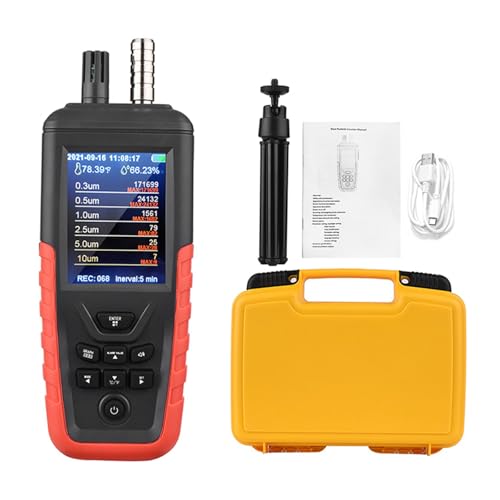
- Six particle channels plus PM2.5 and PM10
- Includes tripod for hands-free monitoring
- 999 records with PDF export via USB
Best For: Stationary workshop checks and contamination detection
Multi-Gas Inspection Pick
CEM DT-9883M Air Quality Counter

- Six particle channels from 0.3 to 10 micrometers
- Also monitors PM2.5/PM10, HCHO, TVOC, and CO2
- Stores 5,000 records and 20 minutes of video
Best For: Workshops needing particle and broader air-quality checks
Best Overall Workshop Monitor
Temtop Handheld Particle Counter

- Counts multiple particle sizes plus PM2.5, PM10, and TSP
- Logs readings to 32GB storage and exports by USB
- Adds temperature and humidity monitoring
Best For: Workshops needing comprehensive monitoring and long-term data logging
Best Compact Inspection Pick
RuchundeBu TC-8100 Particle Counter

- Detects 0.3 µm and 2.5 µm particles
- Stores up to 999 records with trend curves
- Lightweight design with color backlit display
Best For: Portable workshop spot checks and basic environmental inspection
Best for Fixed-Point Monitoring
3-Channel Laser Particle Counter
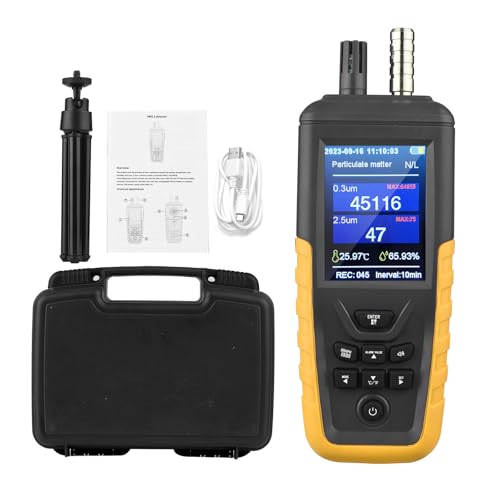
- Includes tripod for hands-free continuous monitoring
- Measures 0.3 µm, 2.5 µm, and 10 µm particles
- Runs for 9+ hours and exports records as PDF
Best For: Fixed-location workshop monitoring and extended measurement sessions
Precision Workshop Monitoring
PerfectPrime AQ9600 Particle Counter

- Measures 0.3, 2.5, and 10.0 µm particles
- Offers custom or continuous sampling
- Includes FED209E and ISO14464-1 alarm levels
Best For: Flexible multi-size particle monitoring
Indoor Air Logging Choice
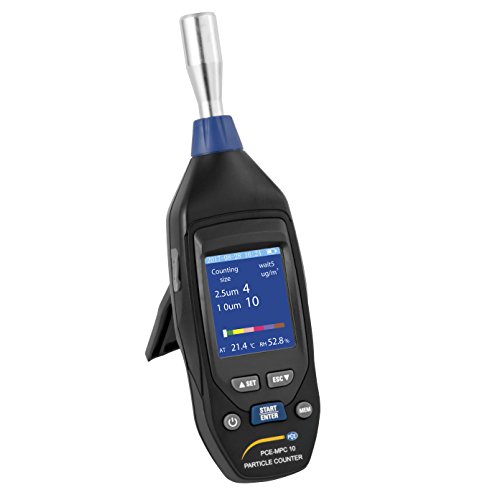
- Measures PM2.5 and PM10
- Logs up to 5,000 data records
- Adds temperature and humidity readings
Best For: Logged indoor air-quality checks
Six-Channel Workshop Coverage
GOYOJO Six-Channel Particle Monitor

- Lists six particle-size channels
- Runs on battery power
- Provides an audible alarm
Best For: Portable multi-channel workshop checks
Professional Cleanroom Pick – CEM DT-9880 Particle Counter
For workshops that need detailed airborne-particle readings, the CEM DT-9880 is a feature-rich option among particle counters for workshops. It simultaneously measures six listed particle sizes from 0.3 to 10 micrometers and records environmental conditions for on-site documentation.
Best For: Workshops, laboratories, cleanrooms, and facilities that need portable particle measurements with photo and record storage.
Pros:
- Measures particles across six size channels from 0.3 to 10 micrometers.
- Stores up to 5,000 records, including counts, temperature, humidity, and sample volume.
- Includes a calibration certificate, carry case, Parker filter tube, and USB connectivity.
Cons:
- The supplied notes list six particle sizes, although the product title describes seven.
- Its 2.8-inch display is smaller than some newer handheld meters.
The DT-9880 is a practical choice when documentation matters as much as live readings. Its built-in camera, video storage, and generous memory support inspection work, while the included accessories make it ready for field use.
Connected Monitoring Choice – UNI-T UT337B Laser Particle Counter
The UNI-T UT337B suits workshops that want real-time particle distribution data with modern connectivity. It measures six particle sizes simultaneously, adds temperature, humidity, and dew-point readings, and supports both WiFi monitoring and Type-C data transfer.
Best For: Professional workshops and controlled environments needing wireless monitoring, compliance-oriented readings, and large data capacity.
Pros:
- Six-channel synchronous measurement covers 0.3 to 10.0 micrometer particles.
- 2.83 L/min sampling, a 3.5-inch color display, and 10,000-record storage support efficient inspections.
- Includes WiFi, Type-C USB, environmental sensors, and a camera for linked context photos.
Cons:
- The supplied notes do not specify battery runtime.
- Its larger 11.42-inch listed length may be less convenient in tight work areas.
With ISO 21501-4:2018 compliance listed and both cumulative and differential counting modes, the UT337B is oriented toward more structured air-quality assessments. Its connectivity is especially useful when readings need to be transferred or monitored beyond the instrument.
Fixed-Point Value Option – WapoRich T7-TC8200 Air Quality Counter
The WapoRich T7-TC8200 is a flexible option for particle counters for workshops, especially when a team wants alarms, trend viewing, and hands-free monitoring. It measures six particle channels, reports PM2.5 and PM10 mass concentration, and includes a tripod for fixed-point checks.
Best For: Workshops performing recurring contamination checks, filter testing, or stationary air-quality monitoring.
Pros:
- Measures six particle sizes from 0.3 to 10 micrometers and PM2.5/PM10 concentration.
- Stores 999 records and exports historical data to a PC as PDF via USB.
- Includes customizable alarms, a pollution indicator, tripod, and a claimed 9-plus-hour battery life.
Cons:
- Its 999-record capacity is lower than the storage offered by the CEM and UNI-T models here.
- The supplied notes do not identify the manufacturer’s calibration certificate.
This meter stands out for practical monitoring features rather than maximum data capacity. The tripod, alarm thresholds, color pollution indicator, and power-saving controls make it well suited to repeated checks at a workstation or inspection point.
Multi-Gas Inspection Pick – CEM DT-9883M Air Quality Counter
For workshops concerned with more than airborne dust, the CEM DT-9883M combines particle counting with broader air-quality measurements. It tracks six particle sizes, PM2.5/PM10 concentration, and listed HCHO, TVOC, and CO2 readings in a portable format.
Best For: Workshops and facilities that need particle data alongside multiple indoor-air-quality indicators.
Pros:
- Measures particles from 0.3 to 10 micrometers across six channels.
- Adds PM2.5/PM10 concentration plus HCHO, TVOC, and CO2 monitoring.
- Stores up to 5,000 records and 20 minutes of video, with camera support and USB export.
Cons:
- The supplied notes do not provide measurement ranges or accuracy figures for HCHO, TVOC, or CO2.
- Its 2.8-inch display may feel compact for viewing multiple measurements at once.
The DT-9883M is the broader diagnostic choice in this group. It makes sense when workshop air assessments need context beyond particle counts, though buyers should review the detailed specifications for the additional gas and vapor sensors before purchase.
Best Overall Workshop Monitor – Temtop Handheld Particle Counter
For workshops that need more than a basic dust reading, this Temtop model combines particle counting with PM measurements, temperature, and humidity monitoring. Its onboard logging and USB transfer make it a practical choice for walkthrough inspections and recurring air-quality checks.
Best For: Workshop users who want broad environmental monitoring, extended data logging, and measurements for particles as small as 0.3 µm.
Pros:
- Counts 0.3 µm, 0.5 µm, and 1.0 µm particles while also measuring PM2.5, PM10, and TSP.
- Temperature and humidity sensors add useful context for indoor-air assessments.
- 3500mAh battery supports over four hours of continuous monitoring.
- 32GB storage and USB export support interval-based records without requiring software.
Cons:
- Its 1.4-pound weight may be less convenient for extended handheld use than lighter options.
- The feature set may be more extensive than necessary for simple spot checks.
This is a strong all-around pick among particle counters for workshops, especially when you need both immediate readings and a substantial archive for later review.
Best Compact Inspection Pick – RuchundeBu TC-8100 Particle Counter
The RuchundeBu TC-8100 is a compact option for workshop inspections where portability and straightforward on-device review matter. It uses laser scattering to detect particle sizes including 0.3 µm and includes temperature, humidity, AQI, and data-history functions.
Best For: Users who want a lightweight handheld tester with a color display, stored readings, and a one-year manufacturer warranty.
Pros:
- Detects 0.3 µm and 2.5 µm particles and provides temperature, humidity, and AQI information.
- Stores up to 999 groups of records and can display data curves.
- 3.2-inch full-color TFT display includes backlight support.
- Battery operation and external USB power provide flexible use options.
Cons:
- The supplied notes do not specify PM10 measurement or a broad range of particle-size channels.
- The battery compartment requires removing an insulating sheet before first use.
With its low stated weight of 11.36 ounces and inspection-oriented features, this model is convenient for carrying between work areas, though buyers seeking more detailed channel coverage may prefer another option.
Best for Fixed-Point Monitoring – 3-Channel Laser Particle Counter
This three-channel laser particle counter is a useful fit for workshops that need repeatable readings at a set location. Its included tripod, customizable alarms, long battery life, and USB PDF export support both short inspections and longer monitoring sessions.
Best For: Workshop users who want hands-free monitoring, visual pollution indicators, and more than nine hours of battery operation.
Pros:
- Measures 0.3 µm, 2.5 µm, and 10 µm particles, with PM2.5 and PM10 mass concentration readings.
- Included tripod and 1/4-inch mounting thread enable fixed-point monitoring.
- Stores up to 999 records and exports historical data to a PC as PDF.
- Offers customizable alarms, color-coded pollution indication, and a stated 9+ hour battery life.
Cons:
- Its particle-count channels are limited to three specified sizes.
- The supplied notes do not identify a dedicated onboard memory capacity beyond 999 records.
The tripod and extended runtime make this a particularly practical choice when workshop air needs to be watched continuously rather than sampled only while walking around.
Precision Workshop Monitoring – PerfectPrime AQ9600 Particle Counter
PerfectPrime AQ9600, PM 0.3/2.5/10 Μm Air Quality Particle/Dust Detector/Counter
Check Price On AmazonFor workshops that need particle counters for workshops with multiple size thresholds, the PerfectPrime AQ9600 measures particles at 0.3, 2.5, and 10.0 µm. Custom sampling from 1 second to 59 minutes 59 seconds and continuous sampling support flexible spot checks or ongoing monitoring.
Best For: Users who want three particle-size channels and adjustable sampling controls.
Pros:
- Measures 0.3, 2.5, and 10.0 µm particles.
- Supports custom sampling intervals and continuous sampling.
- Provides alarm levels aligned with FED209E and ISO14464-1 standards.
- Advertised measurement accuracy is ±3% of reading and ±5 digits.
Cons:
- A 9 V DC battery is required and is not included.
- The 0.3 µm channel is reported only in particles per liter.
The AQ9600 is a strong fit when particle-size coverage and configurable sampling matter more than a built-in temperature or humidity monitor. Confirm the included power adapter and plan for the separate 9 V battery.
Indoor Air Logging Choice – PCE Instruments PCE-MPC 10
The PCE Instruments PCE-MPC 10 is one of the more practical particle counters for workshops when the main concern is PM2.5 and PM10 indoor air quality. Its color display, USB connection, and 5,000-data logger make it suited to recording conditions over time.
Best For: Workshop users who want PM2.5 and PM10 readings alongside temperature and humidity data.
Pros:
- Measures PM2.5 and PM10 particulate matter.
- Includes temperature and 0–100% relative humidity measurement ranges.
- Features a 2-inch full-color LCD with user-friendly graphics.
- Stores up to 5,000 data records and connects through USB.
Cons:
- It does not list the smaller 0.3 µm channel found on some particle counters.
- The stated temperature accuracy is ±1 °C.
Choose the PCE-MPC 10 if trend logging and environmental context are more useful to you than broad particle-size classification. Its PM2.5/PM10 focus keeps operation straightforward for routine indoor checks.
Six-Channel Workshop Coverage – GOYOJO Six-Channel Particle Monitor
The GOYOJO six-channel monitor is designed for shoppers comparing particle counters for workshops and wanting broad size coverage in a battery-powered format. It lists channels from 0.3 µm through PM10, with an audible alarm for alerting users during checks.
Best For: Workshop monitoring that benefits from six listed particle-size channels and audible alerts.
Pros:
- Lists six channels: 0.3, 0.5, 1.0 µm, PM2.5, and PM10 categories.
- Uses battery power for portable operation.
- Includes an audible alarm.
- Compact design is described as easy to store.
Cons:
- The supplied notes do not specify measurement accuracy.
- The notes do not provide sampling intervals, display details, or data-logging capacity.
The GOYOJO is worth considering when channel variety and an audible warning are priorities. Because the supplied specifications omit accuracy and logging information, verify those details before relying on it for documented workshop assessments.
How We Picked the Best Particle Counters for Workshops
We focused on instruments suited to hands-on workshop use rather than laboratory-only applications. The selection includes compact counters that measure common airborne particle ranges such as PM2.5, PM10, and 0.3-micron particles, along with models offering broader six-channel sizing.
We also considered display readability, portability, real-time measurement, environmental readings, data or photo support, and the usefulness of added sensors. A particle counter is most valuable when it can be operated quickly at multiple locations, so practical controls and straightforward reporting mattered alongside headline specifications.
Quick Comparison
- Basic dust checks: Three-channel PM2.5 and PM10 meters can provide a simple snapshot of workshop air.
- More detailed sizing: Six-channel instruments distinguish several particle-size ranges, including 0.3, 0.5, 1.0, 2.5, 5.0, and 10 microns.
- Broader air monitoring: Some models add temperature, humidity, CO2, HCHO, or TVOC readings.
- Portable inspections: Handheld designs are useful for checking workbenches, extraction points, storage areas, and room-wide conditions.
Key Buying Factors for Particle Counters for Workshops
Particle-Size Channels
Choose the range that matches your goal. PM2.5 and PM10 are useful for general air-quality checks, while 0.3-micron detection can reveal finer dust that may not be visible. Six-channel counters provide more detail when you need to compare sources or evaluate filtration.
Sampling and Display Usability
A clear color screen, readable measurements, and fast real-time updates make field checks easier. Look for controls you can use while wearing gloves and a form factor that is comfortable to carry around the workshop.
Extra Measurements
Temperature and humidity can help explain changing readings, while CO2 and VOC sensors provide broader indoor-air context. These additions are useful, but they should not replace a dedicated instrument when compliance-grade measurements are required.
Documentation and Repeatability
Photo support, saved readings, or other recording features can help document problem areas and compare conditions before and after using extraction or filtration. For consistent results, follow the manufacturer’s sampling instructions and keep the sensor inlet clean.
Who Should Buy Which Particle Counters for Workshops?
Choose a simple PM2.5/PM10 monitor if you need occasional checks of visible dust, general air quality, or the effect of basic ventilation. These models are typically easier to use and sufficient for routine screening.
Choose a six-channel particle counter if your workshop produces fine particulate from sanding, machining, cutting, or finishing and you want to see how particle sizes change between locations. More channels are especially helpful when comparing dust-control methods.
Choose a multifunction air-quality meter if the workshop is occupied for long periods and you also want readings for humidity, temperature, CO2, formaldehyde, or VOCs. Treat those measurements as supplementary unless the device is specifically certified for your intended application.
For workplace decisions, use these products as screening and troubleshooting tools, not automatic proof of regulatory compliance. Pair readings with effective source capture, suitable filtration, ventilation, cleaning practices, and appropriate respiratory protection.