Finding reliable ultrasonic thickness gauges under 200 means balancing measurement range, probe performance, material compatibility, and useful features such as data storage or PC connectivity.
This roundup compares 10 budget-friendly gauges suited to maintenance, fabrication, inspection, and DIY projects. Use the buying guide below to narrow your choice by application and workflow.
Best 10 Ultrasonic Thickness Gauges Under 200 Picks for 2026
Best Value Industrial Gauge
Industrial-882 Thickness Tester

- 1–225 mm measurement range
- Color LCD and rechargeable design
- Stores readings for inspection routines
Best For: One-sided checks on pipes, tanks, steel, and other solid materials
Most Feature-Rich
Industrial-884X PC Data Thickness Gauge

- 0.85–400 mm measurement range
- Stores 2,000 readings with statistics
- PC export and USB-C charging
Best For: Quality-control workflows requiring records, reporting, and flexible calibration
Simple Preset Operation

- 1.2–200 mm measuring range
- 11 material presets
- Backlit LCD with USB and RS-232C
Best For: Routine maintenance checks using common material settings
Wide-Range Color Display
Industrial-882X Thickness Meter

- 1–300 mm measurement range
- HD color screen with adjustable backlight
- Works with metals, plastics, ceramics, and glass
Best For: Broad-range pipeline, vessel, and industrial material inspections
Best Value
Compact Digital Thickness Gauge

- 0.039–11.81-inch range with 0.01 mm resolution
- Adjustable 1000–9999 m/s sound velocity
- 500-reading storage and included calibration accessories
Best For: DIY users and routine maintenance checks
Best Data Storage
High-Precision Thickness Gauge

- 1,500-reading capacity across 15 files
- 12 presets plus three custom sound-velocity slots
- USB transfer and high/low measurement alarms
Best For: Documented inspections and larger measurement batches
Best Range
Industrial-886 Thickness Tester

- Measures up to 400 mm or 15.75 inches
- Single and continuous measurement modes
- Stores 100 groups and displays key statistics
Best For: Thicker components and industrial field inspections
Wide-Range Workshop Pick
300 mm Ultrasonic Thickness Gauge
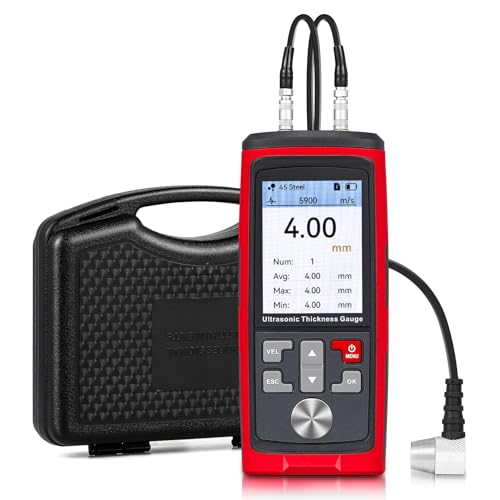
- 1–300 mm range with 0.01 mm resolution
- Stores 1,500 readings and supports computer output
- Works with metals, plastics, glass, PVC, and ceramics
Best For: Detailed workshop and corrosion inspections
Easy-Logging Value Pick
DANOPLUS Digital Thickness Gauge

- 0.03–11.8-inch measuring range
- Manual or automatic storage for 1,500 data groups
- Color display with limit alerts and unit switching
Best For: Routine inspections with organized data logging
Portable Long-Run Pick
PM1301 Ultrasonic Thickness Gauge

- Broad range with up to 0.0003-inch resolution
- Up to 8 hours of continuous use
- Lightweight body with presets and probe recognition
Best For: Field inspections and portable corrosion checks
Best Value Industrial Gauge – Industrial-882 Thickness Tester
For shoppers comparing ultrasonic thickness gauges under 200, the Industrial-882 offers a broad 1–225 mm range for non-destructive checks on solid materials. Its color display, adjustable sound velocity, rechargeable battery, and data storage suit routine workshop and field inspections.
Best For: Checking steel structures, pipes, tanks, plates, and other solid materials when only one-sided access is available.
Pros:
- Measures materials from 1 to 225 mm thick.
- Supports adjustable sound velocity for materials such as steel, aluminum, copper, plastic, and glass.
- Portable rechargeable design with color LCD and stored readings.
Cons:
- Does not measure paint or coating thickness.
- Not designed for cast iron.
The Industrial-882 is a practical choice when you need wide coverage and portable operation without paying for more advanced PC reporting features. Confirm that your material is solid and compatible before purchasing.
Most Feature-Rich – Industrial-884X PC Data Thickness Gauge
Among ultrasonic thickness gauges under 200, the Industrial-884X stands out for its extensive measurement range, PC data export, and inspection statistics. It is designed for users who need organized records and flexible calibration across manufacturing and industrial workflows.
Best For: Production quality control, engineering inspections, batch tracking, and detailed material verification.
Pros:
- Measures 0.85–400 mm with 1 mil or 0.01 mm display resolution.
- Stores up to 2,000 readings and provides minimum, maximum, average, and count statistics.
- Supports PC export, automatic sound-velocity calculation, and optional specialized probes.
- Uses a rechargeable 3.7V 2000mAh battery with USB-C charging.
Cons:
- The supplied standard probe may not cover every specialized application.
- Its broader feature set may be more than needed for occasional basic checks.
The Industrial-884X is the strongest fit here for inspection programs that depend on stored data and reporting. Its expandable probe architecture also gives it more room to adapt than simpler handheld gauges.
Simple Preset Operation – TM-8812 Metal Thickness Gauge
The TM-8812 is a straightforward option among ultrasonic thickness gauges under 200, combining one-sided measurement with 11 material presets. Its backlit LCD, inch/mm switching, and optional data interfaces make it suitable for routine maintenance work.
Best For: Basic thickness checks on pipes, tanks, metal plates, machinery parts, and common preset materials.
Pros:
- Measures 1.2–200 mm with 0.1 mm display resolution.
- Includes 11 material presets plus custom sound-velocity settings.
- Offers backlit LCD viewing, automatic shutoff, USB, and RS-232C interfaces.
Cons:
- PC software for data collection is not included.
- Uses four AAA batteries rather than a rechargeable battery.
- Its range is narrower than some alternatives in this roundup.
The TM-8812 makes sense for buyers who value quick setup through material presets and do not need built-in storage or advanced reporting. Budget separately for compatible software if PC data collection is important.
Wide-Range Color Display – Industrial-882X Thickness Meter
For users seeking ultrasonic thickness gauges under 200 with broad coverage, the Industrial-882X measures 1–300 mm and supports metals, plastics, ceramics, and glass. Its adjustable color display and reference-block calibration are useful in varied inspection environments.
Best For: Measuring pipeline and pressure-vessel wall thickness, checking corrosion levels, and inspecting compatible industrial materials.
Pros:
- Provides a wide 1–300 mm measurement range.
- Supports adjustable sound velocity from 1000 to 9999 m/s.
- Uses an HD color screen with adjustable backlight brightness and color options.
- Compact handheld design with included lithium-ion battery.
Cons:
- Not recommended for porous materials such as cast iron or carbon fiber.
- Requires compatible materials that transmit ultrasonic waves at a constant speed.
The Industrial-882X is a compelling option when a 300 mm upper range and color-screen visibility matter more than extensive data-management features. Its material limitations should be checked carefully for specialized inspections.
Best Value – Compact Digital Thickness Gauge
For shoppers comparing ultrasonic thickness gauges under 200, this compact model offers a practical mix of broad measurement capability, adjustable sound velocity, and basic data management. It measures from 0.039 to 11.81 inches with 0.01 mm resolution and displays readings in either inches or millimeters.
Best For: DIY users, maintenance checks, and general inspections of compatible metal and nonmetal materials.
Pros:
- Measures 1 to 300 mm with claimed accuracy of ±0.5%H+0.05 mm.
- Supports adjustable sound velocity from 1000 to 9999 m/s.
- Stores up to 500 readings and displays average, minimum, and maximum values.
- Includes two 5 MHz probes, rechargeable batteries, a calibration block, and a one-year warranty.
Cons:
- The supplied probe setup is described for materials with parallel top and bottom surfaces.
- Its 500-reading storage is smaller than the capacity of some newer models.
This is a well-equipped choice when portability and straightforward field measurements matter more than advanced record-keeping. Its color display, alarms, and included accessories make it a convenient starting point for routine thickness checks.
Best Data Storage – High-Precision Thickness Gauge
Among ultrasonic thickness gauges under 200, this model stands out for organized measurement storage. It covers 1 to 300 mm, includes a 5Md10 precision probe, and provides multiple preset and custom sound-velocity options for compatible metals, plastics, ceramics, and glass.
Best For: Users who need to save, review, and transfer a larger number of inspection readings.
Pros:
- Stores up to 1,500 readings across 15 files, with USB data transfer.
- Offers 12 preset sound velocities plus three custom slots.
- Displays maximum, minimum, and average values with manual or automatic saving.
- Provides backlighting, adjustable auto-shutdown, and audible high/low limit alarms.
Cons:
- Resolution changes from 0.01 mm below 100 mm to 0.1 mm from 100 to 300 mm.
- The listed package weight is 1.67 pounds, making it less lightweight than the most compact option here.
If inspection documentation is a priority, the larger memory and file organization are useful advantages. The customizable velocity settings also make it more adaptable across compatible material types, while the alert display helps identify readings outside set limits.
Best Range – Industrial-886 Thickness Tester
For buyers seeking ultrasonic thickness gauges under 200 with extra depth capability, the Industrial-886 measures from 1 to 400 mm, or 0.04 to 15.75 inches. Its pulse-echo design is intended for compatible homogeneous materials, while adjustable sound velocity supports calibration across different materials.
Best For: Field checks and industrial maintenance involving thicker plates, pipelines, tanks, and structural components.
Pros:
- Offers the widest listed measurement range, up to 400 mm or 15.75 inches.
- Supports manual sound-velocity settings from 1000 to 9999 m/s.
- Includes single and continuous measurement modes for spot checks or scanning.
- Stores up to 100 measurement groups and shows average, minimum, and maximum values.
Cons:
- Its storage capacity is lower than the 1,500-reading capacity of the data-focused model.
- The notes do not specify included probes, batteries, or warranty coverage.
The main reason to choose this tester is its 1–400 mm range, which extends beyond the other listed options. Continuous measurement and statistics mode add practical value for repeat inspections, though buyers should verify the included accessories before ordering.
Wide-Range Workshop Pick – 300 mm Ultrasonic Thickness Gauge
For shoppers comparing ultrasonic thickness gauges under 200, this model stands out for its broad 1–300 mm measurement range, 0.01 mm resolution, and support for both metal and nonmetal materials. Its data storage and computer-output capability also make it useful for repeat inspections.
Best For: Pipeline, pressure-vessel, manufacturing, and corrosion-checking work requiring a wide range and stored readings.
Pros:
- Measures from 0.039 to 11.811 inches with a stated ±0.5% H+0.05 mm error range.
- Adjustable sound speed from 1000 to 9999 m/s supports different materials.
- Stores up to 1,500 data points and can output data line graphs through computer software.
- Includes a probe, calibration block, coupling agent, rechargeable battery, and USB cable.
Cons:
- Its extensive functions may be more than needed for occasional spot checks.
- The supplied notes do not specify the continuous operating time of the rechargeable battery.
This is a well-equipped option when range, inspection records, and material flexibility matter more than having the smallest possible instrument.
Easy-Logging Value Pick – DANOPLUS Digital Thickness Gauge
Among ultrasonic thickness gauges under 200, the DANOPLUS model is a practical choice for users who want straightforward operation and organized records. It combines a 0.03–11.8-inch range with manual or automatic logging, unit switching, and built-in calibration support.
Best For: Automotive, metalworking, and manufacturing users who need simple measurements with saved inspection data.
Pros:
- Measures steel, metals, ceramics, glass, and plastics across a 0.03–11.8-inch range.
- Stores up to 1,500 data groups using manual or automatic recording.
- Color display provides MAX, MIN, and average readings, with mm/in unit switching.
- High and low limit alerts use a red indicator and optional buzzer.
Cons:
- The supplied notes do not state the adjustable sound-speed range.
- Its listed accuracy is expressed as ±(0.5% H+0.05) mm, so users should review whether that suits their inspection requirements.
Choose this model if accessible controls, automatic logging, and quick calibration are priorities in a compact inspection tool.
Portable Long-Run Pick – PM1301 Ultrasonic Thickness Gauge
For buyers seeking ultrasonic thickness gauges under 200 that are easy to carry between inspection points, the PM1301 combines a broad range with a lightweight body and rechargeable battery. Its material presets, probe recognition, alarms, and computer-software support add flexibility for field and workshop use.
Best For: Portable metal and nonmetal inspections, including pipes, plates, pressure vessels, and corrosion-related thickness checks.
Pros:
- Measures 0.039–11.811 inches, with up to 0.0003-inch resolution and stated ±(0.5% H+0.001 inches) accuracy.
- Offers adjustable sound velocity from 1000 to 9999 m/s plus 12 material presets.
- Runs for up to 8 hours continuously on its built-in 1000mAh rechargeable battery.
- Includes a color backlit LCD, data storage, alarms, automatic probe recognition, and a carrying case.
Cons:
- The supplied information identifies the kit as PM1301 but refers to PM1201 in one feature description, which may warrant model verification.
- The notes do not specify the maximum number of stored readings.
With its low 5.57-ounce weight and stated eight-hour runtime, this is the strongest fit of the three for mobile inspections where portability is a daily concern.
How We Picked the Best Ultrasonic Thickness Gauges Under 200
We focused on the specifications that matter most in affordable ultrasonic inspection tools: measurement range, stated resolution, supported materials, probe design, calibration options, display readability, and data-handling features. The selection includes compact gauges for routine metal checks as well as wider-range models intended for thicker steel, pipes, tanks, and industrial components.
Because budget instruments can vary in accuracy depending on calibration, surface condition, couplant, and material type, treat advertised specifications as a starting point. A gauge with adjustable sound velocity and a suitable probe is generally more useful than one with a larger headline range but fewer configuration options.
Quick Comparison
| Feature | What to look for | Why it matters |
|---|---|---|
| Measurement range | About 0.03–8, 11.8, or 15.75 inches | Determines the thicknesses you can measure |
| Material support | Steel, metals, plastic, glass, PVC, or pipes | Sound velocity varies by material |
| Data features | Memory, recording, or PC transfer | Helps document inspections and compare readings |
| Calibration | Adjustable sound velocity and zero calibration | Improves results across different materials and probes |
Key Buying Factors for Ultrasonic Thickness Gauges Under 200
Range and Resolution
Choose a range that comfortably covers your work rather than selecting solely by the maximum number. Models reaching roughly 15.75 inches suit heavier sections, while an 8-inch maximum may be sufficient for common sheet metal, tubing, and vehicle components. Confirm the displayed resolution and whether accuracy changes across the range.
Material and Surface Compatibility
Ultrasonic gauges need a reasonably clean, coupled surface. Rust, paint, scale, curvature, and rough finishes can affect readings. If you inspect several materials, prioritize adjustable sound velocities and compatibility with steel, copper, aluminum, plastics, glass, and PVC. A capable probe and proper couplant are just as important as the meter.
Records and Field Usability
For occasional checks, a clear digital display and simple calibration may be enough. For maintenance programs or inspection reports, choose a model with stored readings, data recording, or PC connectivity. Also consider battery access, automatic shutoff, portability, and whether the controls are practical while wearing gloves.
Who Should Buy Which Ultrasonic Thickness Gauges Under 200?
For general metal inspection: Choose a mid-range model covering common steel and pipe thicknesses with adjustable sound velocity.
For thicker industrial materials: Select one of the widest-range gauges, especially if you inspect tanks, heavy plate, or large structural components.
For documented maintenance: Prioritize PC data transfer, memory, or recording features over an unnecessarily high maximum range.
For mixed materials: Look for broad material support, calibration controls, and a probe suited to curved or uneven surfaces. Anyone needing certified nondestructive testing should verify calibration and required standards before relying on a budget gauge for formal compliance work.