Vibration meters with external probes make it easier to measure hard-to-reach machinery while keeping the display away from heat, moving parts, and confined spaces. The products in this roundup cover portable pen-style testers, industrial analyzers, remote sensors, and meters with acceleration, velocity, and displacement readings.
Use the comparison below to match measurement ranges, probe designs, data functions, and durability to your maintenance workflow.
Best 10 Vibration Meters with External Probe Picks for 2026
Best Remote-Probe Workhorse
VM-424 Industrial Vibration Meter

- Remote piezoelectric sensor for difficult measurement points
- Three vibration parameters with dual frequency modes
- Interchangeable magnetic, short, and long probe tips
Best For: Routine industrial inspections and preventive maintenance
Best Complete Field Kit
Digital Vibration Meter with 3 Probes
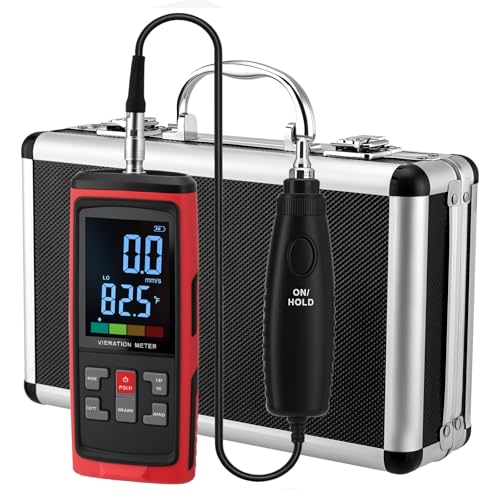
- Adds temperature readings to three vibration measurements
- Three probe types cover varied contact situations
- USB-C charging and included aluminum storage case
Best For: Portable daily inspections across rotating equipment
Best Sensor Upgrade
Fluke 805 External Vibration Sensor

- 90-degree low-profile head for tight spots
- Powerful magnet fits flat and curved surfaces
- Coiled cable extends beyond 7 feet
Best For: Compatible Fluke-based inspection setups needing remote access
Best for Trend Analysis
GOYOJO Pen-Type Vibration Meter

- Time- and frequency-domain waveform display
- Stores results for USB export and review
- 73 g body with up to 20 hours of measurement
Best For: Lightweight inspections that require records and waveform visibility
Best for ISO-Based Mechanical Checks
VM-6320 Vibration Analysis Meter

- Acceleration, velocity, and displacement readings
- 10 Hz–10 kHz acceleration frequency range
- ISO 2954-oriented rotating-equipment checks
Best For: Periodic maintenance and on-site rotating machinery inspections
Best for Connected Condition Monitoring
SWANSOFT 5-in-1 Vibration Meter

- Five functions include temperature measurement
- Magnetic remote probe for hard-to-reach areas
- Stores about 397,000 points with PC transfer
Best For: Portable logging and trend analysis in maintenance environments
Best for Detailed Portable Analysis
PM633C Digital Vibration Meter
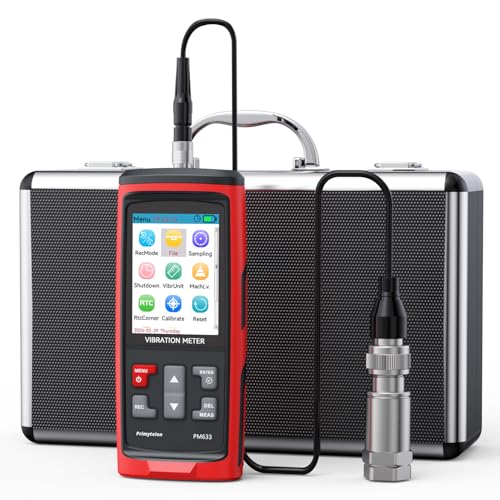
- Color display with graphs and statistical readings
- 30 Hz–14 kHz selectable frequency coverage
- Stores up to 397,000 points with PC software
Best For: Portable equipment checks requiring recorded data and analysis
Heavy-Duty Choice

- Remote sensor with 39-inch (2-meter) cable
- Selectable units for three vibration measurements
- Stores up to 500 readings
Best For: Routine maintenance inspections requiring a cable-connected sensor
Data-Tracking Pick

- Stores 500 readings in five groups
- Measures acceleration, velocity, and displacement
- Supports 10Hz–4kHz frequency modes
Best For: Preventive maintenance with grouped trend comparisons
Portable Maintenance Pick

- Measures acceleration, velocity, and displacement
- Large LCD for quick readings
- Designed for rotating machinery inspections
Best For: Portable preventive-maintenance checks on motors and pumps
Best Remote-Probe Workhorse – VM-424 Industrial Vibration Meter
For technicians comparing vibration meters with external probe capability, the VM-424 focuses on practical contact measurements where handheld placement is awkward. Its remote piezoelectric sensor, interchangeable tips, and three vibration readings make it suited to routine checks on motors, pumps, compressors, gearboxes, fans, and other rotating machinery.
Best For: Preventive-maintenance rounds and condition screening when you need flexible probe placement and an easy-to-read handheld display.
Pros:
- Measures acceleration, velocity, and displacement.
- Includes magnetic, short, and long interchangeable probe tips.
- Offers 10 Hz–1 kHz and 1 kHz–3 kHz acceleration modes.
- Backlit LCD includes data-hold and max-hold functions.
Cons:
- Does not provide full-spectrum FFT analysis.
- Designed for periodic diagnostics rather than permanent online monitoring.
The VM-424 is a focused inspection tool rather than a laboratory analyzer. Its external sensor and contact-tip options are especially useful for reaching recessed or inconvenient measurement points during routine industrial checks.
Best Complete Field Kit – Digital Vibration Meter with 3 Probes
This digital option is one of the more versatile vibration meters with external probe flexibility, pairing three interchangeable probes with acceleration, velocity, displacement, and temperature readings. USB-C charging, a carrying case, and a shockproof body support repeated on-site testing.
Best For: Maintenance teams that want a portable inspection kit with multiple probe styles, temperature readings, and extended runtime.
Pros:
- Provides acceleration, velocity, displacement, and 0–40°C temperature readings.
- Includes magnetic, long-type, and standard probes.
- Offers low- and high-frequency modes for general inspection and screening.
- USB-C charging supports up to 20 hours of runtime, with an aluminum case included.
Cons:
- Its temperature measurement range is limited to 0–40°C.
- The feature-rich kit weighs 1.8 pounds, making it less minimal than a pen-style meter.
With practical accessories and inspection-oriented features such as peak hold and a real-time bar graph, this meter is a strong fit for technicians who value portability and probe flexibility over advanced waveform analysis.
Best Sensor Upgrade – Fluke 805 External Vibration Sensor
The Fluke FLUKE-805/ES is an external sensor accessory rather than a standalone meter, making it relevant when your existing setup needs a more capable remote connection. Its low-profile 90-degree body, strong magnet, and stretchable coiled cable help position the sensor on flat or curved surfaces and in tight spaces.
Best For: Users who already have compatible vibration-measurement equipment and need a rugged external sensor for difficult access points.
Pros:
- Low-profile 90-degree head reaches tight locations.
- U-shaped magnet provides firm attachment to flat or curved surfaces.
- Coiled cable stretches beyond 7 feet while reducing dangling.
- Removable magnet supports direct attachment to mounting pads or threaded holes.
Cons:
- It is a sensor accessory, not a complete vibration meter.
- Compatibility with a user’s existing meter should be confirmed before purchase.
This is the specialized choice for improving sensor access and mounting security. Its value depends on having compatible measurement hardware already in place, but the rugged cable, connector, and flexible mounting options suit demanding field work.
Best for Trend Analysis – GOYOJO Pen-Type Vibration Meter
The GOYOJO GVB-2 takes a more data-oriented approach than many compact vibration meters with external probe use, combining three vibration measurements with time- and frequency-domain waveform views. Its pen-style body, onboard storage, and USB export make it convenient for recording and reviewing routine checks on motors, bearings, pumps, fans, and compressors.
Best For: Technicians who want a lightweight inspection meter with waveform viewing and stored measurement records.
Pros:
- Displays acceleration, velocity, and displacement readings.
- Shows both time-domain and frequency-domain waveforms.
- Stores results and supports USB transfer to PC software for export.
- Lightweight 73 g design offers up to 20 hours of continuous measurement.
Cons:
- The supplied notes do not specify interchangeable external probe tips.
- Using PC software for export adds a step beyond viewing readings on the device.
For buyers prioritizing inspection history and visual vibration feedback, the GVB-2 offers more than a basic numeric meter. Its compact design and data-storage workflow make it practical for repeated checks, while its waveform features support closer review of unusual machine behavior.
Best for ISO-Based Mechanical Checks – VM-6320 Vibration Analysis Meter
HOJILA Digital Vibration Meter VM-6320 Vibration Analysis Meter Mechanical Vibration Meters
Check Price On AmazonFor buyers comparing vibration meters with external probe capability, the VM-6320 is a focused tool for on-site checks of rotating machinery. Its separate accelerometer supports acceleration, velocity, and displacement measurements across a broad frequency range.
Best For: Periodic vibration measurements, predictive maintenance, quality control, and commissioning of rotating equipment.
Pros:
- Measures acceleration, velocity, and displacement in dedicated ranges.
- 10 Hz to 10 kHz acceleration frequency range supports varied machinery checks.
- Designed in accordance with ISO 2954 for detecting imbalance, misalignment, and related mechanical faults.
- Individual accelerometer is intended to provide accurate, repeatable readings.
Cons:
- The supplied notes do not mention data storage, PC transfer, or graphing features.
- Its stated focus is periodic measurement rather than continuous online monitoring.
The VM-6320 is a straightforward choice when dependable multi-parameter readings and a wide acceleration frequency range matter more than advanced data-management features.
Best for Connected Condition Monitoring – SWANSOFT 5-in-1 Vibration Meter
The SWANSOFT stands out among vibration meters with external probe capability by combining a separate magnetic sensor with temperature measurement, on-device graphs, and substantial data storage. It is suited to technicians who want to record readings and transfer files for trend analysis.
Best For: Workshops, production sites, and maintenance teams checking motors, HVAC systems, pumps, fans, compressors, turbines, and similar equipment.
Pros:
- Five measurement functions cover acceleration, velocity, displacement, frequency, and temperature.
- Separate probe with strong magnetic sensor helps reach confined areas and reduce movement effects.
- Stores up to approximately 397,000 data points and transfers CSV or BMP files through PC software.
- Backlit display provides line graphs and maximum, minimum, and average readings.
Cons:
- It is not a permanent online monitoring system.
- It is not a multichannel laboratory spectrum analyzer or full-spectrum FFT tool.
- PC software is compatible with Windows systems, according to the supplied notes.
Choose this model if portable logging and file transfer are priorities. Its external magnetic probe and broad feature set make it more versatile for recurring field checks than a basic readout-only meter.
Best for Detailed Portable Analysis – PM633C Digital Vibration Meter
The PM633C is a compact option for buyers seeking vibration meters with external probe capability and a color display. It combines vibration and temperature measurements with frequency switching, machine-grade selection, stored data, and computer software support.
Best For: Portable condition checks of motors, HVAC equipment, engines, generators, pumps, fans, compressors, and turbines.
Pros:
- Measures acceleration, velocity, displacement, frequency, and temperature.
- Supports high- and low-frequency measurement modes from 30 Hz to 14 kHz.
- TFT color display shows maximum, minimum, average, and line-graph information.
- Stores up to 397,000 data points and includes PC software for transferring and analyzing data.
Cons:
- The supplied notes do not specify the computer software operating-system compatibility.
- Its listed temperature range is limited to 14°F–140°F.
With its compact size, included probe, calibration report, and extensive recording functions, the PM633C is a strong fit for users who want portable measurements with more analysis and documentation than a basic vibrometer provides.
Heavy-Duty Choice – Extech 407860 Vibration Meter
The Extech 407860 is a practical option for buyers seeking vibration meters with external probe capability. Its remote sensor uses a 39-inch (2-meter) cable, while selectable measurement units and 500-reading memory support routine equipment checks.
Best For: Maintenance teams that need a cable-connected sensor, flexible measurement units, and basic vibration data storage.
Pros:
- Remote vibration sensor on a 39-inch (2-meter) cable.
- Measures velocity, acceleration, and displacement with selectable units.
- Stores and recalls up to 500 readings.
- Offers 5% basic accuracy across a 10Hz to 1kHz frequency range.
Cons:
- Its listed frequency range ends at 1kHz, which may limit higher-frequency diagnostics.
- The supplied notes do not identify advanced analysis features beyond stored readings.
Choose the Extech when access around machinery makes a remote sensor especially useful and your inspections fit its frequency range and accuracy specifications.
Data-Tracking Pick – VM-422 Industrial Vibrometer
The VM-422 is one of the more feature-focused vibration meters with external probe-style measurement for structured maintenance work. It records up to 500 readings in five groups and covers acceleration, velocity, and displacement, with selectable low- and high-frequency modes.
Best For: Preventive-maintenance programs that compare readings across machines or inspection intervals.
Pros:
- Measures acceleration, velocity, and displacement.
- Stores 500 readings as five groups of 100 records.
- Provides 10Hz–1kHz low-frequency and 1kHz–4kHz high-frequency modes.
- Color LCD includes a vibration-severity bar for quick visual assessment.
Cons:
- It is intended for periodic diagnostics and does not replace a laboratory FFT analyzer or permanent monitoring system.
- The supplied notes describe an integrated sensor rather than a separately specified cable-connected external probe.
The VM-422 stands out when onboard memory, grouped records, and broader frequency selection matter more than advanced multi-channel analysis.
Portable Maintenance Pick – AS63B Digital Vibration Meter
The AS63B is a compact handheld choice for buyers comparing vibration meters with external probe applications for everyday machinery checks. It combines acceleration, velocity, and displacement measurements in a portable design suited to motors, pumps, bearings, fans, compressors, and gearboxes.
Best For: Technicians performing quick preventive-maintenance and troubleshooting checks on rotating equipment.
Pros:
- Offers three measurement modes: acceleration, velocity, and displacement.
- Designed for motors, pumps, fans, compressors, gearboxes, and bearings.
- Large LCD supports quick reading during inspections.
- Portable design suits factory, workshop, and field use.
Cons:
- The supplied notes do not specify an external probe cable or data-memory capacity.
- Its listed package weight is 1.58 pounds, making it less lightweight than some handheld alternatives.
The AS63B is a straightforward fit for routine condition checks when portability and three-mode measurement are the priorities.
How We Picked the Best Vibration Meters with External Probe
We selected meters based on practical features for machinery inspection: external or remote probe access, useful vibration parameters, measurement range, display readability, portability, probe attachment, memory or analysis functions, and suitability for motors, pumps, fans, bearings, and other rotating equipment. Models from the list include basic handheld testers as well as more capable instruments designed for repeated industrial checks.
Specifications can vary by configuration, so confirm the supplied probe, connector, cable length, frequency range, battery requirements, and calibration documentation before purchase.
Quick Comparison
- Best for broad routine checks: Choose a 3-in-1 meter that measures acceleration, velocity, and displacement.
- Best for difficult access: Look for a remote probe with a durable cable and a secure contact point.
- Best for repeated inspections: Prioritize memory, data logging, clear units, and consistent probe placement.
- Best for established maintenance programs: Consider an instrument with recognized standards support, such as ISO 10816 references.
- Best for demanding environments: Favor rugged housings, protected connectors, strong magnets, and replaceable or supported probes.
Key Buying Factors for Vibration Meters with External Probe
Measurement Parameters and Range
Acceleration can help reveal high-frequency bearing or gear problems, velocity is commonly used for overall machine-severity checks, and displacement is useful for larger, slower movements. A meter covering all three provides more flexibility, but verify its actual ranges and resolution for your equipment.
Probe Design and Contact Method
A remote probe is only useful if it can reach the measurement point reliably. Check whether the kit includes a pointed contact tip, flat sensor, magnetic mount, or multiple probes. Magnetic attachment speeds up repeat measurements, while a handheld contact tip may work better on irregular surfaces. Cable length and connector durability also matter in the field.
Data Handling and Usability
For occasional troubleshooting, a simple LCD meter may be sufficient. For route-based maintenance, memory, hold functions, frequency analysis, alarms, backlighting, and easy unit selection can save time. A clear display and uncomplicated controls are especially important when wearing gloves or working in low light.
Standards, Calibration, and Durability
ISO references can help with consistent machine-condition assessments, but they do not replace correct measurement technique or equipment-specific limits. Look for calibration support, a rugged case, dependable battery access, and documentation that explains probe placement and operating limits.
Who Should Buy Which Vibration Meters with External Probe?
Facility and maintenance technicians should choose a versatile 3-in-1 instrument with an external probe, readable display, and enough range for their machinery. Predictive-maintenance teams will benefit from memory, repeatable mounting, analysis functions, and standards-oriented measurements. HVAC and building-service contractors may prefer a compact pen-style meter that is quick to carry between motors, fans, and pumps. Heavy industrial users should prioritize rugged construction, secure connectors, long cables, magnetic or angled probe options, and available calibration service.
Before ordering, compare the included accessories rather than the meter body alone. The right probe, cable, mounting method, and documentation often determine whether a vibration meter produces consistent readings in real maintenance conditions.