The best vibration meters help maintenance teams spot imbalance, misalignment, looseness, and bearing problems before they become costly failures. This roundup compares 10 options ranging from compact pen-style testers to feature-rich industrial analyzers.
Use the guide below to match measurement range, sensor design, data features, and portability with the equipment and maintenance tasks you handle most often.
Best 10 Vibration Meters Picks for 2026
Professional Pick

- Reduces variation from angle and contact pressure
- Four-level vibration and bearing severity scale
- Compact handheld design with included AA batteries
Best For: Technicians performing repeatable rotating-equipment checks
Data-Tracking Choice

- Stores up to 500 readings in five groups
- Measures acceleration, velocity, and displacement
- Color display includes severity indication
Best For: Preventive maintenance and trend comparison
Flexible Measurement Pick
Extech 407860 Heavy-Duty Meter

- Remote sensor with 39-inch cable
- Selectable units for three vibration measures
- Stores and recalls up to 500 readings
Best For: Field inspections requiring remote sensor access
Wide-Frequency Option
VM-6320 Vibration Analysis Meter

- 10 Hz–10 kHz acceleration frequency range
- Measures three core vibration parameters
- Designed for ISO 2954 periodic measurements
Best For: On-site rotating-machinery diagnostics
Best Overall
SWANSOFT 5-in-1 Vibration Meter

- Measures acceleration, velocity, displacement, frequency, and temperature
- Remote magnetic sensor supports hard-to-reach equipment checks
- Stores about 397,000 data points with PC file transfer
Best For: Versatile maintenance inspections and trend tracking
Best for Data Analysis
PM633C Digital Vibration Meter
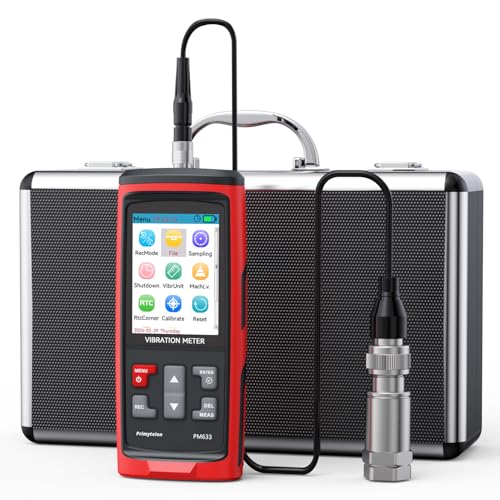
- Covers acceleration, velocity, displacement, frequency, and temperature
- Color TFT display provides graphs, averages, and ISO severity ratings
- Stores about 397,000 readings and connects to PC software
Best For: Compact inspections with organized computer-based analysis
Best Simple Portable Pick

- Measures acceleration, velocity, and displacement
- Large LCD supports quick readings in field and workshop settings
- Designed for motors, pumps, bearings, fans, and other rotating machinery
Best For: Straightforward portable preventive-maintenance checks
Best Precision Pick
PM63A Handheld Vibration Meter

- Three-in-one acceleration, velocity, and displacement readings
- Long and short probes included
- 20-hour runtime with calibration report and case
Best For: Portable predictive maintenance checks on motors and rotating equipment
Best for Hard-to-Reach Points
VM-424 Remote-Probe Vibration Meter

- Remote sensor supports narrow measurement locations
- Low- and high-frequency acceleration modes
- Magnetic, short, and long probe tips included
Best For: Periodic industrial inspections where probe access is limited
Best for Data Review
GOYOJO GVB-2 Pen-Type Vibrometer

- Time- and frequency-domain waveform display
- Stores readings and supports USB data export
- Lightweight 73g body with 20-hour runtime
Best For: Portable inspections requiring waveform visibility and maintenance records
Professional Pick – Fluke 805 FC Vibration Meter
The Fluke 805 FC is a practical choice among vibration meters for technicians who need repeatable handheld readings. Its sensor design helps reduce variation from changing contact pressure or device angle, while the four-level severity scale makes machine-condition checks easier to interpret.
Best For: Maintenance professionals assessing overall vibration and bearing condition on rotating equipment.
Pros:
- Sensor design minimizes measurement variation caused by angle and contact pressure.
- Supports consistent data quality across low and high frequency ranges.
- Four-level severity scale helps indicate maintenance urgency.
- Compact 13.7-ounce design uses two included AA batteries.
Cons:
- One-year warranty is relatively limited.
- Supplied notes do not specify data-storage capacity or advanced analysis features.
The Fluke 805 FC stands out for straightforward, repeatable condition checks rather than extensive onboard data management. It is a strong fit when consistent readings and quick severity assessment matter most.
Data-Tracking Choice – VM-422 Industrial Vibrometer
The VM-422 is one of the more useful vibration meters for maintenance routes that require stored readings. It measures acceleration, velocity, and displacement, with five memory groups holding up to 500 records for reviewing machine trends over time.
Best For: Preventive-maintenance teams comparing readings across machines or inspection intervals.
Pros:
- Measures acceleration, velocity, and displacement.
- Stores up to 500 readings in five groups of 100.
- Offers selectable 10 Hz–1 kHz and 1 kHz–4 kHz acceleration ranges.
- Color LCD includes a visual vibration-severity bar.
Cons:
- It is not intended to replace laboratory multichannel FFT analyzers.
- It is not a permanently installed monitoring system.
- Supplied notes do not list a warranty or included battery details.
With memory, grouped storage, and three measurement types, the VM-422 is well suited to structured handheld diagnostics. Its stated role is periodic maintenance tracking, not full laboratory vibration analysis.
Flexible Measurement Pick – Extech 407860 Heavy-Duty Meter
The Extech 407860 gives vibration meters useful unit flexibility for field measurements. It covers velocity, acceleration, and displacement, includes a remote sensor on a 39-inch cable, and can store or recall up to 500 readings.
Best For: Technicians who need remote-probe access and selectable measurement units during equipment inspections.
Pros:
- Selectable units for velocity, acceleration, and displacement.
- Remote vibration sensor uses a 39-inch, 2-meter cable.
- Stores and recalls up to 500 readings.
- Specifies 5% basic accuracy across a 10 Hz–1 kHz frequency range.
Cons:
- Its listed frequency range is narrower than some specialized meters.
- Supplied notes do not identify a vibration-severity scale.
- The notes do not describe advanced waveform or FFT functions.
The 407860 is a practical option when probe placement and unit selection are more important than advanced analysis. Its remote sensor and reading memory add flexibility for routine heavy-duty inspections.
Wide-Frequency Option – VM-6320 Vibration Analysis Meter
HOJILA Digital Vibration Meter VM-6320 Vibration Analysis Meter Mechanical Vibration Meters
Check Price On AmazonThe VM-6320 is a vibration meter designed for on-site checks of rotating machinery. It measures acceleration, velocity, and displacement, while its acceleration mode extends from 10 Hz to 10 kHz for detecting issues such as imbalance and misalignment.
Best For: Quality control, commissioning, and predictive-maintenance inspections on rotating equipment.
Pros:
- Measures acceleration, velocity, and displacement.
- Provides a 10 Hz–10 kHz acceleration frequency range.
- Designed for periodic measurements in line with ISO 2954.
- Uses an individual accelerometer for repeatable readings.
Cons:
- At 1.74 pounds, it is heavier than the other listed handheld options.
- Supplied notes do not mention onboard data storage.
- The notes do not specify battery or warranty information.
The VM-6320 emphasizes broad-frequency measurement and mechanical-fault detection for field work. It is a compelling choice when inspection coverage matters more than lightweight portability or documented data memory.
Best Overall – SWANSOFT 5-in-1 Vibration Meter
For buyers who want broad capability in a handheld package, this SWANSOFT vibration meter combines acceleration, velocity, displacement, frequency, and temperature readings. Its remote magnetic sensor, data storage, and PC transfer support make it practical for routine condition checks and trend tracking across industrial equipment.
Best For: Maintenance technicians, engineers, and QC inspectors who need multiple measurements and substantial data storage.
Pros:
- Measures five key parameters, including temperature and frequency.
- Remote magnetic sensor helps reach difficult measurement points.
- Stores up to approximately 397,000 data points and transfers CSV/BMP files to a Windows PC.
- Backlit display shows line graphs and maximum, minimum, and average values.
Cons:
- It is not a permanent online monitoring system.
- It is not a full-spectrum FFT analyzer or multi-channel laboratory tool.
This is a strong all-around choice among vibration meters when flexible measurements and recordkeeping matter more than continuous monitoring or advanced spectrum analysis.
Best for Data Analysis – PM633C Digital Vibration Meter
The PM633C is a compact vibration meter focused on measurement flexibility and analysis features. It covers acceleration, velocity, displacement, frequency, and temperature, while its color display, severity rating, stored readings, and dedicated PC software support more organized equipment assessments.
Best For: Users who want a lightweight instrument with broad ranges, display-based analysis, and computer connectivity.
Pros:
- Uses a piezoceramic shearing-type accelerometer with stated accuracy of ±1.5% plus 2 digits.
- Supports high- and low-frequency measurement modes from 30 Hz to 14 kHz.
- Color TFT display includes line graphs, Max/Min/Average readings, and ISO vibration severity ratings.
- Stores up to approximately 397,000 readings and connects to PC software for transfer and storage.
Cons:
- PC software may require customer support if download or installation assistance is needed.
- The supplied notes do not describe a remote sensor or magnetic mounting feature.
Choose this model if you value a compact design and computer-assisted record management, especially when frequency-range flexibility and on-device interpretation are part of your workflow.
Best Simple Portable Pick – AS63B Digital Vibration Meter
The AS63B keeps vibration measurement straightforward with three core modes: acceleration, velocity, and displacement. Its portable design and large LCD make it a practical choice for quick checks of motors, pumps, bearings, fans, compressors, gearboxes, and other rotating machinery.
Best For: Technicians who need a compact vibration meter for routine inspections and basic machinery troubleshooting.
Pros:
- Provides acceleration, velocity, and displacement measurements in one device.
- Large LCD is designed for quick reading in field, workshop, and factory applications.
- Suitable for checking motors, pumps, fans, compressors, gearboxes, bearings, and other rotating equipment.
- Supports preventive maintenance focused on imbalance, looseness, bearing wear, and misalignment.
Cons:
- It offers three measurement modes rather than the five-parameter coverage of the other listed models.
- The supplied notes do not mention data storage, PC transfer, temperature measurement, or frequency analysis.
This is the most approachable option for quick, repeatable machinery checks when you want essential vibration readings without the added analysis and archiving features of larger instruments.
Best Precision Pick – PM63A Handheld Vibration Meter
For industrial teams that need straightforward vibration meters for predictive maintenance, the PM63A combines a high-sensitivity piezoelectric ceramic accelerometer with three useful measurement modes. It can check acceleration, velocity, and displacement on motors, fans, compressors, gearboxes, and pumps.
Best For: Routine field diagnostics and early screening for looseness, resonance, and bearing wear.
Pros:
- Measures acceleration, velocity, and displacement with stated accuracy of ±5% ±2 digits.
- Includes both long and short probes for different measurement points.
- Offers up to 20 hours of continuous runtime and includes a calibration report and carrying case.
Cons:
- The supplied notes do not indicate waveform viewing, data storage, or PC export.
- Its handheld contact design may be less convenient for hard-to-reach measurement points than a remote-probe meter.
The PM63A is a practical choice when you want a compact, ready-to-use vibration meter focused on core machine-condition measurements and portable inspections.
Best for Hard-to-Reach Points – VM-424 Remote-Probe Vibration Meter
The VM-424 is one of the more flexible vibration meters for periodic industrial inspections because its remote piezoelectric sensor lets you position the probe on narrow or recessed machine components while viewing the main unit from a safer, more comfortable location.
Best For: Maintenance rounds involving motors, pumps, compressors, gearboxes, fans, and difficult-to-access bearing housings.
Pros:
- Measures acceleration, velocity, and displacement across the stated industrial ranges.
- Includes low- and high-frequency acceleration modes from 10Hz–1kHz and 1kHz–3kHz.
- Provides magnetic, short, and long interchangeable probe tips, plus backlit LCD, data hold, and max hold.
Cons:
- It does not perform full-spectrum FFT analysis or replace permanent online monitoring.
- At 1.12 pounds, it is heavier than the pen-style option in this roundup.
Choose the VM-424 when probe placement and viewing flexibility matter more than advanced spectrum analysis. Its accessories and hold functions suit repeatable spot checks across industrial equipment.
Best for Data Review – GOYOJO GVB-2 Pen-Type Vibrometer
The GOYOJO GVB-2 stands out among vibration meters for maintenance teams that want more than a single live reading. Its pen-style design measures three vibration parameters, displays time- and frequency-domain waveforms, and stores results for later review or USB export to PC software.
Best For: Portable inspections where technicians need waveform views and saved measurement records.
Pros:
- Measures acceleration, velocity, and displacement across broader stated ranges than the other listed meters.
- Displays time-domain and frequency-domain waveforms for more visual troubleshooting.
- Stores readings for comparison and supports USB connection for PC review and export.
Cons:
- The supplied notes do not specify included probe tips or a carrying case.
- Using data export and waveform features may require additional setup with the PC software.
For technicians who track equipment condition over time, the GVB-2 offers the strongest documentation workflow here. Its 73-gram pen-style body and 20-hour measurement time also make it convenient for daily rounds.
How We Picked the Best Vibration Meters
We evaluated these Vibration Meters by focusing on the features that matter during real equipment checks: measurement modes, usable ranges, sensor and probe design, display readability, portability, memory, operating time, and suitability for predictive maintenance. Models that measure acceleration, velocity, and displacement offer more flexibility across motors, pumps, fans, gearboxes, and bearings. We also considered whether a meter is better suited to quick screening or repeated analysis by maintenance professionals.
Because specifications and included accessories can vary by seller, confirm the current measurement ranges, calibration details, probe type, batteries, and warranty before ordering.
Quick Comparison
- Best-known professional option: Fluke 805 FC for dependable field screening and a recognizable industrial tool ecosystem.
- Best for broad measurement coverage: VM-422, VM-424, PM633C, and similar instruments that report acceleration, velocity, and displacement.
- Best for remote or hard-to-reach points: Models with remote sensors or probes, including the SWANSOFT, VM-424, and PM633C-style designs.
- Best for portability: Pen-type and compact handheld meters such as the GOYOJO and AS63B.
- Best for longer inspection sessions: Choose a model with strong battery life, replaceable batteries, or a stated continuous runtime.
Key Buying Factors for Vibration Meters
Measurement Parameters and Range
Acceleration is useful for detecting many high-frequency bearing and mechanical issues, while velocity is a common general-purpose indicator of machine condition. Displacement can help assess lower-frequency movement and overall vibration severity. Check both the available parameters and their ranges to ensure they suit your machinery.
Sensor and Probe Arrangement
A built-in sensor is fast for routine checks, but a remote probe can improve access around guards, tight spaces, and awkward mounting points. For repeatable readings, consider how securely the sensor contacts the test surface and whether the kit includes useful probe accessories.
Data Handling and Usability
Memory, hold functions, backlighting, automatic range selection, and clear units can make inspections faster and reduce recording errors. If you need trend analysis or maintenance reports, prioritize models that store readings or connect to compatible software; a basic display meter may be enough for occasional spot checks.
Durability and Calibration
Industrial environments demand a housing that can tolerate regular handling, dust, and minor impacts. Look for published accuracy information and a practical calibration process. A protective case is useful when the instrument travels between sites.
Who Should Buy Which Vibration Meters?
Choose a professional field meter if you manage critical assets, need consistent screening results, or want a tool backed by established industrial support. Choose a multi-parameter handheld meter for general maintenance teams inspecting several machine types. Choose a remote-probe model when measurement points are difficult to reach or safety requires distance from moving equipment. Choose a compact pen-style meter for quick checks, basic troubleshooting, and occasional use where maximum analysis features are unnecessary.
Whichever model you choose, take readings at consistent locations and under comparable operating conditions. Vibration Meters are most valuable when measurements are logged over time, allowing you to identify changes before they develop into unplanned downtime.