Accurate weighing depends on more than display resolution. Air movement, vibration, calibration, and workspace conditions can all affect results, especially when measuring small samples.
These 10 precision balances with draft shields cover compact 0.001 g models, highly sensitive 0.0001 g analytical balances, and versatile options with USB or RS232 connectivity. Use the guide below to match capacity, readability, and features to your workflow.
Best 10 Precision Balances with Draft Shield Picks for 2026
Compact Professional Choice

- 122 g capacity with 0.001 g readability
- Draft shield and RS232 connectivity
- Includes a five-year warranty
Best For: Routine precision weighing of small items and materials
Fine-Resolution Lab Pick
U.S. Solid 220 g Analytical Balance

- 0.1 mg readability and 220 g capacity
- Includes calibration weight and draft shield
- Counting, percentage, units, and RS232 functions
Best For: Laboratory, pharmacy, research, and micro-component weighing
Touchscreen Convenience Pick
Tree 210 g Touchscreen Balance

- 210 g capacity with 0.001 g readability
- Glass draft shield and touchscreen controls
- Two-year warranty with U.S. support
Best For: Accessible precision weighing of powders, jewelry, and small items
Feature-Rich Micro-Weight Pick
LICHEN 120 g 0.1 mg Lab Balance

- 0.0001 g readability and 120 g capacity
- Counting, unit conversion, and RS232C
- Overload protection with windshield accessories
Best For: Laboratory, pharmacy, chemical, and jewelry applications
Versatile Precision Pick
500g Analytical Balance with 0.001g Readability

- 500g capacity with 0.001g accuracy
- Counting and multiple unit-conversion functions
- RS-232C interface for data transfer
Best For: General lab, jewelry, school, and light industrial weighing
Micro-Readability Choice
120g Analytical Balance with Draft Shield
- 0.0001g (0.1mg) readability
- Includes 100g external calibration weight
- Counting, percentage, and RS-232 functions
Best For: Small-sample lab, pharmacy, jewelry, and research work
Roomy Draft-Shield Model

- 0.0001g readability and 220g capacity
- Static-dissipating glass draft shield
- Includes 200g calibration weight and RS232C
Best For: Professional lab, pharmacy, jewelry, and scientific weighing
Best Value Draft-Shield Balance

- 600g capacity with 0.01g readability
- Detachable draft shield and dust cover
- USB and RS232 connectivity
Best For: Routine lab, jewelry, and counting work
Best Ultra-Precision Pick
220g x 0.0001g Analytical Balance
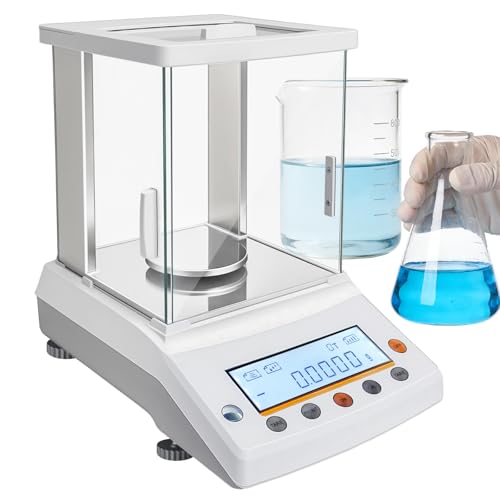
- 0.0001g readability for fine measurements
- Glass shield limits airflow and vibration effects
- Touchscreen LCD with counting and percentage modes
Best For: Sensitive lab, pharmacy, and jewelry weighing
Best Connected Analytical Balance

- 0.0001g readability with 220g capacity
- RS232C supports computer or printer data transfer
- Gram, carat, and counting functions
Best For: Connected laboratory and jewelry workflows
Compact Professional Choice – A&D FX-120i Precision Balance
A&D FX-120i Precision Balance,Compact Scale 122 g X 0.001 g,Draft shield,RS232,5year warranty,New
Check Price On AmazonThe A&D FX-120i is a compact precision balance with draft shield protection, 0.001 g readability, and a 122 g maximum capacity. Its RS232 connectivity and five-year warranty make it a practical choice for users who need repeatable measurements and long-term support.
Best For: Weighing packages, food, envelopes, coins, medicines, herbs, gemstones, and metals where 0.001 g readability is sufficient.
Pros:
- 0.001 g readability with a 122 g capacity
- Draft shield helps support stable readings
- RS232 connectivity and five-year warranty
Cons:
- Lower capacity than some analytical models
- Does not offer the 0.0001 g readability found on several alternatives
The FX-120i is a straightforward option for buyers prioritizing a compact design, dependable precision, and warranty coverage. Consider a 0.1 mg model if your work requires finer resolution.
Fine-Resolution Lab Pick – U.S. Solid 220 g Analytical Balance
For buyers seeking precision balances with draft shield protection and 0.1 mg readability, this U.S. Solid analytical balance offers a strong feature set. It combines electromagnetic transducer technology with external calibration, multiple units, and data connectivity.
Best For: Laboratory samples, pharmacy, chemistry, jewelry, research, beads, pellets, and micro-components.
Pros:
- 220 g capacity with 0.0001 g readability
- Includes a 200 g calibration weight and external calibration
- Draft shield, counting, percentage weighing, and five units
- RS232 output and overload alarm
Cons:
- Plastic construction may feel less substantial than metal-bodied equipment
- Requires calibration for the stated fine-accuracy performance
With its relatively high capacity and 0.1 mg resolution, this model is well suited to detailed laboratory and small-component work. The included calibration weight and RS232 port add practical value for routine workflows.
Touchscreen Convenience Pick – Tree 210 g Touchscreen Balance
This Tree analytical balance pairs 0.001 g readability with a glass draft shield and a touchscreen interface. It is a user-friendly option among precision balances with draft shield protection, especially for buyers who prefer touch controls over physical buttons.
Best For: Chemicals, powders, herbs, jewelry, precious metals, tickets, and coins in a home, workshop, or workspace setting.
Pros:
- 210 g capacity with 0.001 g readability
- Glass draft shield helps minimize environmental effects
- High-resolution touchscreen interface
- Two-year manufacturer warranty and U.S. customer support
Cons:
- Less precise than 0.0001 g analytical models
- Supplied notes do not list RS232 connectivity or calibration weights
The touchscreen design makes this balance appealing for straightforward, frequent weighing, while its glass shield supports more stable readings. Choose a finer-resolution model for work demanding 0.1 mg increments.
Feature-Rich Micro-Weight Pick – LICHEN 120 g 0.1 mg Lab Balance
The LICHEN lab scale is designed for buyers who need precision balances with draft shield accessories and 0.0001 g readability. It adds RS232 connectivity, unit conversion, counting functions, overload protection, and compatibility with laboratory and jewelry workflows.
Best For: Laboratory, pharmaceutical, chemical, food-processing, and jewelry applications requiring 0.1 mg readability.
Pros:
- 0.0001 g readability with a 120 g capacity
- Supports grams and carats plus counting functions
- Built-in RS232C interface for computer or printer connections
- Includes overload protection and windshield-related accessories
Cons:
- Minimum starting weight is listed as 10 mg
- Requires a dedicated socket and must not share sockets with other instruments
- Lower capacity than the 220 g U.S. Solid model
LICHEN offers a broad set of laboratory-oriented functions in a compact 120 g platform. Its fine readability and RS232C interface suit controlled workflows, provided the dedicated power requirement fits your workspace.
Versatile Precision Pick – 500g Analytical Balance with 0.001g Readability
If you need precision balances with draft shield protection for routine lab, jewelry, school, or light industrial work, this model combines a 500g maximum capacity with 0.001g readability. Its unit conversions, counting mode, and RS-232C connection add practical flexibility for everyday weighing.
Best For: General laboratory, jewelry, education, agriculture, and quality-control weighing where 0.001g readability is sufficient.
Pros:
- 500g maximum capacity with 0.001g accuracy and ±0.005g tolerance.
- Supports unit conversion, counting, fault detection, and overload protection.
- RS-232C interface connects to printers, computers, and other equipment.
Cons:
- Its 0.001g readability is less granular than 0.0001g analytical balances.
- Requires a stable, dry, clean surface and protection from drafts, sunlight, temperature swings, and magnetic interference.
This is a practical high-capacity option for users who want a draft-shielded analytical balance with useful connectivity and straightforward operating features.
Micro-Readability Choice – 120g Analytical Balance with Draft Shield
For applications requiring precision balances with draft shield stability and 0.1mg readability, this U.S. Solid model is built around a 120g capacity and electromagnetic transducer. It also includes external calibration, counting and percentage modes, and RS-232 data output.
Best For: Pharmacy, chemistry, research, powder, bead, jewelry, and micro-component weighing.
Pros:
- 0.0001g (0.1mg) readability for highly detailed measurements.
- Includes a 100g calibration weight for external calibration.
- Draft shield, five weighing units, counting, percentage weighing, and RS-232 connectivity.
- Reported settling time is about three seconds on 100–240V AC power.
Cons:
- 120g capacity is lower than the other balances in this roundup.
- External calibration requires using the included 100g weight.
Choose this balance when fine readability matters more than maximum capacity. Its draft shield and calibration setup support repeatable small-sample work, while the interface helps with documentation.
Roomy Draft-Shield Model – VEVOR 220g Analytical Balance
This VEVOR balance is a strong option among precision balances with draft shield protection, offering 0.0001g readability, a 220g capacity, and stabilization in three seconds or less. Its static-dissipating glass shield, included calibration weight, and RS232C interface suit professional weighing workflows.
Best For: Laboratory, jewelry, pharmacy, and scientific weighing involving powders, reagents, herbs, screws, or gems.
Pros:
- 0.0001g accuracy with a 220g maximum capacity.
- Static-dissipating glass draft shield helps reduce airflow interference.
- Includes a 200g calibration weight and supports calibration within ±0.0005g according to the supplied notes.
- Offers four units, bidirectional RS232C communication, and a 3.5-inch stainless steel pan.
Cons:
- Only four units are listed: g, oz, ct, and mg.
- At 12.4 pounds, it may be less convenient to move between work areas.
With more capacity than the 120g model while retaining 0.0001g readability, this balance provides a useful middle ground for labs and professional users who need a spacious pan and documented data transfer.
Best Value Draft-Shield Balance – 600g x 0.01g Precision Scale
For general laboratory, jewelry, and bench weighing, this precision balance with draft shield combines a useful 600g capacity with 0.01g readability. Its detachable shield, leveling features, multiple units, and connectivity make it a practical choice for routine measurements.
Best For: General lab, jewelry, and piece-counting tasks that need moderate capacity and hundredth-gram readability.
Pros:
- 600g maximum capacity with 0.01g readability.
- Draft shield, dust cover, bubble leveling, and height-adjustable feet support consistent weighing.
- USB and RS232 interfaces support printer or computer connections.
- Includes tare, check-weighing, piece counting, manual calibration, and multiple unit conversions.
Cons:
- Its 0.01g readability is less precise than the 0.0001g balances in this roundup.
- The supplied notes do not specify included software or printer accessories.
This is the most capacity-focused option of the three, with a broad feature set for everyday weighing. Choose it when 600g capacity matters more than ultra-fine 0.1mg resolution.
Best Ultra-Precision Pick – 220g x 0.0001g Analytical Balance
This 0.1mg analytical balance is designed for users who prioritize fine resolution in laboratory, pharmacy, jewelry, and research workflows. Its glass shield, electromagnetic sensor, rapid stabilization, and thermal-expansion technology target repeatable readings in a compact countertop format.
Best For: Sensitive weighing applications requiring 0.0001g readability and a glass draft shield.
Pros:
- Provides 0.0001g readability with a 220g maximum capacity.
- Glass shield helps reduce the effects of airflow, small vibrations, and temperature shifts.
- High-precision sensors are designed for fast stabilization in under five seconds.
- Touchscreen LCD, counting, and percentage-weighing functions add operating flexibility.
Cons:
- Its 220g capacity is substantially lower than the 600g model.
- The supplied notes list a 200g calibration weight but do not describe computer or printer connectivity.
Among these options, this model offers the clearest combination of ultra-fine readability and convenience-oriented operation. It is a strong fit when 0.1mg resolution matters more than higher capacity or documented data interfaces.
Best Connected Analytical Balance – LICHEN 220g x 0.0001g
The LICHEN analytical balance is another 0.1mg option for laboratory, pharmaceutical, chemical, food-processing, and jewelry work. It pairs 220g capacity and 0.0001g readability with counting, unit conversion, RS232C data transfer, and a supplied power adapter.
Best For: Users who need ultra-fine weighing with RS232C connectivity and gram-to-carat conversion.
Pros:
- Offers 0.0001g readability and a 220g maximum capacity.
- Supports gram and carat conversion plus multiple counting settings.
- Built-in RS232C interface supports computer or printer connections.
- Includes overload protection and is described as meeting ISO and CE standards.
Cons:
- The notes indicate that the balance must not share sockets with other instruments.
- Windshield and weighing weights are described as available accessories, not clearly listed as included components.
- The supplied information does not state a stabilization time or include a calibration weight.
This model stands out for documented workflow connectivity and carat support alongside 0.1mg readability. It is worth considering for users who need to transfer weighing data or work across laboratory and jewelry applications.
How We Picked the Best Precision Balances with Draft Shield
We focused on the specifications that matter most for repeatable small-sample weighing: readability, maximum capacity, draft-shield design, calibration support, interface options, and intended use. The selection includes balances with 0.001 g and 0.0001 g readability, along with capacities ranging from approximately 120 g to 600 g.
Because listed specifications do not guarantee identical real-world performance, buyers should also consider setup conditions, calibration procedures, seller support, and whether replacement parts or service are available. A draft shield helps reduce air-current effects, but it does not replace a stable, level, vibration-controlled work surface.
Quick Comparison
| Best For | Typical Readability | Capacity Range | Useful Features |
|---|---|---|---|
| Routine precision weighing | 0.001 g | About 122–500 g | Compact size, draft shield, straightforward operation |
| Milligram-level laboratory work | 0.0001 g | About 120–220 g | Electromagnetic sensing, enclosed weighing area |
| Connected workflows | 0.001–0.01 g | Up to about 600 g | USB or RS232 data transfer |
| Multi-purpose weighing | Varies | Varies | Multiple units such as grams, ounces, carats, or milligrams |
Key Buying Factors for Precision Balances with Draft Shield
Readability and Capacity
Readability is the smallest displayed increment, not necessarily the guaranteed accuracy across the entire weighing range. Choose 0.0001 g models for very small samples and analytical work, while 0.001 g balances may be more practical for routine formulation, jewelry, education, and general laboratory tasks. Make sure your heaviest container and sample remain comfortably below the maximum capacity.
Draft-Shield Construction
Glass or clear-panel shields reduce disturbances from air currents and let you observe the sample without exposing the weighing pan. Sliding doors are especially useful when adding material gradually. Check the usable chamber size if you work with tall vessels or larger containers.
Calibration and Stability
Look for external or internal calibration support, leveling feet, a bubble level, tare functionality, and overload protection. For 0.0001 g measurements, allow the balance to warm up and stabilize before recording results. Place it away from vents, doors, direct sunlight, and vibrating equipment.
Connectivity and Daily Operation
USB and RS232 ports can simplify recordkeeping and integrate measurements with a computer, printer, or laboratory system. Also consider display readability, unit options, response time, power requirements, and whether the controls are suitable for gloved or frequent use.
Who Should Buy Which Precision Balances with Draft Shield?
Choose a compact 0.001 g balance if you need dependable everyday precision without the extra sensitivity of a high-end analytical setup. Select a 0.0001 g model for laboratory, pharmacy, research, or jewelry applications where milligram-level readings are central to the task. Buyers weighing larger loads should prioritize capacity while confirming that the stated readability remains appropriate at their target load.
If data transfer matters, prioritize models with USB or RS232 connectivity. For occasional educational, hobby, or multi-unit weighing, a balance with simple controls and selectable units may offer better value than the most sensitive option. Whichever model you choose, use certified calibration weights, keep the draft shield closed during readings, and verify performance regularly.