A reliable wireless connection can make a noticeable difference in online gaming, especially when your PC is far from the router or running without Ethernet. The right adapter can improve speed, signal stability, and access to newer WiFi standards.
We’ve compared 10 USB and PCIe options, from affordable dual-band adapters to high-performance WiFi 6E and WiFi 7 models, so you can choose based on your gaming setup, router, and budget.
Best 10 Wifi Adapters for Gaming Picks for 2026
Best WiFi 6E USB Adapter

- Tri-band WiFi 6E up to 3 Gbps
- Adjustable high-gain antenna and cradle
- Works with Windows 10 and 11
Best For: Gamers with a WiFi 6E router
Best PCIe Gaming Upgrade

- WiFi 6 speeds up to 2.4 Gbps
- Includes Bluetooth 5.3
- Magnetized antenna base for placement
Best For: Desktop gamers wanting WiFi and Bluetooth
Best WiFi 7 USB Adapter

- Tri-band WiFi 7 up to 6.5 Gbps
- High-gain antenna with included cradle
- USB 3.0 installation for Windows 11 PCs
Best For: Windows 11 users with WiFi 7 routers
Best Value WiFi 6E Adapter

- Tri-band AX5400 speeds up to 5.4 Gbps
- Dual adjustable high-gain antennas
- Supports Windows 10/11 and Linux
Best For: Users wanting flexible USB WiFi 6E connectivity
Best Wi-Fi 6 Upgrade

- Wi-Fi 6 dual-band connectivity
- Two high-gain adjustable antennas
- Windows 10/11 with WPA3 security
Best For: Windows users upgrading an older desktop or laptop adapter
Best Wi-Fi 7 Performance

- Tri-band Wi-Fi 7 with 6 GHz
- MLO and Multi-RU support
- Four adjustable 5 dBi antennas
Best For: Windows users with a compatible Wi-Fi 7 router
Best Budget Choice

- Affordable dual-band AC1300 speeds
- Two external 5 dBi antennas
- Supports multiple Windows versions
Best For: Windows users needing an inexpensive dual-band replacement
Best Wi-Fi 7 Upgrade

- Tri-band Wi-Fi 7 with 6 GHz support
- Up to 6,200 Mbps combined rated speed
- High-gain antennas and USB 3.0 cradle
Best For: Windows users with a Wi-Fi 7 router
Best Coverage-Focused Pick
WAVLINK AX1800 Wi-Fi 6 Adapter
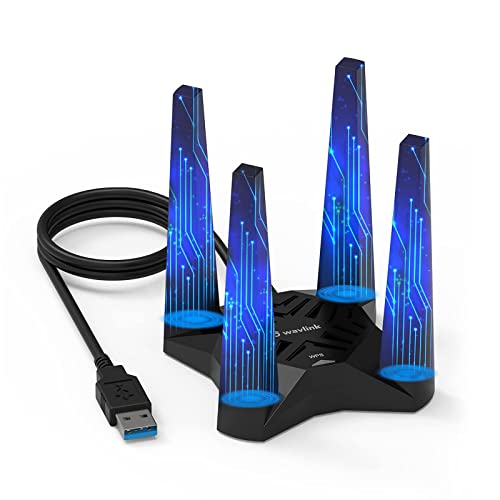
- Up to 1,800 Mbps dual-band rating
- Four high-gain antennas with magnetic base
- MU-MIMO, OFDMA, and WPA3 support
Best For: Windows gaming desktops needing flexible antenna placement
Best Simple Wi-Fi 6 Upgrade
TP-Link AX1800 Wi-Fi 6 Adapter

- Up to 1,201 Mbps on 5 GHz
- Adjustable 5 dBi antenna and USB cable
- MU-MIMO, OFDMA, and WPA3 support
Best For: Windows users upgrading a desktop or laptop to Wi-Fi 6
Best WiFi 6E USB Adapter – NETGEAR Nighthawk A8000
The NETGEAR Nighthawk A8000 is a strong choice for gamers who want to upgrade a Windows PC without opening the case. As one of the more capable wifi adapters for gaming, it adds tri-band WiFi 6E, a high-gain adjustable antenna, and USB 3.0 connectivity for a responsive wireless connection.
Best For: Windows 10 or 11 users with a WiFi 6E router who want access to the less-congested 6 GHz band.
Pros:
- Tri-band AXE3000 speeds up to 3 Gbps, with support for 2.4, 5, and 6 GHz.
- Adjustable high-gain antenna and included cradle help improve reception.
- Simple USB 3.0 installation with WPA3 security and broad router compatibility.
Cons:
- The 6 GHz band requires a compatible WiFi 6E router.
- Windows 10 or 11 is required.
The A8000 is a practical plug-in upgrade for gaming PCs that need better wireless performance without a PCIe installation. Its 6 GHz capability is especially useful in busy homes, but the benefit depends on having compatible networking equipment.
Best PCIe Gaming Upgrade – TP-Link Archer TX3000E
The TP-Link Archer TX3000E is an internal PCIe option for desktop gamers who want WiFi 6 performance and built-in Bluetooth. It is one of the more permanent wifi adapters for gaming, pairing a high-speed dual-band connection with a magnetized antenna base for flexible placement.
Best For: Windows 10 or 11 desktop users who have an open PCIe slot and want WiFi plus Bluetooth 5.3.
Pros:
- WiFi 6 speeds up to 2.4 Gbps with OFDMA and MU-MIMO for reduced network congestion.
- Magnetized antenna base and two high-performance antennas support flexible positioning.
- Includes Bluetooth 5.3 and a low-profile bracket for compatible cases.
Cons:
- Requires opening the desktop and installing a PCIe card.
- Driver installation is required, and Bluetooth needs the included USB cable connected to a motherboard header.
The TX3000E makes sense when you are upgrading a desktop rather than a laptop or compact PC. Its external antenna base can help with placement, while Bluetooth 5.3 adds convenient support for controllers, headphones, and keyboards.
Best WiFi 7 USB Adapter – NETGEAR Nighthawk A9000
The NETGEAR Nighthawk A9000 is designed for Windows 11 PCs ready for a WiFi 7 upgrade. With tri-band BE6500 performance, USB 3.0, and a flippable external antenna, it is a forward-looking pick among wifi adapters for gaming, particularly for users with a compatible WiFi 7 network.
Best For: Windows 11 gamers with a modern WiFi 7 router who want a high-speed USB connection for gaming and streaming.
Pros:
- WiFi 7 tri-band performance rated up to 6.5 Gbps.
- Flippable high-gain antenna and included cradle help optimize reception.
- USB 3.0 design avoids the need to install an internal network card.
Cons:
- Requires Windows 11 or newer and does not support Windows 10.
- WiFi 7 and 6 GHz benefits depend on compatible network equipment.
The A9000 is the most future-focused option in this group, but its requirements are specific. Choose it when your PC runs Windows 11 and your router can take advantage of its WiFi 7 capabilities; otherwise, a WiFi 6 or 6E adapter may be more practical.
Best Value WiFi 6E Adapter – PLERY AX5400 USB Adapter
The PLERY AX5400 is a USB WiFi 6E adapter aimed at desktop and laptop users who want fast tri-band connectivity without installing a PCIe card. Its dual high-gain antennas, USB 3.0 interface, and support for Windows and Linux make it a flexible entry in the wifi adapters for gaming category.
Best For: Windows 11 gamers seeking 6 GHz connectivity, or Windows 10 and Linux users who primarily need 5 GHz or 2.4 GHz support.
Pros:
- Tri-band AX5400 speeds rated up to 5.4 Gbps.
- Dual adjustable high-gain antennas support longer-range coverage.
- Pre-loaded drivers, WPA3 security, OFDMA, and MU-MIMO simplify setup and multitasking.
Cons:
- 6 GHz operation requires Windows 11 and a WiFi 6E or WiFi 7 router.
- Windows 10 users are limited to 5 GHz and 2.4 GHz connections.
This adapter offers broad compatibility and strong stated throughput for a USB model. It is a sensible choice when you want external antennas and WiFi 6E features, provided you match the operating system and router requirements to your intended band.
Best Wi-Fi 6 Upgrade – TP-Link Archer TX30U Plus
The TP-Link Archer TX30U Plus is a practical choice among wifi adapters for gaming when you want a modern Wi-Fi 6 connection without opening your desktop. Its dual-band design, high-gain antennas, beamforming, and USB 3.0 interface are suited to gaming, streaming, and everyday browsing, although actual performance depends on distance, walls, and network conditions.
Best For: Windows 10 or 11 desktop and laptop users upgrading an older or malfunctioning Wi-Fi adapter.
Pros:
- Wi-Fi 6 dual-band speeds rated up to 1,201 Mbps on 5 GHz and 574 Mbps on 2.4 GHz.
- Two adjustable high-gain antennas and beamforming help improve reception and coverage.
- USB 3.0, WPA3 security, MU-MIMO, and OFDMA support.
- Built-in driver and compact folding design simplify setup and storage.
Cons:
- Compatible only with Windows 10 and Windows 11.
- Does not guarantee maximum advertised speeds in every home or network environment.
This is a well-rounded Wi-Fi 6 USB upgrade for compatible Windows systems, especially when stronger reception and current security features matter more than broad operating-system support.
Best Wi-Fi 7 Performance – WAVLINK BE6500 USB Adapter
The WAVLINK BE6500 is a high-end option among wifi adapters for gaming, with tri-band Wi-Fi 7 connectivity and support for the 6 GHz band. Its advertised capacity, MLO and Multi-RU features, four adjustable antennas, and USB 3.0 connection are designed for demanding gaming, streaming, and file-transfer workloads, provided your router and PC support the required features.
Best For: Windows 10 or 11 desktop users with a Wi-Fi 7-compatible network who want maximum wireless capacity.
Pros:
- Tri-band Wi-Fi 7 speeds rated up to 688 Mbps on 2.4 GHz and 2,882 Mbps on both 5 GHz and 6 GHz.
- MLO and Multi-RU are designed to improve latency and stability on busy networks.
- Four foldable 5 dBi antennas support flexible positioning and wider coverage.
- Built-in Windows driver, USB 3.0, receive mode, and hotspot mode add convenience.
Cons:
- Limited to Windows 10 and Windows 11 according to the supplied specifications.
- The 6 GHz and Wi-Fi 7 benefits require compatible networking equipment.
- Larger antenna hardware may be less convenient than a compact dongle.
The BE6500 is the most future-focused pick here for a compatible setup. It makes the most sense when you already have a Wi-Fi 7 router and need high throughput, tri-band flexibility, and advanced wireless features.
Best Budget Choice – Nineplus AC1300 USB Adapter
The Nineplus AC1300 is a budget-friendly option among wifi adapters for gaming when you need a simple dual-band replacement for a desktop or laptop. It combines 5 GHz and 2.4 GHz connectivity with two 5 dBi antennas and USB 3.0, offering a straightforward way to improve an older Windows computer’s wireless connection.
Best For: Windows users who want an affordable dual-band adapter for gaming, streaming, and general online use.
Pros:
- Dual-band performance is rated up to 867 Mbps on 5 GHz and 400 Mbps on 2.4 GHz.
- Two high-gain 5 dBi antennas help with reception and longer-distance connections.
- USB 3.0 supports faster data transfer and remains compatible with USB 2.0 ports.
- Supports Windows 11, 10, 8.1, 8, 7, and XP, with setup assistance available.
Cons:
- Does not support Mac OS, Chromebook, or Linux.
- Windows 7 may require manual driver installation.
- It uses Wi-Fi 5 rather than newer Wi-Fi 6 or Wi-Fi 7 standards.
The Nineplus adapter is a sensible low-cost replacement when compatibility with several Windows versions and external antennas are priorities. It is less suitable for shoppers seeking the newest wireless standard or non-Windows support.
Best Wi-Fi 7 Upgrade – TP-Link BE6200 USB Adapter
For gamers looking for high-end wifi adapters for gaming, the TP-Link BE6200 is a strong desktop-PC upgrade. Its tri-band Wi-Fi 7 support adds access to the 6 GHz band when paired with a compatible router, while the included cradle and high-gain antennas make placement easier.
Best For: Windows 10 or 11 desktop and laptop users with a Wi-Fi 7 router who want maximum wireless throughput and low-latency gaming potential.
Pros:
- Tri-band Wi-Fi 7 supports 6 GHz, 160 MHz channels, Multi-RUs, and 4K-QAM.
- Rated speeds reach up to 2,882 Mbps on 6 GHz, 2,594 Mbps on 5 GHz, and 688 Mbps on 2.4 GHz.
- Two high-gain antennas, beamforming, and a detachable USB 3.0 cradle help improve reception and placement.
- Includes WPA3 security and a preloaded driver for Windows 10/11 installation.
Cons:
- It is compatible with Windows 10/11 only.
- Its Wi-Fi 7 and 6 GHz capabilities require a compatible tri-band Wi-Fi 7 router.
- Actual performance depends on the connecting router and network conditions.
This is the most advanced option in the group, particularly for a newer Wi-Fi 7 network. It is a better long-term choice than a basic dual-band adapter, but its extra capability is harder to justify if your router is limited to Wi-Fi 5 or Wi-Fi 6.
Best Coverage-Focused Pick – WAVLINK AX1800 Wi-Fi 6 Adapter
The WAVLINK AX1800 is one of the more practical wifi adapters for gaming when signal strength and flexible placement matter. Its dual-band Wi-Fi 6 design, four high-gain antennas, magnetic base, and USB 3.0 cable are suited to desktop setups that need a steadier connection.
Best For: Windows 10/11 desktop users who want a Wi-Fi 6 adapter with extended placement options and strong advertised coverage.
Pros:
- Dual-band speeds are rated at up to 1,200 Mbps on 5 GHz and 600 Mbps on 2.4 GHz.
- Four 3 dBi high-gain antennas and a magnetic base support signal-focused placement.
- MU-MIMO and OFDMA are designed to reduce congestion and latency across multiple devices.
- Supports WPA3, USB 3.0, and soft AP mode for creating a Wi-Fi hotspot from a wired connection.
Cons:
- Compatibility is limited to Windows 10/11 according to the supplied notes.
- Driver installation is required for the computer to recognize the adapter.
- Full performance is best paired with a Wi-Fi 6 router; a Wi-Fi 5 router can limit results.
The WAVLINK stands out for its antenna array and flexible magnetic-base design rather than maximum headline speed. It is a sensible choice for a gaming desktop located farther from the router, provided you are using a supported Windows system.
Best Simple Wi-Fi 6 Upgrade – TP-Link AX1800 Wi-Fi 6 Adapter
The TP-Link AX1800 offers a straightforward way to add Wi-Fi 6 to a compatible desktop or laptop. For wifi adapters for gaming, its dual-band support, adjustable high-gain antenna, and 1-meter USB 3.0 cable provide a practical balance of speed, placement flexibility, and everyday convenience.
Best For: Windows 10/11 users seeking a compact Wi-Fi 6 upgrade for gaming, streaming, and downloads without moving to Wi-Fi 7.
Pros:
- Wi-Fi 6 dual-band speeds are rated at up to 1,201 Mbps on 5 GHz and 574 Mbps on 2.4 GHz.
- A 5 dBi adjustable high-gain antenna and 1-meter USB 3.0 cable allow flexible positioning.
- MU-MIMO and OFDMA help reduce congestion and improve throughput.
- Supports WPA3 security and is designed for Windows 10/11 desktops and laptops.
Cons:
- It is not compatible with Linux or Mac systems.
- Actual speeds cannot exceed the router’s capabilities.
- Best performance requires a Wi-Fi 6 or newer router.
This adapter is a good middle-ground pick for a Windows gaming setup that needs a modern dual-band connection. It delivers useful Wi-Fi 6 features and adjustable placement, though users with a Wi-Fi 7 router may prefer the faster TP-Link BE6200.
How We Picked the Best Wifi Adapters for Gaming
We focused on the features that matter most for PC gaming: wireless standard, advertised throughput, band support, antenna design, connection type, compatibility, and practical placement. The selection includes USB adapters for easy installation and PCIe cards for desktops that need stronger internal hardware and more flexible antennas.
Advertised speeds are theoretical maximums rather than guaranteed gaming performance. Actual results depend on your router, internet plan, network congestion, distance, wall construction, and computer configuration. We also considered whether each adapter is a sensible match for current WiFi 6, WiFi 6E, or WiFi 7 networks.
Quick Comparison
| Adapter type | Best suited for | Main advantage |
|---|---|---|
| USB WiFi 6 | Affordable upgrades | Simple setup and solid everyday performance |
| USB WiFi 6E | Compatible 6GHz networks | Less congestion and higher available bandwidth |
| USB WiFi 7 | Newer premium networks | Strong long-term potential and high throughput |
| PCIe WiFi 6 | Desktop gaming PCs | Stable placement and external antenna flexibility |
Key Buying Factors for Wifi Adapters for Gaming
Wireless Standard and Router Compatibility
Match the adapter to your router whenever possible. WiFi 6 is a strong choice for most households, while WiFi 6E adds access to the 6GHz band. WiFi 7 can be worthwhile if you already own, or plan to buy, a WiFi 7 router. A newer adapter will not automatically make an older router faster.
Latency, Stability, and Signal Quality
Gaming depends more on consistent latency and low packet loss than on headline download speed. Dual or tri-band support, beamforming, and well-positioned antennas can help maintain a cleaner connection. Keep USB adapters away from metal obstructions and use a USB extension cradle when it improves line of sight.
USB Versus PCIe
USB models are easiest to install and work well for laptops or desktops that need a quick upgrade. PCIe cards generally offer better antenna positioning and a tidier permanent setup, but they require an available slot and may need Bluetooth headers or driver installation.
Operating System and Physical Fit
Check Windows support, included drivers, USB version requirements, and available PCIe space before buying. Larger adapters and external antenna bases may need room around the PC, while compact dongles are more convenient but can have less flexible placement.
Who Should Buy Which Wifi Adapters for Gaming?
- Choose a USB WiFi 6 adapter for an affordable, simple upgrade on a Windows gaming PC.
- Choose a WiFi 6E adapter if your router supports 6GHz and nearby networks create congestion on 5GHz.
- Choose a WiFi 7 adapter for a newer premium network and better future readiness.
- Choose a PCIe card when you have a desktop tower, an open expansion slot, and want flexible external antennas.
- Choose a high-gain dual-antenna model when your PC is far from the router or separated by several walls.
For competitive gaming, Ethernet remains the most predictable option when available. If wireless is necessary, prioritize stable placement, a compatible router, and low interference over the largest advertised speed number.