Choosing the right calculator can make chemistry feel far more manageable, especially when you’re balancing formulas, stoichiometry, logarithms, and unit conversions.
This roundup highlights the best calculators for chemistry students in 2026, with options that are practical for homework, lab work, and exam prep.
Best 10 Calculators for Chemistry Students Picks for 2026
Higher-Level Math & Science Pick
TI-36X Pro Engineering/Scientific Calculator

- MathPrint and stacked fractions improve readability.
- MultiView shows multiple calculations at once.
- Supports chemistry, calculus, stats, and biology.
Best For: Chemistry students who also need a versatile scientific calculator for advanced math and science.
Feature-Rich Solar Option
Sharp EL-W516TBSL Scientific Calculator

- WriteView 4-line display improves formula readability.
- 640 functions with seven modes for advanced coursework.
- Solar powered with memory buttons and a Home key.
Best For: Students who want a large-display scientific calculator with broad function coverage.
Budget Exam-Ready Choice
SC-216 Non-Graphing Scientific Calculator

- 240 functions cover trig, stats, and engineering.
- 2-line display shows entries and results clearly.
- Non-programmable design suits school exams.
Best For: Middle and high school chemistry students needing a simple exam-ready calculator.
Reliable Two-Line Classic
TI-30XIIS Scientific Calculator

- Two-line display shows input and result together.
- Covers stats, angle modes, and scientific notation.
- Solar and battery power add convenience.
Best For: Chemistry students who prefer a simple, reliable scientific calculator for daily use.
Compact Study Helper
iPepul Scientific Calculator with Notepad
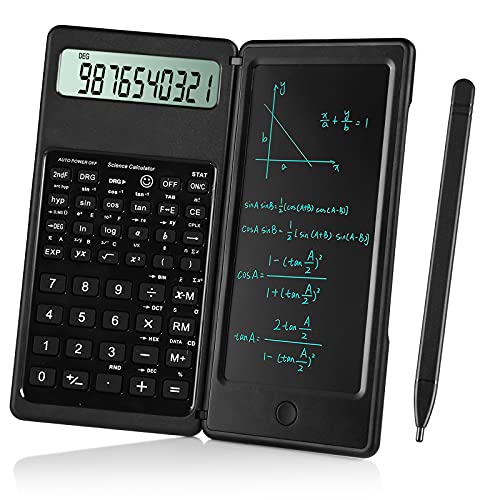
- Built-in reusable notepad for writing while calculating
- 10-digit LCD with large screen area
- Lightweight, portable design for school bags
Best For: Students who want a calculator and notepad in one
Exam-Ready Multiview
TI-34 MultiView Scientific Calculator

- Four-line display supports comparing entries and results
- MathPrint formats fractions and expressions like a textbook
- Approved for SAT, ACT, and AP exams
Best For: Middle and high school chemistry students who need an exam-approved calculator
Advanced ClassWiz
Casio FX-9910CW Scientific Calculator

- High-definition LCD with Natural Textbook Display
- Suited for engineering, science, and statistics coursework
- Compact battery-powered scientific calculator
Best For: Students who need an advanced calculator for science-heavy coursework
MultiView Pick
TI-30XS MultiView for chemistry and science

- Four-line MultiView display
- Textbook-style fractions and expressions
- Scientific notation plus x/y table feature
Best For: Students who want a simple scientific calculator for chemistry and general science
Graph-Lite Pick
Nadex scientific calculator with visual functions

- Over 360 functions for advanced math
- Graph features for formula visualization
- Large screen with three operating modes
Best For: Students who need a feature-rich scientific calculator for chemistry and advanced math
Budget Basic Pick
TI-30Xa for general chemistry work

- Core scientific functions for chemistry
- Traditional fraction entry and conversions
- Battery-powered with slide case
Best For: Students who want a simple scientific calculator for introductory chemistry
Higher-Level Math & Science Pick – TI-36X Pro Engineering/Scientific Calculator
Texas Instruments TI-36X Pro Engineering/Scientific Calculator | 9.7 Inch | Black.
Check Price On AmazonIf you want calculators for chemistry students that can also handle broader science and math coursework, the TI-36X Pro is a strong all-around option. Its MathPrint display and MultiView screen make it easier to check expressions, fractions, and conversions as you work through lab calculations or multi-step homework.
Best For: Chemistry students who also need a dependable scientific calculator for algebra, trig, statistics, and higher-level science classes.
Pros:
- MathPrint shows expressions, symbols, and stacked fractions in a textbook-style format.
- MultiView display lets you see multiple calculations on screen at once.
- Supports degree/radian modes, number format changes, and fraction/decimal conversions.
- Suitable for a wide range of subjects, including biology, calculus, and statistics.
Cons:
- Battery powered only, with no solar option.
- May be more calculator than needed for students who only need basic chemistry functions.
Overall, this is a practical choice if you want a feature-rich scientific calculator that stays useful well beyond chemistry. It offers the kind of display and math support that can make complex problem-solving easier to follow.
Feature-Rich Solar Option – Sharp EL-W516TBSL Scientific Calculator
For chemistry students who like a larger display and lots of function access, this Sharp model is a flexible pick among calculators for chemistry students. The WriteView screen helps formulas appear more naturally, and the 4-line display makes it easier to review work without losing track of your steps.
Best For: Students who want a solar-powered scientific calculator with a big display and broad function support.
Pros:
- Large 16-digit, 4-line LCD display with WriteView formatting.
- 640 functions and 7 modes, including Stat, Complex, Matrix, List, and Equation.
- Solar powered for low-maintenance use.
- Includes temporary and definable memory buttons plus a Home key to start fresh.
Cons:
- Bulkier feature set may feel unnecessary for students who only need basic chemistry calculations.
- No dedicated chemistry-specific functions are listed in the supplied details.
This is a smart choice if you want a calculator that emphasizes display clarity and a wide range of modes. It should suit students who often move between chemistry, statistics, and other advanced math tasks.
Budget Exam-Ready Choice – SC-216 Non-Graphing Scientific Calculator
SC-216 Non-Graphing Scientific Calculator, Middle/High School, Fraction Key | Non Programmable
Check Price On AmazonThe SC-216 is a straightforward option for calculators for chemistry students who want something compact, durable, and easy to use for schoolwork. With a 2-line display and 240 functions, it covers common chemistry, trig, and statistics needs without adding unnecessary complexity.
Best For: Middle and high school chemistry students who need a non-programmable, exam-ready scientific calculator.
Pros:
- 240 functions with support for trigonometry, statistics, and engineering modes.
- 2-line display improves clarity by showing entries and results.
- Non-programmable design is suitable for school and exam use.
- Compact build includes a hard cover and uses common AAA batteries.
Cons:
- Basic 12-digit display may feel limited for users who want more advanced formatting.
- Fewer premium features than higher-end scientific calculators.
For students who mainly need reliable core functions, this is a practical and portable choice. It offers the essentials for chemistry without overwhelming you with extra modes or features.
Reliable Two-Line Classic – TI-30XIIS Scientific Calculator
The TI-30XIIS is a dependable everyday choice in calculators for chemistry students who want a proven scientific calculator with a simple two-line layout. Its entry-and-result display makes it easier to check work, while the included scientific and engineering functionality covers the kinds of calculations students use most often.
Best For: Chemistry students who want a classic, no-frills scientific calculator for class, homework, and lab work.
Pros:
- Two-line display shows the entry and calculated result at the same time.
- Handles 1- and 2-variable statistics plus three angle modes.
- Supports scientific and engineering notation modes.
- Solar and battery power provide flexible everyday use.
Cons:
- Less feature-rich than advanced models with multi-line or formula-style displays.
- Does not list chemistry-specific functions beyond general scientific capabilities.
If you want a straightforward calculator from a well-known scientific line, this model fits the bill. It is a sensible pick for students who value simplicity, readability, and reliability over extra features.
Compact Study Helper – iPepul Scientific Calculator with Notepad
If you want calculators for chemistry students that also help with quick notes, this iPepul model is a practical pick. The built-in notepad lets you write while calculating, which can be handy for classwork, lab steps, and problem solving, while the 10-digit display keeps basic calculations easy to read.
Best For: Students who like a calculator and reusable notepad in one portable tool.
Pros:
- Calculator and notepad are designed together for writing and calculating at the same time.
- 10-digit LCD screen with a large 5.2-inch display area for clear viewing.
- Lightweight at 120 g and sized for a bag, pocket, or even wallet.
- Reusable note surface helps reduce paper use and can be cleared with a button.
Cons:
- More of a general scientific calculator than an advanced chemistry-specific model.
- Runs on button batteries rather than rechargeable power.
- Best suited to straightforward student use, not heavy advanced coursework features.
Overall, this is a simple, student-friendly option if you value portability and the convenience of keeping calculations and notes together. It is especially useful for everyday school work where quick writing and basic scientific functions matter most.
Exam-Ready Multiview – TI-34 MultiView Scientific Calculator
For calculators for chemistry students, the TI-34 MultiView is a strong intermediate choice when you want clear on-screen math and reliable classroom features. Its four-line MultiView display, MathPrint formatting, and fraction tools make it easier to review expressions, compare results, and work through school science problems.
Best For: Middle and high school students taking chemistry alongside algebra and geometry.
Pros:
- Four-line MultiView display helps compare entries and results on screen.
- MathPrint shows expressions and stacked fractions in textbook format.
- Advanced fraction capabilities are useful for school math and science work.
- Approved for use on SAT, ACT, and AP exams.
Cons:
- Not as feature-rich as a higher-end advanced scientific model.
- Screen is smaller than some newer calculators.
- Battery is not rechargeable.
This is a dependable pick if you want a classroom-tested calculator that emphasizes readability and exam approval. It is especially practical for students who need solid scientific functions without jumping to a graphing calculator.
Advanced ClassWiz – Casio FX-9910CW Scientific Calculator
If you need calculators for chemistry students that lean more advanced, this Casio ClassWiz model is designed for science and statistics coursework. Its high-definition quadruple-graded LCD and Natural Textbook Display make equation input and review easier, which can be helpful when dealing with more detailed scientific work.
Best For: Students in engineering, science, or statistics courses who want a more advanced scientific calculator.
Pros:
- Advanced ClassWiz design aimed at engineering, science, and statistics coursework.
- High-definition quadruple-graded LCD improves equation viewing.
- Natural Textbook Display helps with easier input and review.
- Compact battery-powered design with included AAA battery.
Cons:
- Product details here do not list specific chemistry-focused functions.
- May be more calculator than a beginner needs.
- Smaller screen size than some large-display student models.
This is the most advanced-feeling option in the group and makes sense for students expecting heavier science coursework. If your chemistry classes are getting more technical, its display style and ClassWiz platform should be a plus.
MultiView Pick – TI-30XS MultiView for chemistry and science
If you’re comparing calculators for chemistry students, the TI-30XS MultiView is a practical choice for everyday classwork. Its four-line display helps you review multiple steps at once, while textbook-style math entry makes fractions, exponents, and expressions easier to read during problem solving.
Best For: Students who want a straightforward scientific calculator for chemistry, general science, and other high school STEM classes.
Pros:
- MultiView screen shows up to four lines so you can compare calculations on-screen.
- Displays math expressions and stacked fractions in a textbook-like format.
- Shows scientific notation with proper superscripted exponents.
- Includes a table feature for exploring x/y values.
Cons:
- It is a scientific calculator, not a graphing calculator.
- Best suited to general science rather than advanced college-level math needs.
Overall, this is one of the strongest all-around calculators for chemistry students who need clarity and reliability without extra complexity. The four-line layout is especially useful when you want to keep track of steps and results side by side.
Graph-Lite Pick – Nadex scientific calculator with visual functions
For shoppers comparing calculators for chemistry students, the Nadex model stands out if you want a feature-heavy scientific calculator with visual support. It offers over 360 functions, including complex numbers, fractions, linear regression, standard deviation, and variable solving, plus graph functions meant for formula visualization.
Best For: Students who want a feature-rich scientific calculator for chemistry, physics, and advanced math classes.
Pros:
- Over 360 functions cover complex numbers, fractions, and variable solving.
- Graph functions can help visualize formulas, even though it is not a true graphing calculator.
- Large screen supports simultaneous display of equations and graphic visuals.
- Includes three operating modes for calculation, angular measurement, and display.
Cons:
- The product notes state that it is not a graphing calculator.
- Its feature set may be more than some students need for basic chemistry work.
This is a strong pick if you want more functions than a basic scientific calculator and like the idea of formula visualization. It is best for students who expect to use the same calculator across chemistry, physics, and advanced math.
Budget Basic Pick – TI-30Xa for general chemistry work
If you want a straightforward option among calculators for chemistry students, the TI-30Xa keeps things simple. It has a one-line display and covers the core scientific functions most students need for general chemistry and basic science calculations.
Best For: Students who want a basic, battery-powered scientific calculator for introductory chemistry and science courses.
Pros:
- Performs trigonometric functions, logarithms, roots, powers, reciprocals, and factorials.
- Handles fractions in traditional numerator/denominator format.
- Includes 1-variable statistics plus unit conversions like degrees/radians and DMS.
- Battery-powered design comes with a slide case.
Cons:
- One-line display is less convenient than multi-line models.
- Does not offer the larger feature set of more advanced calculators.
This is a sensible no-frills choice if you mainly need the essentials for chemistry homework and class tests. It trades display convenience and advanced features for simplicity and familiarity.
How We Picked the Best Calculators for Chemistry Students
We focused on Calculators for Chemistry Students that offer the right mix of scientific functions, ease of use, and classroom practicality. The strongest picks include models with fraction handling, exponents, logs, statistical tools, and clear displays that reduce input mistakes.
We also considered durability, battery or solar support, and whether a calculator is simple enough for daily use without being overly limited. Since course rules vary, we prioritized models that suit common high school and college chemistry needs rather than specialized engineering-only use.
Quick Comparison
For most chemistry courses, a reliable scientific calculator with multi-line display is the safest choice. Four-line and WriteView-style screens are especially helpful when checking long equations, balancing reactions, or reviewing stoichiometry steps.
If you want the simplest option, basic scientific calculators are usually enough for introductory chemistry. If your classes are more advanced, look for stronger fraction support, more function keys, and easier access to logs, powers, and memory features.
Key Buying Factors for Calculators for Chemistry Students
Display Style
A readable display matters more than many buyers expect. Multi-line displays can make entered expressions easier to verify, which is useful when working with nested calculations or repeated formula inputs.
Scientific Function Set
Look for powers, roots, scientific notation, logs, natural logs, memory functions, and fraction tools. These are core features for chemistry students handling molar mass, pH, gas laws, and concentration problems.
Exam and Classroom Rules
Check whether your school allows programmable or graphing models before you buy. Many chemistry classes only require a standard scientific calculator, and some exams restrict advanced capabilities.
Power and Durability
Battery plus solar backup can be a practical advantage for long school days. A sturdy build and comfortable key spacing also help if you use the calculator often during labs and homework sessions.
Who Should Buy Which Calculators for Chemistry Students?
Introductory students usually do best with a straightforward scientific model that covers the essentials without adding complexity. Students taking honors chemistry, AP Chemistry, or early college science courses may prefer a more advanced calculator with better display visibility and fraction handling.
If you value speed and simplicity, choose a familiar non-graphing scientific calculator. If you want the most flexibility for future math and science classes, pick a feature-rich model that can stay useful beyond chemistry.
In short, the best Calculators for Chemistry Students are the ones that match your course requirements, display preference, and comfort level. A good fit should help you solve problems faster, check your work more easily, and stay compliant with classroom rules.