Choosing the right calculator can make statistics coursework faster, cleaner, and far less frustrating. From summarizing data sets to handling probability and regression, the best model depends on your class level and exam rules.
This roundup of calculators for statistics students focuses on practical features, ease of use, and value so you can pick a calculator that fits your coursework without paying for tools you will never use.
Best 10 Calculators for Statistics Students Picks for 2026
Four-Line Multiview Value
TI-30XS for stats-focused study

- Four-line display shows multiple calculations at once.
- Textbook-style layout keeps expressions readable.
- Supports stats, science, and function tables.
Best For: Students who want a simple scientific calculator for statistics and general math.
Graphing Power for Data Work

- Graphing calculator with regressions and probability functions.
- Includes bar charts, pie charts, and spreadsheet apps.
- Backlit LCD and data-transfer features add convenience.
Best For: Students who need graphing and more advanced statistics tools.
Two-Line Scientific Helper

- Two-line display shows input and result together.
- Includes statistics, trig, and hyperbolic functions.
- Protective lid and sturdy buttons suit school use.
Best For: Students who want a simple scientific calculator with stats support.
Advanced ClassWiz Pick
FX-9910CW for science and stats

- High-definition LCD improves readability.
- Natural Textbook Display simplifies equation entry.
- Built for engineering, science, and statistics coursework.
Best For: Students who want a modern scientific calculator with an easy-to-read display.
Graphing Workhorse
TI-84 Plus for Stats and Graphing

- Up to 10 functions can be graphed and analyzed at once.
- Includes list-based stats, regression, and hypothesis tests.
- Preloaded apps and split-screen options add flexibility.
Best For: Stats students who want a familiar graphing calculator with strong analysis tools.
Textbook-Style Scientific
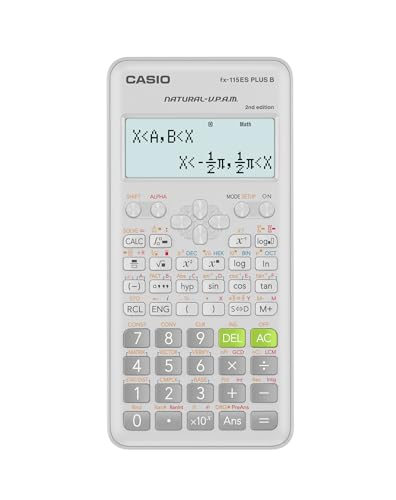
- Natural Textbook Display matches textbook formatting.
- Compact scientific calculator for coursework use.
- Lightweight, battery-powered design.
Best For: Students who need a simple scientific calculator for stats-related coursework.
Stats-Heavy Renewed Pick
TI-84 Plus with Advanced Analysis

- List-based stats plus many regression models are included.
- Has 9 hypothesis tests, 6 confidence intervals, and ANOVA.
- Also graphs functions, sequences, and statistical plots.
Best For: Students who want a feature-rich graphing calculator with advanced statistics tools.
Budget Scientific Starter

- 1-variable statistics with mean and standard deviation
- Covers fractions, trig, logs, roots, powers, and factorials
- Battery-powered and includes a slide case
Best For: Students taking introductory statistics and general math
Advanced Classroom Option

- MultiView display shows multiple calculations at once
- MathPrint shows textbook-style expressions and stacked fractions
- Works for statistics, calculus, and other higher-level math
Best For: High school and college stats students who need a non-graphing calculator
Exam-Ready Two-Line Pick

- One- and two-variable statistics included
- Two-line display shows entry and result together
- Solar plus battery power and exam approval
Best For: High school statistics students preparing for standardized tests
Four-Line Multiview Value – TI-30XS for stats-focused study
If you want one of the most practical calculators for statistics students, the TI-30XS MultiView is built to make comparisons and formulas easier to follow. Its four-line display lets you view multiple calculations at once, while the textbook-style layout helps keep expressions readable during classwork and homework.
Best For: Students who want a straightforward scientific calculator for statistics, algebra, and general science.
Pros:
- Four-line MultiView display helps compare results and spot patterns on-screen.
- Textbook-style math display makes fractions and symbols easier to read.
- Includes scientific notation output and quick access to frequently used functions.
- Can explore (x,y) table values for functions automatically or by entry.
Cons:
- It is a scientific calculator, not a graphing model.
- Best suited for general math and stats rather than advanced plotting work.
For statistics students who mainly need clear input, multi-line viewing, and dependable scientific functions, this is a strong everyday pick. It covers the core classroom needs without adding unnecessary complexity.
Graphing Power for Data Work – fx-9860GII with stats tools
Among calculators for statistics students who need more than basic arithmetic, the Casio fx-9860GII stands out for its broad set of data and probability tools. It adds features like regression types, chi-squared goodness-of-fit, bar graphs, pie charts, spreadsheet apps, and a backlit LCD for easier viewing.
Best For: Students who need graphing capability and a wider statistics feature set for coursework.
Pros:
- Includes chi-squared GOF, random integers, unit conversion, and multiple probability functions.
- Supports regressions, pie charts, bar graphs, and graphing X=f(Y).
- Built-in eActivity and spreadsheet applications add flexibility for data work.
- Backlit LCD improves visibility in different lighting conditions.
Cons:
- More complex than a basic scientific calculator.
- May be more calculator than needed for intro-level stats classes.
If your statistics classes involve heavier data analysis, graphing, and model exploration, this Casio offers far more depth than a standard scientific calculator. It is a strong choice when you want one device to handle stats and visual analysis together.
Two-Line Scientific Helper – TI-30 XIIB for coursework
The TI-30 XIIB is a practical option for calculators for statistics students who want a clear, no-frills scientific model. Its two-line display shows input and result at a glance, and the calculator includes statistics alongside advanced scientific, trigonometric, and hyperbolic functions.
Best For: Students who want a simple two-line scientific calculator with statistics support.
Pros:
- Two-line display makes it easy to review input and result together.
- Includes statistics plus advanced scientific and trigonometric functions.
- Scrollable input line supports 11 digits, with decimal and exponent display.
- Protective lid and sturdy color-coded buttons help with classroom use.
Cons:
- Does not offer graphing features.
- Display is less expansive than multi-line models.
For students who mainly need a reliable scientific calculator with stats features and easy-to-read results, this Texas Instruments model keeps things simple. It is a solid everyday school calculator without the learning curve of a graphing unit.
Advanced ClassWiz Pick – FX-9910CW for science and stats
For calculators for statistics students who also want a modern scientific layout, the Casio FX-9910CW brings a high-definition LCD and Natural Textbook Display. That combination makes equation entry and review easier, which is useful when you are checking formulas and working through statistics coursework.
Best For: Students in science or statistics courses who want a modern scientific calculator with an easy-to-read display.
Pros:
- High-definition quadruple-graded LCD improves visibility.
- Natural Textbook Display makes equation input and review easier.
- Designed for engineering, science, and statistics coursework.
- Battery-powered with an included AAA battery.
Cons:
- Feature details are less explicit than some competing stats-focused models.
- It is still a scientific calculator, so it is not built for full graphing work.
This Casio is a good fit if you value display quality and a clean input experience over a long list of extra tools. It should suit students who need a dependable scientific calculator for statistics and related coursework.
Graphing Workhorse – TI-84 Plus for Stats and Graphing
Texas Instruments TI-84 Plus Graphics Calculator, Black 320 x 240 pixels (2.8" diagonal)
Check Price On AmazonFor calculators for statistics students, the TI-84 Plus is a practical all-purpose choice with strong graphing, list handling, and analysis tools. It supports up to ten functions at once, offers multiple graph styles, and includes interactive zoom and split-screen options for checking equations and visualizing results.
Best For: Stats students who want a familiar graphing calculator with built-in statistical analysis and graphing flexibility.
Pros:
- Up to 10 graphing functions can be defined, saved, graphed, and analyzed at one time.
- List-based one- and two-variable statistical analysis with multiple regression models.
- Includes 9 hypothesis tests, 6 confidence interval functions, and one-way ANOVA.
- Preloaded apps and interactive geometry software add extra coursework support.
Cons:
- Graphing-focused design may be more calculator than some students need for basic stats work.
- Battery-powered model requires keeping a spare battery in mind.
Overall, this TI-84 Plus stands out for students who need a calculator that can handle both statistics and broader graphing tasks. It is especially useful if you want one device that can support class, homework, and exam use.
Textbook-Style Scientific – Casio FX-115ESPLSB for Stats
Among calculators for statistics students, this Casio scientific model is a straightforward option when you want a compact tool for coursework without moving up to a graphing calculator. Its Natural Textbook Display shows expressions the way they appear in class materials, which can make setup and checking calculations feel more intuitive.
Best For: Students who need a simple scientific calculator for stats-related coursework and clear expression display.
Pros:
- Natural Textbook Display shows expressions exactly as in textbooks.
- Compact scientific design is suited to engineering, science, and statistics coursework.
- Battery-powered and lightweight for everyday classroom use.
Cons:
- It is a scientific calculator, so it lacks the graphing and advanced statistical features of a TI-84 class device.
- No stats-specific functions are listed in the supplied notes beyond coursework suitability.
This is a sensible pick if you mainly need a reliable scientific calculator and prefer a textbook-style display. It makes the most sense for classes where graphing is not required but clear input and portability matter.
Stats-Heavy Renewed Pick – TI-84 Plus with Advanced Analysis
If you are comparing calculators for statistics students and want a TI-84 option with deeper analysis features, this renewed model is a strong fit. It goes beyond basic graphing with list-based statistical analysis, multiple regression types, statistical plots, hypothesis testing, confidence intervals, and one-way ANOVA.
Best For: Students who want a feature-rich graphing calculator with advanced statistics tools.
Pros:
- Supports list-based one- and two-variable statistical analysis.
- Includes regression models such as linear, exponential, polynomial, logistic, and more.
- Offers 9 hypothesis tests, 6 confidence interval functions, and one-way ANOVA.
- Can graph multiple function types and analyze roots, maxima, minima, derivatives, and integrals.
Cons:
- Renewed product condition may not appeal to everyone.
- More calculator than needed for students taking only introductory stats.
This renewed TI-84 Plus is the most statistics-forward option in the group, especially if your coursework uses regression, testing, and data plots. It is best suited to students who will actually use the advanced menu of statistical tools rather than only basic arithmetic.
Budget Scientific Starter – TI-30Xa for Core Statistics
If you need calculators for statistics students without paying for extra features, the TI-30Xa is a straightforward pick. It covers one-variable statistics, basic scientific functions, and common conversions, making it a practical fit for early math, algebra, and introductory stats work.
Best For: Students who need a simple, battery-powered calculator for pre-algebra through introductory statistics and general science.
Pros:
- Includes 1-variable statistics with mean and standard deviation
- Handles fractions, trigonometry, logarithms, roots, powers, and factorials
- Supports fraction/decimal and angle conversions
- Battery-powered and comes with a slide case
Cons:
- One-line display is less flexible than multi-line models
- Focused on basic statistics rather than advanced coursework
For students who mainly need dependable basics, the TI-30Xa keeps things simple and covers the essential functions most early statistics classes require. It is a sensible low-cost option when advanced display features are not necessary.
Advanced Classroom Option – TI-36X Pro for Statistics
Texas Instruments TI-36X Pro Engineering/Scientific Calculator | 9.7 Inch | Black.
Check Price On AmazonThe TI-36X Pro is a stronger choice for calculators for statistics students who need more depth than a basic scientific model. Its MultiView display can show multiple calculations at once, and the MathPrint layout presents expressions and stacked fractions in a textbook-style format that is useful in higher-level math and statistics classes.
Best For: High school through college students in statistics, calculus, and other courses where graphing calculators may not be allowed.
Pros:
- MultiView display shows multiple calculations at the same time
- MathPrint formats expressions and stacked fractions clearly
- Suitable for statistics, algebra, geometry, trigonometry, and calculus
- Supports conversions and multiple number-format modes
Cons:
- More advanced than a basic starter calculator
- Battery-powered only, with no solar assist noted
This model stands out when students want a non-graphing calculator with more capable math handling and a clearer display. For statistics courses that go beyond the basics, it offers a useful balance of power and classroom practicality.
Exam-Ready Two-Line Pick – TI-30XIIS for Stats
The TI-30XIIS is a practical middle ground for calculators for statistics students who want clear display and exam-friendly basics. Its two-line screen shows the entry and result together, and it includes one- and two-variable statistics along with standard scientific and fraction features.
Best For: Students who want a reliable, exam-approved calculator for high school statistics and general science.
Pros:
- Includes one- and two-variable statistics
- Two-line display makes it easier to follow calculations
- Solar and battery powered for flexible use
- Approved for SAT, ACT, and AP exams
Cons:
- Less advanced than the TI-36X Pro
- Not designed for graphing or higher-end statistical workflows
For many students, this is the most balanced option because it combines statistics support with a clear display and broad exam acceptance. If you want a dependable calculator that can move from classwork to test day, it is a strong contender.
How We Picked the Best Calculators for Statistics Students
We focused on calculators that are useful for common statistics tasks such as descriptive statistics, standard deviation, combinations and permutations, fraction work, and basic graphing or data entry when needed. We also considered display clarity, menu usability, exam acceptance, and whether the calculator is a better fit for introductory or more advanced coursework.
Quick Comparison: What Type of Calculator Do You Need?
If you are in an introductory class, a scientific calculator is usually enough for summary statistics, probability, and formula work. If your course uses data analysis, regression, or graphing, a graphing calculator can save time. Many Calculators for Statistics Students sit in the middle: they offer stronger statistical functions than basic models without the complexity of a full graphing device.
Key Buying Factors
Statistics Functions
Look for built-in one-variable and two-variable statistics, standard deviation, linear regression, factorials, and probability tools. These features matter more than flashy extras for most students.
Display and Ease of Use
A multi-line display helps you review inputs and catch mistakes, which is especially useful when entering long formulas or checking data calculations. Clear menus and labeled keys also reduce errors during timed exams.
Exam Rules
Always check your instructor’s or testing program’s calculator policy before buying. Some classes allow graphing calculators, while others require non-graphing scientific models only.
Battery and Portability
Solar-plus-battery models are convenient for long semesters, while battery-only units may be simpler to manage. Lightweight calculators are easier to carry between statistics, math, and science classes.
Who Should Buy Which Calculators for Statistics Students?
Choose a basic scientific calculator if you only need standard statistics operations and want an affordable option. Pick a more advanced scientific model if your coursework includes repeated distribution work, regression, or heavier formula use. Select a graphing calculator if your professor allows it and you expect to handle data visualization, function plotting, or more advanced analysis. For most Calculators for Statistics Students, the best choice is the simplest model that still covers your class requirements comfortably.