The right cooled astronomy camera can make deep-sky imaging more consistent by reducing thermal noise and preserving detail during long exposures. This roundup compares 10 notable color and monochrome options across several sensor sizes, resolutions, and budgets.
Use the buying guide below to match sensor format, cooling performance, connectivity, and workflow features to your telescope and imaging goals.
Best 10 Cooled Astronomy Cameras Picks for 2026
High-Speed Deep-Sky Pick

- STARVIS 2 color sensor with 8.29MP resolution
- More than 35°C below-ambient two-stage TEC cooling
- 47fps full-resolution high-speed mode and zero amp glow
Best For: Versatile deep-sky, lunar, solar, and planetary imaging
Large-Sensor Value

- 4/3-inch IMX294 color sensor with 11.7MP resolution
- 63ke- full well capacity and 14-bit ADC output
- Cooling to 30°C below ambient with broad OS support
Best For: Deep-sky imaging with a large sensor and flexible software support
Integrated Smart-Rig Option

- Combines imaging, guiding, and ASIAir control
- 256GB eMMC storage plus external-storage support
- Wireless connectivity and cooling down to 30–35°C below ambient
Best For: Simplified, phone-controlled astrophotography rigs
Square-Frame Deep-Sky Choice
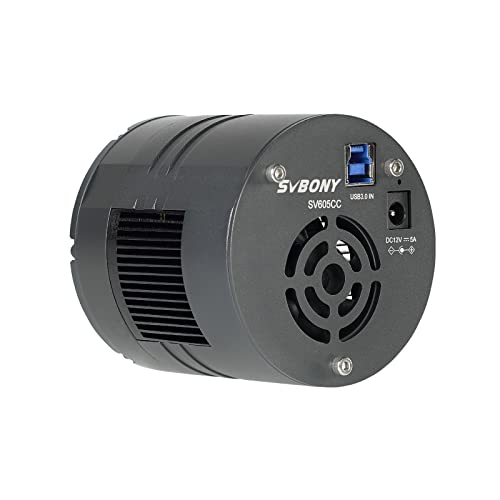
- 9MP square 1-inch IMX533 color sensor
- Up to 80% stated quantum efficiency and glow suppression
- Two-stage cooling to 30°C below ambient
Best For: Deep-sky, panoramic, meteor-monitoring, and lucky imaging
Best High-Speed Mono Value

- 8.29MP monochrome sensor with up to 47 fps
- Zero amp glow and 40ke- full well capacity
- TEC cooling, USB 3.0, and 512MB cache
Best For: Versatile deep-sky and planetary imaging
Best Color APS-C Option
SVBONY SC571CC Cooled Color Camera

- 26MP APS-C color sensor for broad coverage
- 16-bit ADC with up to 14 stops of dynamic range
- Cooling, window heater, and zero amp glow
Best For: High-resolution one-shot-color deep-sky imaging
Best High-Resolution Mono Choice

- 26.1MP APS-C monochrome IMX571 sensor
- 16-bit output and 13.9 stops of dynamic range
- 30–35°C cooling with 1.0e read noise
Best For: Detailed, filter-based deep-sky imaging
Accessible Deep-Sky Choice

- 11.7MP IMX294 color sensor
- USB 3.0 with up to 19 fps RAW8
- Includes UV/IR-cut filter
Best For: Beginners and intermediate deep-sky imagers
High-Resolution Mono Flagship

- 62MP full-frame monochrome sensor
- True 16-bit ADC with up to 14 stops
- Zero amp glow for long exposures
Best For: Experienced monochrome astrophotographers
Full-Frame Color Detail

- 62MP full-frame color sensor
- True 16-bit ADC and zero amp glow
- Built-in anti-dew heater
Best For: High-resolution one-shot color imaging
High-Speed Deep-Sky Pick – ZWO ASI585MC Pro
The ZWO ASI585MC Pro is one of the more versatile cooled astronomy cameras for users who want a color camera that can handle deep-sky imaging as well as solar, lunar, and planetary work. Its STARVIS 2 sensor, 8.29MP resolution, and fast USB 3.0 transfer make it a flexible choice for both long exposures and high-frame-rate capture.
Best For: Astrophotographers seeking a versatile cooled color camera for deep-sky and planetary imaging.
Pros:
- Two-stage TEC cooling can reach more than 35°C below ambient under stated test conditions.
- Zero amp glow and a 47ke- full well capacity support clean, high-dynamic-range images.
- USB 3.0 and 512MB DDR3 cache enable up to 47fps at full resolution in high-speed mode.
- Built-in USB 2.0 hub can connect accessories such as an electronic filter wheel, guide camera, or focuser.
Cons:
- The compact 2.9μm pixels may require careful matching with a telescope and seeing conditions.
- Cooling performance varies with ambient temperature and extended operation.
With high quantum efficiency, HCG mode, low read noise at high gain, and no amp glow, the ASI585MC Pro offers a strong balance between sensitivity and versatility. It is especially appealing if you want one camera for several types of astronomical targets.
Large-Sensor Value – SVBONY SV405CC
The SVBONY SV405CC is a cooled astronomy camera built around a large 4/3-inch IMX294 color sensor. Its 4.63μm pixels, 63ke- full well capacity, and 14-bit output make it well suited to deep-sky imaging where light gathering, dynamic range, and smooth tonal data matter.
Best For: Deep-sky photographers who want a larger sensor and broad software compatibility.
Pros:
- The back-illuminated IMX294 sensor provides 11.7MP resolution and strong light capture.
- Two-stage TEC cooling can lower sensor temperature up to 30°C below ambient.
- Smart HCG mode activates at gain 120 or higher to reduce read noise while retaining dynamic range.
- USB 3.0, a 256MB buffer, and support for Windows, Linux, Mac OS, Chrome OS, and Raspberry Pi add flexibility.
Cons:
- The camera is relatively heavy at 3.08 pounds.
- Its full-resolution speed is lower than some smaller-sensor cameras, at 19fps in RAW8 or 16fps in RAW16.
The SV405CC makes a practical case for a larger cooled color sensor without sacrificing modern connectivity. Its 14-bit ADC, high full-well capacity, and HCG mode are useful for capturing faint targets while preserving processing latitude.
Integrated Smart-Rig Option – ZWO ASI585MC Air
ZWO ASI585MC AIR Cooled Color Astronomy Camera w/Built-in Guide Camera & ASIAir with Power Supply
Check Price On AmazonThe ZWO ASI585MC Air combines a cooled color imaging camera, guide camera, and control system in one unit. For shoppers comparing cooled astronomy cameras, its built-in ASIAir features, wireless connectivity, storage, and accessory ports make it a particularly convenient option for streamlined, phone-controlled setups.
Best For: Users who want integrated imaging, guiding, and telescope control with minimal separate hardware.
Pros:
- Combines imaging, guiding, and control functions in a single camera system.
- Built-in 256GB eMMC storage and support for up to 1TB external storage provide substantial capacity.
- Dual-band Wi-Fi, Bluetooth, multiple USB ports, and DC outputs support connected rigs.
- STARVIS 2 technology, zero amp glow, HCG mode, and cooling of 30–35°C below ambient support clean images.
Cons:
- Its integrated system may be more than needed for users who already own separate control hardware.
- The listed continuous shooting speed is 10fps, lower than the ASI585MC Pro’s stated high-speed mode.
The ASI585MC Air is less about maximizing standalone camera specifications and more about simplifying the entire imaging workflow. Its storage, wireless control, guiding capability, and accessory connections make it a compelling choice for portable or tightly integrated rigs.
Square-Frame Deep-Sky Choice – SVBONY SV605CC
The SVBONY SV605CC is a cooled astronomy camera designed around a square 1-inch IMX533 color sensor. Its 9MP resolution, 3.76μm pixels, glow suppression, and USB 3.0 connection make it a practical option for deep-sky photography, panoramic astronomy, meteor monitoring, and lucky imaging.
Best For: Deep-sky enthusiasts who prefer a square sensor for flexible framing and panoramic applications.
Pros:
- The 3008×3008 square sensor provides a distinctive framing format for astronomy targets.
- IMX533 technology offers stated quantum efficiency of up to 80% and glow suppression.
- Two-stage TEC cooling can reduce sensor temperature by up to 30°C below ambient.
- USB 3.0 connectivity supports high-speed camera operation.
Cons:
- The square 1-inch sensor has a smaller format than the 4/3-inch SV405CC.
- The supplied notes do not specify a frame rate or ADC bit depth.
- At 1.6kg, it may add noticeable weight to a portable telescope setup.
The SV605CC stands out for its square IMX533 sensor and emphasis on glow suppression. It is worth considering when composition flexibility, deep-sky work, or specialized uses such as meteor monitoring matter more than maximum sensor size.
Best High-Speed Mono Value – ZWO ASI585MM Pro
The ZWO ASI585MM Pro is one of the more versatile cooled astronomy cameras for buyers who want monochrome deep-sky capability without giving up fast planetary and lunar imaging. Its 8.29MP sensor, zero amp glow, and two-stage TEC cooling make it practical for both long exposures and high-frame-rate capture.
Best For: Astrophotographers who want a compact monochrome camera for deep-sky, lunar, solar, and planetary work.
Pros:
- Fast capture up to 47 fps at full resolution in high-speed mode.
- Two-stage TEC cooling can reach more than 35°C below ambient under specified test conditions.
- Zero amp glow, 40ke- full well capacity, and up to 91% peak QE support clean, detailed images.
- USB 3.0, 512MB DDR3 cache, and a USB 2.0 hub support smooth connected setups.
Cons:
- The 8.29MP, one-inch-class sensor provides less coverage than APS-C alternatives.
- As a monochrome camera, it requires a filter-based imaging workflow for color results.
The ASI585MM Pro stands out when speed and flexibility matter as much as cooling. It is especially appealing for imagers who regularly switch between deep-sky exposures and solar, lunar, or planetary targets.
Best Color APS-C Option – SVBONY SC571CC Cooled Color Camera
The SVBONY SC571CC is a strong choice among cooled astronomy cameras for photographers who want a high-resolution color workflow. Its 26MP APS-C sensor, 16-bit ADC, integrated front-window heater, and dual-stage cooling are designed for detailed long-exposure deep-sky imaging.
Best For: Deep-sky photographers seeking a large color sensor for nebulae, Ha regions, and molecular clouds.
Pros:
- 26MP APS-C BSI sensor with a 23.4 × 15.7mm active area captures broad, detailed frames.
- 16-bit ADC and up to 14 stops of dynamic range support smoother tonal transitions.
- Dual-stage TEC cooling reaches up to 35°C below ambient under the stated specification.
- Front-window heater, zero amp glow, and 512MB DDR3 buffering support extended sessions.
Cons:
- The larger APS-C sensor may require careful matching with the telescope’s image circle.
- Its 1.31-pound body is less lightweight than smaller astronomy-camera formats.
Choose the SC571CC if you prefer a one-camera color setup with generous sensor coverage. Its combination of cooling, dew protection, and high bit depth is particularly useful for all-night deep-sky sequences.
Best High-Resolution Mono Choice – ZWO ASI2600MM Pro
The ZWO ASI2600MM Pro is a high-resolution option among cooled astronomy cameras, pairing a 26.1MP monochrome Sony IMX571 sensor with 16-bit output and a wide 13.9-stop dynamic range. Its low read noise and advanced cooling make it well suited to demanding deep-sky workflows.
Best For: Experienced monochrome imagers who need detailed APS-C coverage and strong tonal performance.
Pros:
- 26.1MP APS-C sensor with 3.76-micron pixels provides substantial imaging detail.
- 16-bit ADC, 13.9 stops of dynamic range, and 1.0e read noise support faint-target work.
- Cooling reaches 30–35°C below ambient, helping reduce thermal noise in long exposures.
- 91% quantum efficiency and a 512MB DDR3 buffer support efficient, stable capture.
Cons:
- The 3.51 fps full-resolution frame rate is much slower than high-speed planetary-oriented cameras.
- Monochrome imaging generally requires filters and a more involved processing workflow.
- The 1.5-pound camera is relatively substantial for a telescope imaging setup.
The ASI2600MM Pro is the more detail-focused pick for photographers building a serious monochrome system. Its APS-C sensor and 16-bit data provide room for detailed crops and nuanced processing, while the cooling supports lengthy exposures.
Accessible Deep-Sky Choice – SV405CC Cooled Color Camera
The SVBONY SV405CC is a practical entry point into cooled astronomy cameras for deep-sky imaging. Its 11.7MP IMX294 color sensor, USB 3.0 connectivity, and included UV/IR-cut filter make it suited to capturing nebulae, galaxies, star clusters, and multiple-star targets.
Best For: Beginners and intermediate astrophotographers who want a color camera for deep-sky targets without assembling a monochrome filter workflow.
Pros:
- TEC-cooled color design for deep-space astrophotography.
- 11.7MP 4/3-format IMX294 sensor with 4K video capability.
- USB 3.0 supports up to 19 fps in RAW8 at full resolution.
- Included UV/IR-cut filter helps limit unwanted ultraviolet and infrared wavelengths.
Cons:
- Lower resolution than the 62MP full-frame alternatives in this roundup.
- Manual focus and exposure controls may require more hands-on setup.
- The listed weight is 3.7 pounds, which may matter for smaller mounts.
The SV405CC emphasizes convenience: a color sensor and included filter simplify the path to usable deep-sky images. Choose it when straightforward operation and a broad range of nebula and galaxy targets matter more than maximum resolution.
High-Resolution Mono Flagship – ASI6200MM Pro Monochrome
The ZWO ASI6200MM Pro is a full-frame option for demanding users comparing cooled astronomy cameras for detailed monochrome imaging. Its 62MP sensor, true 16-bit ADC, 14-stop dynamic range, and zero-amp-glow circuitry are designed for high-resolution stills and extensive image processing.
Best For: Experienced astrophotographers building a monochrome imaging system and needing a large field of view with strong tonal detail.
Pros:
- Full-frame 36×24mm sensor with 62MP resolution.
- True 16-bit ADC and dynamic range up to 14 stops.
- Zero amp glow helps simplify long-exposure processing.
- USB 3.0 and built-in DDR3 cache support stable data transmission.
Cons:
- Monochrome imaging generally requires a more involved filter-based setup.
- External 11–14V power is required for cooling and is not included.
- Its high-resolution full-frame format can demand substantial storage and processing resources.
This camera is aimed at users who will take advantage of monochrome capture, broad framing, and fine dynamic-range control. It is a technically ambitious choice rather than a simple all-in-one color solution.
Full-Frame Color Detail – ASI6200MC Pro
The ZWO ASI6200MC Pro combines a full-frame 62MP color sensor with the advanced features expected from premium cooled astronomy cameras. Its back-illuminated IMX455 sensor, true 16-bit ADC, low readout noise, and zero-amp-glow design target detailed wide-field imaging with less dependence on a monochrome filter workflow.
Best For: Astrophotographers who want high-resolution full-frame color images, large fields of view, and simplified capture compared with a monochrome setup.
Pros:
- 62MP full-frame BSI CMOS sensor with 3.76µm pixels.
- True 16-bit ADC and dynamic range up to 14 stops.
- Ultra-low 1.2e− readout noise and zero amp glow.
- Included polyimide anti-dew heater helps protect the optical window.
Cons:
- External 12V, 3A–5A power is required and is not included.
- Full-frame 62MP files can require significant storage and processing capacity.
- Its premium capabilities may be more than needed for casual imaging.
The ASI6200MC Pro is the color-oriented counterpart to the ASI6200MM Pro, offering broad framing and high detail without requiring a monochrome filter workflow. It is a strong fit when one-shot color convenience and maximum resolution are priorities.
How We Picked These Cooled Astronomy Cameras
We selected models across the main categories astrophotographers consider: one-shot color and monochrome capture, compact and full-frame sensors, resolution, cooling capability, and overall system compatibility. The lineup includes cameras built for planetary and wide-field work as well as demanding deep-sky imaging.
We also considered practical ownership factors, including USB connectivity, filter requirements, guiding options, software and ecosystem support, and whether a camera is suited to a beginner-friendly setup or a more advanced imaging rig. Specifications can vary by revision, so verify current sensor, driver, power, and accessory details before ordering.
Quick Comparison
- Best for simple color imaging: A cooled one-shot color camera reduces the need for separate filters and simplifies capture.
- Best for maximum processing control: Monochrome cameras paired with red, green, blue, and narrowband filters offer greater flexibility.
- Best for compact wide-field rigs: Smaller sensors can be easier to pair with short focal-length telescopes and portable mounts.
- Best for large targets and high-resolution systems: APS-C and full-frame cameras provide broader framing, but they demand better optics and more precise calibration.
- Best for integrated workflows: An astronomy camera with built-in guiding or ecosystem features may reduce setup complexity.
Key Buying Factors for Cooled Astronomy Cameras
Sensor Size and Field of View
Sensor dimensions determine how much sky your telescope captures. Smaller sensors are often forgiving with inexpensive or compact optics, while APS-C and full-frame models can frame expansive nebulae and galaxies more efficiently. Check image-circle coverage, backfocus, and potential vignetting before choosing a larger format.
Color Versus Monochrome
Color cameras are generally easier to operate because they capture a finished color image through a built-in color filter array. Monochrome cameras can deliver sharper, more specialized results, especially with narrowband filters, but require filter wheels, multiple exposures, and more processing time.
Cooling and Power
Thermoelectric cooling helps stabilize the sensor and reduce dark current during long exposures. Compare the stated cooling range, power requirements, and cooling consistency rather than focusing only on the lowest temperature. A reliable power supply and proper cable management are essential in the field.
Resolution, Pixel Size, and Read Noise
More megapixels do not automatically mean better astrophotography. Pixel size should suit the telescope’s focal length and local seeing conditions. Look for a sensible balance of resolution, read noise, dynamic range, full-well capacity, and download speed for your intended targets.
Software and Accessories
Confirm compatibility with your preferred capture software, operating system, guide-camera setup, filters, adapters, and mount-control workflow. Budget for a power supply, suitable USB cables, dew protection, a filter solution, and a storage plan.
Who Should Buy Which Cooled Astronomy Cameras?
Choose a cooled color camera if you want a streamlined setup, faster target changes, or an approachable route into deep-sky imaging. It is usually the practical choice for beginners and portable rigs.
Choose a cooled monochrome camera if you are prepared to use filters and process separate channels for maximum control, stronger narrowband performance, and advanced image refinement.
Choose an APS-C or full-frame model when your telescope can illuminate the larger sensor and your mount, optics, and guiding are already well controlled. Otherwise, a smaller sensor may produce more reliable results with fewer compatibility concerns.