Choosing the right handheld ultrasonic thickness gauge means balancing measurement range, probe performance, coating compensation, calibration options, and data-handling features. The best model depends on whether you inspect pipes, tanks, steel, plastic, glass, or painted surfaces.
We compared 10 popular gauges across their stated capabilities to help you narrow the field and choose a practical instrument for your inspection workflow.
Best 10 Handheld Ultrasonic Thickness Gauges Picks for 2026
Best Through-Coating Option

- Echo-echo mode measures through coatings
- 0.03- to 12-inch measuring range
- Stores up to 500 readings
Best For: Field inspections requiring flexible, coating-tolerant measurements
Best High-Resolution Gauge
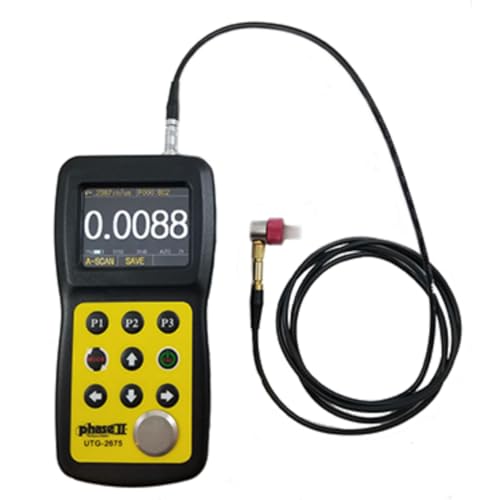
- 0.0001-inch stated resolution
- Measures material down to 0.006 inch
- Includes calibration certificate and case
Best For: Precision checks on thin materials
Best Calibration Starter Kit

- Includes TM-8811 gauge
- Includes five-step R9060 calibration block
- Listed item weight is 16 ounces
Best For: Buyers wanting a gauge-and-calibration-block package
Best Data-Logging Value

- 1-300 mm range with 5 MHz probe
- Stores up to 1,500 measurements
- Rechargeable battery lasts up to 15 hours
Best For: Portable inspection work requiring saved measurement records
Preset-Material Specialist

- 0.05–7.9-inch measurement range
- 10 preset material modes
- Fast, under-one-second sampling
Best For: Routine thickness checks on common materials
Industrial Data-Logging Pro
Industrial-884X Ultrasonic Gauge

- 0.033–15.75-inch measurement range
- Stores up to 2,000 readings
- PC export and expandable probe support
Best For: Industrial inspection and documented quality control
Portable Feature Value
WT100A Digital Thickness Gauge

- 1–300-mm measurement range
- Color display with limit alarm
- Stores up to 500 readings
Best For: Portable general-purpose material inspections
Versatile Precision Pick
T8-UT200 Ultrasonic Thickness Gauge

- Three measurement modes for coated, uncoated, and precious-metal testing
- 0.025–19.685-inch range with 0.01 mm resolution
- Backlit display and measurement-data storage
Best For: Industrial users measuring metals, plastics, ceramics, glass, and precious metals
Simple Portable Option
GM100 Ultrasonic Thickness Gauge

- 1.2–220 mm steel measurement range
- Compact design with intuitive operation
- Suitable for industrial and DIY applications
Best For: Beginners and professionals checking steel thickness on the go
Data-Logging Workhorse
Rechargeable Ultrasonic Thickness Gauge

- 1.00–300.0 mm range with high-resolution readings
- 1,500-reading storage across 15 files with USB transfer
- Custom sound velocities, alarms, and rechargeable operation
Best For: Inspectors managing recurring measurements across metals, plastics, glass, and pipes
Best Through-Coating Option – YUSHI UM-2D
For inspectors comparing handheld ultrasonic thickness gauges, the YUSHI UM-2D stands out for its echo-echo mode, which is designed to measure through paint and coatings. It covers a broad 0.03- to 12-inch range and supports interchangeable probes.
Best For: Field inspections where through-coating measurements and flexible probe options are important.
Pros:
- Echo-echo mode supports measurements through paint and coatings.
- Wide 0.03- to 12-inch measuring range.
- Stores 500 readings in five groups of 100.
- Up to 200 hours of battery life without the backlight.
Cons:
- Uses two AA alkaline batteries rather than a rechargeable battery.
- The display is relatively small at 128 x 64 pixels.
With V-path correction, alarm mode, minimum capture, and compensation for seven probe types, the UM-2D is a versatile choice for users who need coating-tolerant inspection features in a portable meter.
Best High-Resolution Gauge – Accusize PhaseII+ UTG-2675
The Accusize PhaseII+ UTG-2675 is one of the more specialized handheld ultrasonic thickness gauges in this roundup. Its stated 0.0001-inch resolution and ability to measure ultra-thin material make it suited to precision-focused inspection work.
Best For: Users measuring thin materials who want high displayed resolution and through-coating capability.
Pros:
- Resolution reaches 0.0001 inch.
- Designed for ultra-thin material down to 0.006 inch.
- Includes through-coating color A and B scan modes.
- Comes with a calibration certificate, manual, and custom carry case.
Cons:
- Its listed measuring range is narrower than some general-purpose gauges, at 0.2 to 25.4 mm.
- The stated item weight is 9.9 pounds, which may be substantial for frequent handheld use.
The UTG-2675 is a strong fit when thin-material resolution is more important than maximum range. The included calibration documentation and case also make it a practical package for organized inspection work.
Best Calibration Starter Kit – REED TM-8811-KIT
REED Instruments TM-8811-KIT Ultrasonic Thickness Gauge with 5-Step Calibration Block
Check Price On AmazonThe REED TM-8811-KIT adds a five-step calibration block to the TM-8811 ultrasonic thickness gauge. For buyers of handheld ultrasonic thickness gauges who want a basic calibration aid included, this package offers a straightforward starting point.
Best For: Users who want the REED gauge bundled with a dedicated five-step calibration block.
Pros:
- Includes the REED TM-8811 ultrasonic thickness gauge.
- Includes the R9060 five-step calibration block.
- Compact 16-ounce listed item weight.
Cons:
- The supplied notes do not specify the gauge’s measuring range or resolution.
- The kit’s listed included components are limited to the gauge and calibration block.
This kit is best considered when the included calibration block is a priority. Buyers needing detailed performance specifications should verify the gauge’s range and measurement features before ordering.
Best Data-Logging Value – GOYOJO UTG-2
The GOYOJO UTG-2 is a practical option among handheld ultrasonic thickness gauges for pipe, steel, tanks, cast iron, aluminum, and other metal parts. It combines through-coating mode with extensive data storage, statistics, and PC software support for inspection records.
Best For: Maintenance and inspection users who need portable wall-thickness measurements with substantial data storage.
Pros:
- Measures from 1 to 300 mm with the included 5 MHz probe.
- Through-coating mode can reduce paint-removal work when conditions are suitable.
- Stores up to 1,500 measurement groups and provides basic statistics.
- Rechargeable 1,500 mAh battery supports up to 15 hours of continuous use.
Cons:
- The stated measurement range begins at 1 mm, so it is not intended for ultra-thin material checks.
- Through-coating performance depends on suitable surface conditions.
With 0.01 mm or 0.1 mm display settings, coupling prompts, sound-velocity adjustment, and PC data support, the UTG-2 is especially useful for repeat inspections and maintenance documentation.
Preset-Material Specialist – Reed TM-8811
The Reed TM-8811 is a practical option among handheld ultrasonic thickness gauges for routine checks on common metals, plastics, and glass. Its preset material modes, automatic calibration, and fast sampling make it straightforward for general maintenance and inspection work.
Best For: Users measuring common materials who want simple operation and selectable inch or millimeter readings.
Pros:
- Measures thickness from 0.05 to 7.9 inches (1.5 to 200 mm).
- Supports 10 preset materials, including steel, aluminum, brass, PVC, and glass.
- Offers automatic material calibration, sound-velocity display, and readings in under one second.
Cons:
- Its material selection is centered on 10 preset materials rather than a broader customizable library.
- The maximum range is shorter than some industrial gauges.
Choose this model when ease of use and coverage of common materials matter more than advanced data storage or specialized probe options.
Industrial Data-Logging Pro – Industrial-884X Ultrasonic Gauge
The Industrial-884X is a feature-rich choice among handheld ultrasonic thickness gauges for manufacturing, quality control, and field inspection. It combines a wide 0.033–15.75-inch range with PC export, substantial memory, statistical review, and support for multiple probe types.
Best For: Industrial inspectors and quality teams that need broad measurement coverage, stored readings, and reporting capabilities.
Pros:
- Measures 0.033–15.75 inches (0.85–400 mm) with 1-mil or 0.01-mm resolution.
- Stores up to 2,000 readings and provides minimum, maximum, average, and count statistics.
- Supports automatic sound-velocity calculation, PC data export, and optional probes for thin, thick, coarse-grain, and high-temperature materials.
Cons:
- Its broader industrial feature set may be more than needed for occasional basic measurements.
- The supplied standard probe is one of several supported probe options, so specialized applications may require additional probes.
This is the strongest fit in the group for organized inspection workflows, especially when measurements must be retained, reviewed, and transferred for documentation.
Portable Feature Value – WT100A Digital Thickness Gauge
The WT100A is a compact option among handheld ultrasonic thickness gauges, offering a 0.039–11.81-inch range, color display, adjustable sound velocity, and built-in statistics. It is suited to users who want portable measurements with basic storage and limit-alarm functions.
Best For: Portable inspections of metal and nonmetal materials where a color screen, adjustable settings, and moderate data storage are useful.
Pros:
- Measures 1–300 mm with 0.01-mm resolution and stated accuracy of ±(0.5%H+0.05 mm).
- Provides adjustable sound velocity from 1,000 to 9,999 m/s and updates average, minimum, and maximum readings.
- Includes a backlit 2.4-inch color screen, high/low thickness alarm, storage for up to 500 readings, and rechargeable batteries.
Cons:
- Its 500-reading storage capacity is lower than the Industrial-884X’s stated capacity.
- The supplied standard probe is intended for general use; the notes do not specify an expanded probe architecture.
The WT100A balances portability and useful measurement controls, making it a sensible middle-ground choice for general-purpose inspection without a larger industrial data-management feature set.
Versatile Precision Pick – T8-UT200 Ultrasonic Thickness Gauge
For shoppers comparing handheld ultrasonic thickness gauges, the T8-UT200 stands out for its broad material compatibility, multiple measurement modes, and measurement range of 0.025 to 19.685 inches. Its backlit display and stored measurement data also support practical use in industrial and low-light settings.
Best For: Professionals checking coated or uncoated metals, plastics, ceramics, glass, and precious-metal authenticity.
Pros:
- Three modes include IE, PE, and a special precious-metal testing mode.
- Offers 0.01 mm resolution and V-PATH calibration.
- Stores thickness, sound velocity, and time information.
- Backlit, adjustable-contrast LCD supports low-light operation.
Cons:
- Requires a 9V battery.
- Its advanced modes may be more than casual DIY users need.
The T8-UT200 is a strong fit when versatility and data visibility matter. Its wide range and material support make it especially useful for nondestructive inspection across varied applications.
Simple Portable Option – GM100 Ultrasonic Thickness Gauge
Among handheld ultrasonic thickness gauges, the GM100 focuses on straightforward operation and portability. It measures steel thickness from 1.2 to 220 mm and is positioned for uses ranging from industrial work to home DIY projects.
Best For: Users who want a compact, easy-to-operate gauge for steel thickness checks.
Pros:
- Measures a broad 1.2–220 mm thickness range for steel.
- Compact and portable design is suitable for field use.
- Simple operation can work for professionals and beginners.
- Durable construction is designed for demanding jobs.
Cons:
- The supplied specifications focus on steel rather than a broad range of materials.
- Fewer data-management features are listed than on more advanced models.
The GM100 is a practical choice for buyers prioritizing basic thickness measurement, portability, and ease of use over extensive customization or data storage.
Data-Logging Workhorse – Rechargeable Ultrasonic Thickness Gauge
For buyers needing handheld ultrasonic thickness gauges with organized recordkeeping, this rechargeable model combines a 1.00–300.0 mm range with customizable sound velocities and substantial onboard storage. Its alarms, backlit LCD, and USB transfer support repeat inspection work.
Best For: Inspectors who need repeatable readings, saved records, and material-specific sound-velocity settings.
Pros:
- Measures 1.00–300.0 mm, with up to 0.01 mm resolution below 100 mm.
- Supports 12 preset and three custom sound-velocity slots.
- Stores up to 1,500 readings in 15 files and supports USB transfer.
- Includes high/low alarms, MAX/MIN/AVG values, and a backlit display.
Cons:
- The 1.67-pound weight is higher than the compact GM100 listed here.
- Its storage and customization features may be unnecessary for occasional checks.
This model is the strongest fit for structured inspection workflows. The combination of rechargeable operation, configurable velocities, extensive storage, and USB transfer makes it well suited to ongoing measurement programs.
How We Picked the Best Handheld Ultrasonic Thickness Gauges
We focused on the specifications that matter most during non-destructive testing: usable thickness range, material compatibility, through-coating capability, probe design, calibration support, display readability, portability, and data features. We also considered whether each gauge is better suited to occasional maintenance checks, routine field inspection, or more demanding industrial work.
Because ultrasonic performance depends on material, surface condition, couplant, probe pressure, and calibration, published ranges should be treated as a starting point rather than a guarantee for every application. Always verify readings against a suitable reference standard and follow the manufacturer’s operating guidance.
Quick Comparison
- Best for painted or coated surfaces: Choose a model with an echo-echo or through-coating mode.
- Best for broad material coverage: Look for adjustable sound velocity and support for steel, plastic, glass, and other compatible materials.
- Best for calibration-focused work: A kit that includes a stepped calibration block can simplify setup and verification.
- Best for documentation: Prioritize data storage, PC connectivity, or export features.
- Best for occasional checks: A compact gauge with a straightforward interface may offer better value than an advanced logging model.
Key Buying Factors for Handheld Ultrasonic Thickness Gauges
Measurement Range and Resolution
Match the gauge’s stated range to the thinnest and thickest materials you expect to inspect. Resolution is also important when tracking gradual wall loss, but higher displayed precision does not automatically mean higher real-world accuracy.
Coating Compensation
Paint, rust protection, and other coatings can distort readings. Echo-echo or through-coating modes are valuable when removing the coating is impractical. Confirm that the included probe and mode support your intended surface and thickness.
Calibration and Sound Velocity
Different materials transmit sound at different speeds. Adjustable sound velocity, zero calibration, and included calibration blocks make it easier to obtain reliable results. For critical inspections, use certified reference standards and document the calibration process.
Probe, Coupling, and Surface Conditions
Probe size affects access to curved, narrow, or irregular surfaces. A clean, reasonably smooth contact area and suitable couplant are essential. Very rough, corroded, hot, or hard-to-reach surfaces may require specialized probes or procedures.
Data Storage and Field Usability
A bright display, protective case, responsive controls, long battery life, and automatic shutoff can matter more in the field than a long specification sheet. Data storage or PC connectivity is worthwhile when measurements must be reviewed, shared, or audited.
Who Should Buy Which Handheld Ultrasonic Thickness Gauges?
Maintenance technicians and occasional users should favor simple, portable gauges with clear displays and dependable calibration controls. Inspectors working on painted tanks, vessels, or pipes should prioritize through-coating or echo-echo operation. Users covering multiple materials should choose adjustable sound velocity and a suitable measurement range. Teams building inspection records should look for memory, PC data transfer, or other logging tools. For safety-critical or regulated work, choose the model that best supports your documented procedure, then validate it with appropriate reference blocks before relying on its readings.