Indoor particle levels can change quickly with cooking, cleaning, HVAC operation, construction dust, and outdoor pollution. The right particle counter helps you see those changes instead of relying on a single air-quality score.
We selected 10 options ranging from simple PM2.5 and PM10 monitors to multi-channel handheld instruments for HVAC work, inspections, and cleanroom checks. Use the guide below to match features, measurement ranges, and certification needs to your application.
Best 10 Particle Counters for Indoor Air Picks for 2026
Best All-in-One Monitor
Temtop LKC-1000S+ 7-in-1 Air Quality Monitor

- Measures PM2.5, PM10, HCHO, VOCs, humidity, temperature, and AQI
- Includes 12-hour trends and up to three months of Excel data export
- Portable battery operation plus plug-in continuous monitoring
Best For: Home, office, renovation, and broad indoor-air tracking
Best Handheld Professional Meter
Temtop Airing-2000 Particle Counter

- Detects 0.3, 0.5, and 1.0 micrometer particles
- Reports PM2.5, PM10, TSP, temperature, and humidity
- Stores readings on 32GB internal memory and transfers via USB
Best For: Field inspections, facilities, workshops, and environmental monitoring
Best Simple Indoor-Air Logger
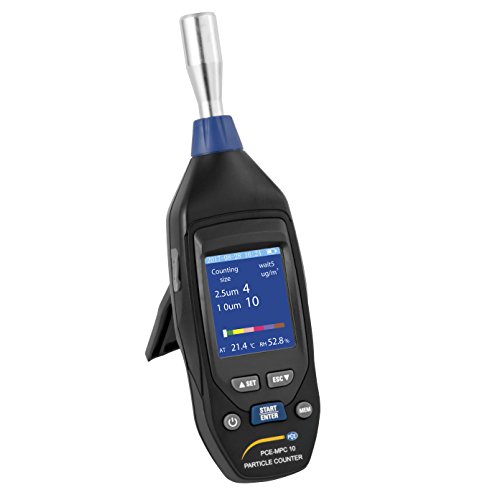
- Measures PM2.5 and PM10 with temperature and humidity
- Stores up to 5,000 readings and supports USB connectivity
- Uses a 2-inch full-color display with simple graphics
Best For: Basic tabletop indoor-air checks and particulate trend logging
Best for Cleanrooms and HVAC
Temtop PMD331 7-Channel Particle Counter

- Monitors seven particle sizes from 0.3 to 10 micrometers
- ISO 21501-4 compliant with calibration documentation
- Stores over two million records with USB and RS-485 Modbus support
Best For: Cleanrooms, laboratories, HVAC, pharmaceutical, and facility audits
Best Multifunctional Pick

- Six particle-size channels from 0.3 to 10 µm
- Measures PM, gases, CO2, temperature, and humidity
- Stores 5,000 records with USB export
Best For: Professional cleanroom and indoor-air assessments
Best Professional IAQ Tool

- Six-channel airborne particle measurement
- Designed for filters, cleanrooms, and remediation
- Lists +/-0.5% measurement accuracy
Best For: Professional facility and cleanroom inspections
Best Portable Value
- Measures three particle sizes plus PM2.5, PM10, and TSP
- Logs data to 32GB storage with USB export
- Over four hours of continuous monitoring
Best For: Routine home, office, school, and field checks
Professional Cleanroom Choice

- Six particle channels from 0.3 to 10 μm
- Stores 5,000 records and 20 minutes of video
- Includes calibration certificate and carrying case
Best For: Cleanrooms, laboratories, hospitals, and field monitoring
Flexible Home and Office Monitor
WapoRich 3-Channel Particle Counter
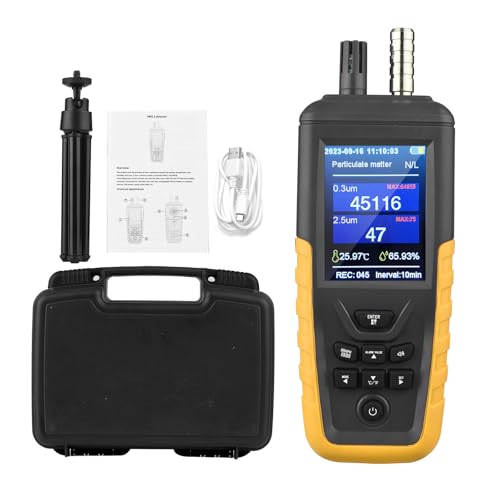
- Tracks three particle sizes plus PM2.5 and PM10
- Stores 999 records and exports PDF reports
- Includes tripod, alarms, and 9-plus-hour battery
Best For: Homes, offices, schools, vehicles, and routine tracking
Six-Channel Cleanroom Monitor
WapoRich T7-TC8200 Particle Counter
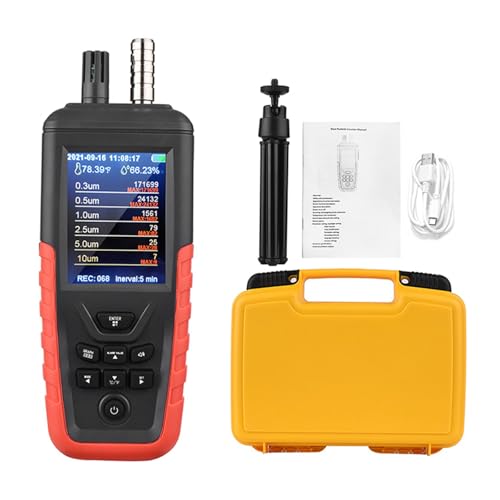
- Measures six particle sizes from 0.3 to 10 μm
- Listed for ISO 14644-1 Class 5-9 testing
- Includes alarms, tripod, PDF export, and 9-plus-hour battery
Best For: Cleanrooms, filter testing, and contamination detection
Best All-in-One Monitor – Temtop LKC-1000S+ 7-in-1 Air Quality Monitor
For shoppers comparing particle counters for indoor air, the Temtop LKC-1000S+ is a versatile choice that combines PM2.5 and PM10 monitoring with formaldehyde, VOC, temperature, humidity, and AQI readings. Its trend histogram and data export make it useful for identifying changes rather than relying only on single spot readings.
Best For: Homeowners, offices, renovation monitoring, and users who want broad indoor-air measurements with exportable data.
Pros:
- Measures seven parameters, including PM2.5, PM10, HCHO, VOCs, and AQI.
- Offers a 12-hour trend histogram for tracking pollution fluctuations.
- Supports up to three months of data export to Excel without a subscription.
- Works as a portable spot-checker or a plug-in continuous monitor.
Cons:
- It does not detect gas or carbon monoxide leaks.
- Readings require warm-up time after moving between hot and cold environments.
- Strong cleaning products, perfumes, and alcohol can affect testing conditions.
The LKC-1000S+ stands out when you want particle readings alongside several other indoor-air indicators. It is less specialized than a professional multi-channel particle counter, but its trend tools, portability, and reporting features are practical for home and office monitoring.
Best Handheld Professional Meter – Temtop Airing-2000 Particle Counter
The Temtop Airing-2000 is a focused option for buyers seeking particle counters for indoor air with professional-style logging. It detects 0.3, 0.5, and 1.0 micrometer particles while also displaying PM2.5, PM10, TSP, temperature, and humidity.
Best For: Environmental monitoring, facility checks, workshops, and field users who need handheld particle-size measurements and onboard storage.
Pros:
- Detects particles at 0.3, 0.5, and 1.0 micrometers.
- Displays PM2.5, PM10, and TSP alongside temperature and humidity.
- Includes 32GB internal storage and USB data transfer.
- Its 3500mAh battery supports more than four hours of continuous operation.
Cons:
- It provides fewer particle-size channels than the seven-channel PMD331.
- The supplied notes do not indicate formaldehyde or VOC measurement.
- Its feature set is oriented toward handheld assessment rather than a broad consumer air-quality dashboard.
Choose the Airing-2000 if particle-size detection, field portability, and data storage matter more than measuring gases. Its straightforward controls and clear display make it a practical professional meter for repeated inspections.
Best Simple Indoor-Air Logger – PCE-MPC 10 PM2.5/PM10 Counter
For a straightforward way to compare particle counters for indoor air, the PCE-MPC 10 focuses on PM2.5 and PM10 readings with supporting temperature and humidity measurements. Its color display, USB connection, and 5,000-data logger suit routine indoor checks and basic trend recording.
Best For: Users who need a simple tabletop monitor for PM2.5, PM10, temperature, humidity, and logged indoor-air readings.
Pros:
- Measures the two commonly used particulate channels: PM2.5 and PM10.
- Includes temperature and humidity ranges of 32–122°F and 0–100% RH.
- Provides a 2-inch full-color LCD with user-friendly graphics.
- Stores up to 5,000 data points and connects through USB.
Cons:
- It does not list smaller particle-size channels such as 0.3 or 0.5 micrometers.
- The supplied notes do not mention gas, VOC, or formaldehyde sensing.
- Its tabletop design is less suited to extended handheld field use.
The PCE-MPC 10 is a sensible pick when you want essential particulate and environmental readings without a more complex sensor package. It offers useful logging and USB connectivity, while its narrower measurement scope keeps it best suited to basic indoor-air assessment.
Best for Cleanrooms and HVAC – Temtop PMD331 7-Channel Particle Counter
For demanding applications, the Temtop PMD331 is a high-end choice among particle counters for indoor air. It combines seven simultaneous particle-size channels from 0.3 to 10 micrometers with ISO 21501-4 compliance, extensive onboard storage, and RS-485 Modbus communication.
Best For: Cleanrooms, laboratories, surgical suites, pharmaceutical facilities, HVAC work, and professional environmental audits.
Pros:
- Measures seven particle sizes simultaneously: 0.3, 0.5, 0.7, 1.0, 2.5, 5.0, and 10 micrometers.
- Meets ISO 21501-4 standards and includes calibration documentation.
- Stores more than 2,000,000 records and supports USB export.
- Offers RS-485 Modbus connectivity and real-time graphing on a 4-inch display.
Cons:
- At 9 pounds, it is substantially heavier than the portable models listed here.
- Individual ISO calibration certificates for specific audits are optional and require a custom quote.
- Its enterprise-grade capabilities may be more than needed for casual home monitoring.
The PMD331 is the strongest fit when repeatability, broad particle-size coverage, and facility integration are priorities. Its rugged professional design and large data capacity justify considering it for regulated or high-stakes environments, but casual users may prefer a simpler monitor.
Best Multifunctional Pick – CEM DT-9883M Particle Counter
For buyers seeking particle counters for indoor air with broader diagnostic capabilities, the CEM DT-9883M combines six particle-size channels with PM2.5/PM10, HCHO, TVOC, CO2, temperature, and humidity monitoring. Its handheld design, large display, calibration certificate, and onboard storage suit on-site inspections.
Best For: Cleanrooms, laboratories, hospitals, and professional indoor-air assessments that benefit from multiple environmental readings.
Pros:
- Measures particles from 0.3 to 10 µm across six size channels.
- Adds PM2.5/PM10, HCHO, TVOC, CO2, temperature, and humidity readings.
- Stores up to 5,000 records and 20 minutes of video, with USB export.
- Includes a calibration certificate and a rechargeable NiMH battery.
Cons:
- At 1.3 pounds, it is less lightweight than a basic handheld monitor.
- The listed operating humidity limit is 80 percent and the upper temperature rating is 40 °C.
The DT-9883M is the most feature-rich option here for users who want particle data alongside several indoor-air indicators. Its added functions and data-recording capacity make it better suited to professional workflows than simple spot checks.
Best Professional IAQ Tool – Fluke 985 Particle Counter
The Fluke 985 is a professional six-channel option for buyers comparing particle counters for indoor air. It is designed for filter-efficiency checks, industrial cleanroom monitoring, indoor-air pre-screening, and locating particle sources during remediation work.
Best For: Facility professionals, cleanroom monitoring, filter testing, and remediation teams that need a dedicated particle counter.
Pros:
- Provides six-channel airborne particle measurement.
- Supports filter-efficiency monitoring and industrial cleanroom checks.
- Useful for pre-screening indoor air quality and locating particle sources.
- Lists measurement accuracy of +/-0.5% and includes a one-year warranty.
Cons:
- At 7.7 pounds, it is substantially heavier than the other listed handheld options.
- The supplied notes do not list additional gas, temperature, or humidity measurements.
- The product dimensions indicate a relatively large carrying footprint.
The Fluke 985 is best viewed as a focused professional instrument rather than an all-in-one environmental monitor. Its stated applications and accuracy make it a strong fit for technical inspections, provided portability is not the top priority.
Best Portable Value – Temtop Airing 2000 Monitor
The Temtop Airing 2000 is a practical choice for buyers who want portable particle counters for indoor air. It measures three particle sizes plus PM2.5, PM10, and TSP, while its temperature and humidity sensors, large LCD, rechargeable battery, and automatic logging support routine walkthroughs and field checks.
Best For: Homes, offices, schools, industrial walkthroughs, and users who want straightforward logging without additional software.
Pros:
- Detects 0.3, 0.5, and 1.0 µm particles alongside PM2.5, PM10, and TSP.
- Includes temperature and humidity sensors for added indoor context.
- A 3500mAh battery supports over four hours of continuous monitoring.
- 32GB internal storage logs at adjustable intervals and exports through USB.
Cons:
- It measures three particle sizes, fewer than the six channels listed for the CEM and Fluke models.
- The supplied notes do not list gas measurements such as CO2, HCHO, or TVOC.
- Its stated continuous-monitoring runtime is over four hours, so extended work may require recharging.
The Airing 2000 balances portability and data logging with a simple interface. It is a sensible pick for repeated indoor checks when PM readings, particle counts, and basic environmental conditions matter more than a wider suite of gas sensors.
Professional Cleanroom Choice – CEM DT-9880 Particle Counter
For buyers comparing particle counters for indoor air, the CEM DT-9880 is a feature-rich handheld option designed for detailed particulate monitoring. It measures six listed particle sizes from 0.3 to 10 micrometers, while also recording temperature and humidity.
Best For: Cleanrooms, laboratories, hospitals, and on-site environmental monitoring.
Pros:
- Measures 0.3, 0.5, 1, 2.5, 5, and 10 μm particles simultaneously.
- Stores up to 5,000 records plus 20 minutes of video.
- Includes a calibration certificate, Parker filter tube, USB accessories, and carrying case.
- Large 2.8-inch color display supports on-site viewing and data export.
Cons:
- Its professional feature set may be more than casual home users need.
- The supplied notes do not specify a battery runtime.
The DT-9880 stands out when detailed particle-size data, substantial onboard storage, and included calibration documentation matter more than having the simplest possible monitor.
Flexible Home and Office Monitor – WapoRich 3-Channel Particle Counter
If you want particle counters for indoor air that also track basic environmental conditions, this WapoRich model combines three particle channels with PM2.5, PM10, temperature, and humidity readings. Its alarms, trend display, and tripod support make it practical for repeated measurements.
Best For: Homes, offices, schools, vehicles, and general air-quality tracking.
Pros:
- Measures 0.3, 2.5, and 10 μm particles with counts up to 2,000,000 per liter.
- Stores 999 records and exports historical data to a PC as PDF.
- Offers customizable alarms, a color pollution indicator, and included tripod.
- Provides 9-plus hours of battery use according to the supplied notes.
Cons:
- Uses three particle channels rather than the six-channel coverage of more specialized models.
- Its stated PM2.5/PM10 accuracy is ±12 μg/m³.
This is a versatile choice for routine indoor monitoring, especially if you value hands-free placement, straightforward pollution alerts, and longer-term recordkeeping.
Six-Channel Cleanroom Monitor – WapoRich T7-TC8200 Particle Counter
For more complete particle profiling, the WapoRich T7-TC8200 is one of the more capable particle counters for indoor air in this lineup. It covers six particle sizes from 0.3 to 10 micrometers, measures temperature and humidity, and is listed as compliant with ISO 14644-1 for Class 5-9 cleanroom testing.
Best For: Class 100 and below cleanrooms, filter-seal testing, and contamination detection.
Pros:
- Provides six-channel particle measurement from 0.3 through 10 μm.
- Lists PM2.5/PM10 accuracy of ±10 μg/m³ from 0-100 μg/m³ and ±10% from 100-1000 μg/m³.
- Stores 999 records, displays trend curves, and exports data as PDF.
- Includes alarm thresholds, pollution indicators, tripod support, and 9-plus-hour battery life.
Cons:
- Its cleanroom-focused capabilities may be unnecessary for basic residential checks.
- It stores fewer records than the CEM DT-9880.
The T7-TC8200 is the strongest fit when six-size particle data and stated cleanroom-oriented compliance are priorities, while its tripod and export functions also support repeatable testing.
How We Picked the Best Particle Counters for Indoor Air
We focused on instruments that measure airborne particulate matter relevant to indoor environments, especially PM2.5 and PM10. For more demanding applications, we also considered channel count, particle-size range, sampling method, display quality, data features, and suitability for professional inspections.
The lineup includes general air-quality monitors with temperature, humidity, TVOC, or formaldehyde readings, as well as dedicated handheld particle counters designed for detailed measurements. Where a product is marketed for cleanrooms, certification and multi-channel capability are important, but they do not automatically make it the best choice for routine home monitoring.
Quick Comparison
- Basic household monitoring: Choose a PM2.5/PM10 monitor with a clear display and simple operation.
- Broader indoor-air diagnostics: Look for temperature, humidity, CO2, TVOC, or formaldehyde measurements alongside particle data.
- HVAC and building inspections: A portable handheld unit with reliable sampling, multiple size channels, and durable controls is usually more useful.
- Cleanroom or controlled-environment work: Prioritize multi-channel counting, a defined particle-size range, pump-based sampling, records, and relevant calibration or certification.
Key Buying Factors for Particle Counters for Indoor Air
Particle Sizes and Channels
PM2.5 and PM10 readings are useful for everyday indoor-air assessments, but they summarize broad size categories. Multi-channel counters can show counts at several thresholds, such as 0.3, 0.5, 1.0, 2.5, 5.0, and 10 microns. More channels provide greater detail, although they can make the instrument more expensive and require more interpretation.
Sampling Method and Accuracy
Check whether the device uses passive diffusion or an internal pump. Pumped sampling can provide more controlled air intake and is often preferred for inspections and cleanroom testing. Review stated flow rate, counting efficiency, concentration limits, calibration information, and any ISO 21501-4 reference before relying on results for formal compliance work.
Extra Air-Quality Sensors
Temperature and relative humidity help explain changing readings. CO2, TVOC, and formaldehyde sensors can add useful context, but they measure different pollutants and should not be treated as substitutes for particle counts. Consider whether you need a single multipurpose monitor or a dedicated particle instrument.
Usability and Records
A readable screen, straightforward controls, rechargeable battery, photo or data storage, and easy export can matter as much as headline specifications. For repeated surveys, choose a model that saves measurements consistently and supports a repeatable sampling routine.
Who Should Buy Which Particle Counters for Indoor Air?
Homeowners and renters should generally choose an easy-to-read PM2.5/PM10 monitor, especially one that also displays humidity and temperature. Allergy-conscious users may prefer a unit that makes short-term changes visible during cleaning, cooking, or ventilation.
HVAC technicians, inspectors, and facility teams should consider a handheld model with a pump, multiple particle-size channels, and saved readings. Cleanroom operators and industrial users need to look beyond consumer-style AQI displays: prioritize channel range, flow control, certification, calibration support, and documentation.
Before buying, define whether you need trend awareness, comparative troubleshooting, or defensible measurement records. That single decision will usually narrow the choices more effectively than choosing by sensor count alone.