Vibration meters with data logging make it easier to capture machine behavior over time instead of relying on a single spot reading. They can help maintenance teams identify changing vibration levels, document equipment condition, and review measurements later on a computer.
This roundup compares 10 options across industrial vibration testing, three-axis measurement, transport monitoring, and multi-channel data collection. Use the buying guide below to match measurement range, logging method, sensor design, and software support to your application.
Best 10 Vibration Meters with Data Logging Picks for 2026
Best Complete Kit
REED R7000SD-KIT Data Logging Vibration Meter

- Includes meter, 16GB microSD card, and adapter
- 110V AC power adapter included
- Convenient package for vibration data logging
Best For: Buyers seeking a bundled vibration meter with storage and power accessories
Best for Industrial Machinery
VB-8206SD Portable Vibration Meter

- Measures acceleration, velocity, and displacement
- RMS, peak, and maximum-hold functions
- Magnetic-base probe and RS232/USB interface
Best For: Industrial machinery vibration checks requiring several measurement modes
Best for Shipping Monitoring
Tzone TDL06 Vibration Data Logger

- Records acceleration and temperature during transport
- Exports PDF and CSV reports by USB
- IP65 design with magnets and replaceable battery
Best For: Shipping and storage monitoring for fragile or temperature-sensitive goods
Best for Long-Term Tracking
3-Axis Vibration Datalogger Truck Tracker

- Records three-axis acceleration data
- Tracks freefall events
- Provides real-time FFT spectral analysis
Best For: Extended vibration tracking on trucks and other demanding applications
Versatile Industrial Logging
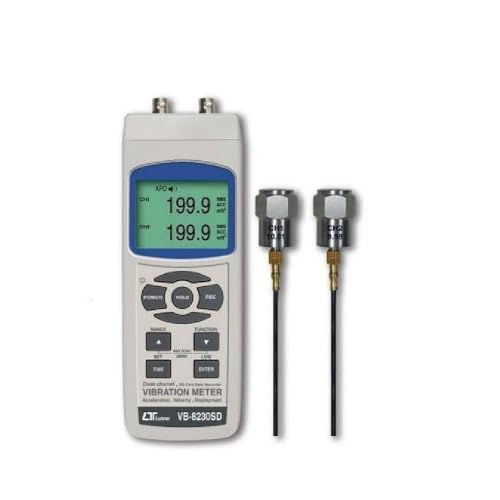
- Measures acceleration, velocity, and displacement
- Logs timestamped CSV files to SD cards
- Includes USB, RS-232, and magnetic placement options
Best For: Industrial maintenance and multi-purpose vibration diagnostics
Proven SD Datalogging
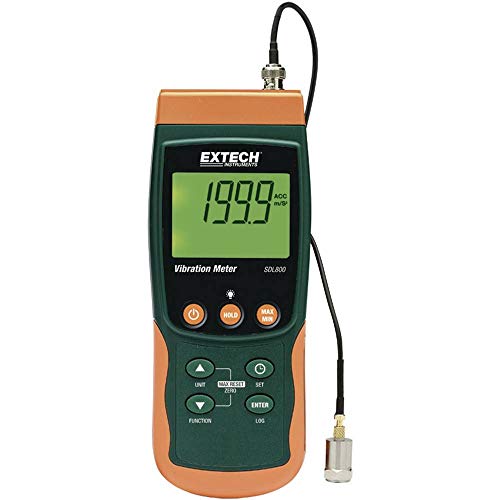
- Remote magnetic sensor with 47.2-inch cable
- Exports timestamped readings in Excel format
- Provides RMS, Peak, and Max Hold modes
Best For: Routine machinery inspections with remote sensor placement
Compact Memory-Based Diagnostics

- Stores up to 500 readings in five groups
- Measures three vibration parameters
- Supports 10 Hz–4 kHz inspection modes
Best For: Periodic maintenance tracking across multiple machines
Four-Channel Logging

- Four-channel simultaneous display
- RMS and peak measurement modes
- Excel-ready SD-card data logging
Best For: Multi-point machinery monitoring
Industrial Monitoring Pick

- Title lists vibration data logging
- Compact 7.5-ounce handheld design
- Specifications conflict with the vibration description
Best For: Buyers willing to verify the listing details
USB Software Bundle
Digital 3D Double-Channel Vibrometer

- Double-channel piezoelectric sensors
- USB cable and software included
- Acceleration range up to 400 m/s²
Best For: Computer-based vibration data logging
Best Complete Kit – REED R7000SD-KIT Data Logging Vibration Meter
REED Instruments R7000SD-KIT Data Logging Vibration Meter with Power Adapter and SD Card
Check Price On AmazonIf you want vibration meters with data logging and the convenience of a ready-to-use package, the REED R7000SD-KIT is a practical option. It includes the R7000SD meter, a 16GB microSD card with adapter, and a 110V AC power adapter.
Best For: Buyers who want a vibration data-logging meter with memory and power accessories included.
Pros:
- Includes the REED R7000SD data-logging vibration meter.
- Comes with a 16GB microSD card and adapter for storing readings.
- Includes a 110V AC adapter.
Cons:
- The supplied notes do not specify measurement ranges or accuracy.
- The kit is supplied with a 110V adapter, which may not suit every power setup.
This kit stands out for its bundled accessories, reducing the need to source a memory card and adapter separately. Review the meter’s detailed specifications before purchase if your application requires a particular measurement range or accuracy.
Best for Industrial Machinery – VB-8206SD Portable Vibration Meter
For users comparing vibration meters with data logging for machinery checks, the VB-8206SD offers acceleration, velocity, and displacement measurements in metric or imperial units. Its separate probe and magnetic base are designed to simplify measurements on industrial equipment.
Best For: Monitoring vibration levels on industrial machinery with multiple measurement modes and a connected probe.
Pros:
- Measures acceleration, velocity, and displacement.
- Supports RMS, peak, and maximum-hold readings.
- Includes a vibration probe with magnetic base for easier placement.
- Offers RS232/USB computer connectivity and a backlit LCD.
Cons:
- The supplied notes do not specify the included data-storage medium.
- Operating conditions are limited to 0–50°C and less than 85% relative humidity.
With defined ranges for acceleration, velocity, and displacement, this model is more application-specific than a basic vibration indicator. Its probe cable is 1.2 meters long, so consider installation distance and your preferred computer interface before buying.
Best for Shipping Monitoring – Tzone TDL06 Vibration Data Logger
The Tzone TDL06 is one of the more specialized vibration meters with data logging, focusing on shocks and environmental changes during transport rather than industrial machinery diagnostics. It records acceleration and temperature, then creates PDF and CSV reports through USB without requiring separate report software.
Best For: Tracking shocks, vibration events, and temperature changes affecting goods during shipping or storage.
Pros:
- Built-in three-axis acceleration sensor with a capacity of 34,560 groups.
- Generates PDF and CSV reports through USB without software.
- Records temperature from -22°F to 158°F.
- Offers magnets, a back clip, IP65 protection, and a replaceable battery.
Cons:
- It does not support measuring vibration data on industrial machinery.
- It cannot record all three single-axis vibration data streams simultaneously.
- Parameter configuration requires free Windows software.
This logger is best viewed as a transport shock recorder rather than a general-purpose machine vibration meter. Its display, event marking, alarm indicators, and USB reports make it useful for documenting handling conditions across a shipment.
Best for Long-Term Tracking – 3-Axis Vibration Datalogger Truck Tracker
Vibration Meter, 3-Axis Vibration Datalogrs Truck Tracker Meter for Long-Term Use
Check Price On AmazonFor long-term vibration meters with data logging, this 3-axis datalogger is designed to record acceleration while also tracking freefall events. It adds real-time FFT spectral analysis, making it a fit for users who want more than basic vibration-event records.
Best For: Long-duration vibration tracking where three-axis acceleration, freefall detection, and spectral analysis are useful.
Pros:
- Records three-axis acceleration data.
- Tracks freefall events in addition to vibration.
- Computes real-time spectral data using FFT analysis.
- Designed for long-term use and harsh environments.
Cons:
- The supplied notes do not provide measurement ranges, storage capacity, or connectivity details.
- Its listed item weight is 3.31 pounds, which may be substantial for some tracking applications.
This model’s strongest differentiator is its combination of long-term recording and real-time spectral analysis. Before purchasing, confirm the available memory, mounting method, battery details, and reporting workflow for your specific truck or equipment-monitoring setup.
Versatile Industrial Logging – VB-8230SD Vibrometer
The VB-8230SD is a flexible choice among vibration meters with data logging, measuring acceleration, velocity, and displacement across a 10 Hz–1 kHz frequency range. Its SD-card logging, timestamped CSV files, and PC connectivity make it practical for maintenance and diagnostic workflows.
Best For: Industrial maintenance, automotive, aerospace, and structural analysis teams that need versatile measurements and Excel-ready records.
Pros:
- Measures acceleration, velocity, and displacement with sensitivity aligned with ISO 2954.
- Supports manual and automatic timestamped logging to 1–16 GB SD cards in CSV format.
- Includes RMS/Peak readings, Max/Min memory recall, DATA HOLD, USB, and RS-232 connectivity.
- Magnetic base, separable probe, and auto power-off support field inspections.
Cons:
- The stated measurement frequency range ends at 1 kHz.
- SD-card logging requires a compatible 1–16 GB card.
Choose this model if you want broad measurement modes and straightforward data transfer for recurring equipment checks. The handheld design and magnetic placement options add convenience during on-site diagnostics.
Proven SD Datalogging – Extech SDL800
The Extech SDL800 is a practical option among vibration meters with data logging, combining a remote magnetic sensor with date- and time-stamped SD-card storage. Its 10 Hz–1 kHz range and Excel-format exports suit routine equipment inspections and PC-based recordkeeping.
Best For: Technicians who want remote sensor placement and simple SD-card transfer of vibration readings.
Pros:
- Remote sensor uses a magnetic adapter and a 47.2-inch cable.
- Stores date- and time-stamped readings on an SD card in Excel format.
- Offers RMS, Peak Value, and Max Hold measurement modes.
- Measures across a 10 Hz–1 kHz frequency range and meets ISO 2954.
Cons:
- Requires six AA batteries, although batteries are included.
- The supplied notes do not specify the included SD-card capacity.
The SDL800 is well suited to repeatable field checks where keeping organized readings matters. The long cable and magnetic adapter can make sensor positioning easier around machinery.
Compact Memory-Based Diagnostics – VM-422 Industrial Vibrometer
The VM-422 is a compact choice among vibration meters with data logging, storing up to 500 readings for later review and comparison. It measures acceleration, velocity, and displacement, while selectable 10 Hz–1 kHz and 1 kHz–4 kHz modes support both general condition checks and higher-frequency machine diagnostics.
Best For: Maintenance teams tracking periodic readings across multiple machines without needing a laboratory FFT analyzer or permanent monitoring system.
Pros:
- Measures acceleration, velocity, and displacement in one handheld instrument.
- Stores 500 records across five groups of 100 for organized trend tracking.
- Offers low- and high-frequency acceleration selection from 10 Hz to 4 kHz.
- Color LCD includes a vibration-severity bar, with front and bottom measurement buttons.
Cons:
- Its internal memory is limited to 500 readings.
- It is not intended to replace multi-channel FFT analyzers or permanent monitoring systems.
This model makes sense for technicians who need grouped onboard storage and quick condition indications during maintenance rounds. Its broad frequency selection adds flexibility, while its defined application boundaries clarify that it is designed for periodic diagnostics.
Four-Channel Logging – Extech VB500
If you need vibration meters with data logging for equipment checks, the Extech VB500 combines four-channel viewing with RMS or peak measurement modes. Its 10 Hz to 1 kHz frequency range, remote magnetic sensors, and SD-card storage make it practical for recording readings and transferring them to a PC in Excel format.
Best For: Maintenance teams monitoring multiple vibration points and saving timestamped readings for later analysis.
Pros:
- Measures RMS or peak vibration values.
- Displays four channels simultaneously on a large backlit LCD.
- Stores date- and time-stamped readings on an SD card in Excel format.
- Includes remote sensors with magnetic adapters and 39-inch cables.
Cons:
- Requires eight AA batteries.
- The frequency range is limited to 10 Hz to 1 kHz.
The VB500 is a strong choice when four-channel visibility and straightforward PC-ready data logging matter more than a compact, single-channel design.
Industrial Monitoring Pick – PCE-RAM 3 Handheld Meter
The PCE Instruments PCE-RAM 3 is presented as a handheld vibration meter for industrial and machinery monitoring, with acceleration, velocity, displacement, data logging, and peak hold functions. However, the supplied specifications describe a gamma, beta, and X-ray meter rather than vibration measurements, so verify the model details carefully before buying.
Best For: Buyers who have confirmed the listing and need the described portable radiation-monitoring functions, not those relying solely on the vibration-meter title.
Pros:
- The listing title includes acceleration, velocity, displacement, data logging, and peak hold.
- Compact 6.5 × 3.62 × 1.26-inch handheld design.
- Lightweight 7.5-ounce body with a 3.7V, 1100 mAh lithium-polymer battery.
Cons:
- Supplied bullet points describe radiation measurement rather than vibration measurement.
- The notes do not provide vibration ranges, frequency response, or logging-storage details.
Because the supplied information conflicts with the product title, this option requires extra specification checking before it can be confidently recommended among vibration meters with data logging.
USB Software Bundle – Digital 3D Double-Channel Vibrometer
This double-channel digital 3D vibrometer is a practical candidate among vibration meters with data logging if you want USB connectivity and included software. It uses two piezoelectric transducers and covers acceleration, velocity, and displacement, with acceleration extending from 10 Hz to 10 kHz.
Best For: Users who want double-channel vibration measurements, broad acceleration frequency coverage, and computer-based data handling.
Pros:
- Includes a USB data cable and software for data logging.
- Uses two piezoelectric transducers for double-channel measurement.
- Measures acceleration, velocity, and displacement.
- Offers acceleration measurement from 0.1 to 400 m/s² and 10 Hz to 10 kHz frequency coverage.
Cons:
- Specified accuracy is 5% of the reading plus 2 digits.
- Operating conditions are limited to 0–50°C and below 90% relative humidity.
With its included USB accessories, dual sensors, and wide acceleration frequency range, this model suits users who want to move logged vibration data to a computer for review.
How We Picked the Best Vibration Meters with Data Logging
We focused on meters that can record measurements rather than only display live readings. The selection includes dedicated industrial vibrometers, SD-card data loggers, USB-connected devices, shipping shock recorders, and multi-channel instruments. We also considered whether a meter measures acceleration, velocity, displacement, or multiple parameters, since each can reveal different equipment problems.
Other important factors included practical measurement ranges, sampling and storage options, sensor configuration, portability, and the usefulness of included software or data-transfer methods. Because applications vary widely, the list deliberately includes both general-purpose handheld meters and more specialized monitoring tools.
Quick Comparison
| Best For | Look For | Typical Advantage |
|---|---|---|
| Routine machinery checks | Acceleration, velocity, and displacement | More complete condition assessment |
| Long-term logging | Large memory or SD-card storage | Extended unattended recording |
| Transport monitoring | Compact design and shock-event logging | Documents handling conditions |
| Detailed equipment studies | Three-axis or multi-channel measurement | Captures direction and location differences |
| Computer-based reporting | USB connectivity and compatible software | Easier export and recordkeeping |
Key Buying Factors for Vibration Meters with Data Logging
Measurement Modes and Range
Acceleration is useful for detecting higher-frequency issues, while velocity is commonly used for overall machinery severity. Displacement can help describe lower-frequency movement. Check the stated range and resolution against the equipment you intend to test; a meter that clips at the upper end or lacks sensitivity at the lower end will limit useful comparisons.
Logging Capacity and File Transfer
SD cards are convenient for long sessions and large datasets, while internal memory may be simpler for short inspections. USB models can streamline downloads and reporting, but confirm whether proprietary software is required. Also check adjustable logging intervals, timestamp support, battery life, and whether the device can continue recording while connected to external power.
Sensor Arrangement
A single-axis sensor may be adequate for repeatable checks at known locations. Three-axis meters provide more context when vibration direction changes or sensor placement is less predictable. Multi-channel models are better suited to comparing several points at once, but they may cost more and require a more involved setup.
Durability and Handling
For field work, prioritize a readable display, secure probe or magnetic mounting options, protective housing, and controls that are usable with gloves. Shipping monitors have different priorities, including compactness, event detection, and easy retrieval of recorded data.
Who Should Buy Which Vibration Meters with Data Logging?
Choose a general-purpose handheld logger if you perform scheduled inspections across pumps, motors, fans, or other rotating equipment. Select an SD-card model when you need extended logging or simple file transfer without depending on a phone. A three-axis or four-channel instrument makes more sense for troubleshooting complex machinery, comparing multiple bearings, or capturing directional vibration.
For transported equipment, use a dedicated shock or vibration recorder designed for shipment monitoring rather than a conventional inspection meter. If you need formal maintenance documentation, prioritize clear export tools, stable timestamps, repeatable sensor placement, and the measurement modes recommended by your machinery manufacturer. Before buying, verify sensor compatibility, included accessories, calibration expectations, and the actual logging interval—not just the headline measurement range.